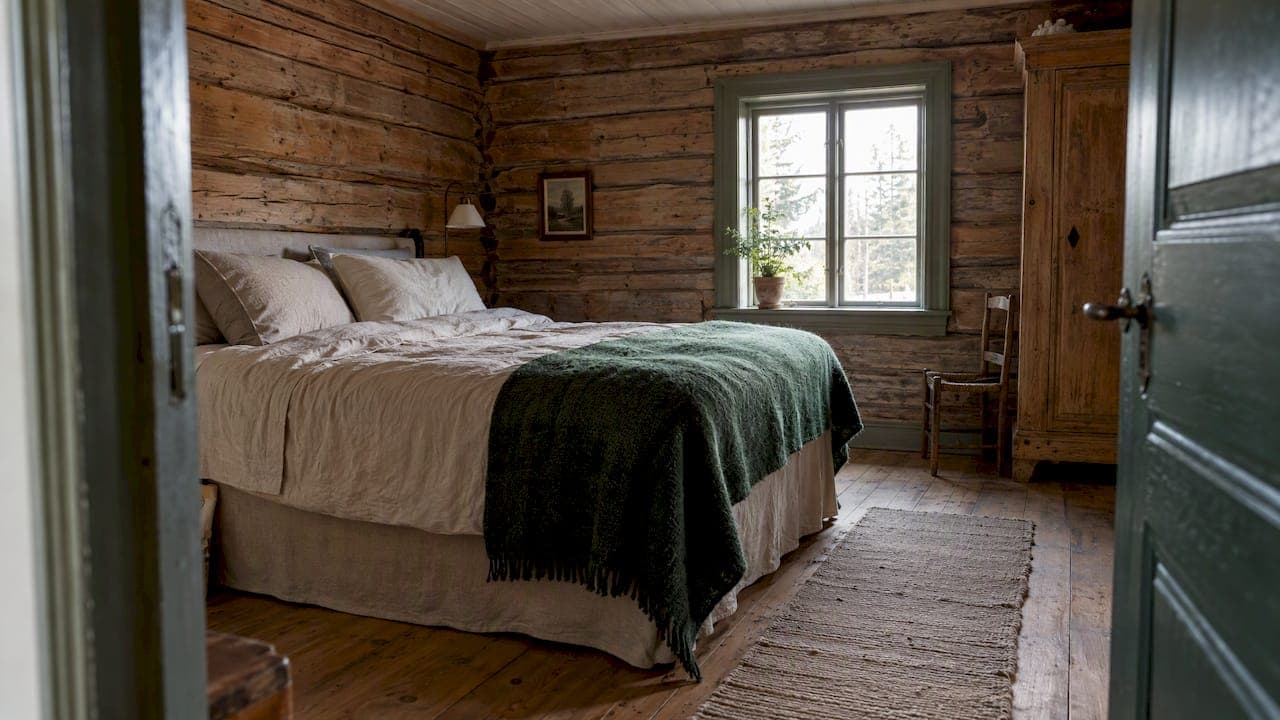
A log house is not medicine, but it is a good place to be well. Studies of wood indoors point to calmer bodies and steadier moods, and a solid timber house that is properly ventilated and kept dry gives you a quiet, even indoor climate to rest in. Below we set out what the research says, what it cannot say, and how we think about it in our own 1700s log farmhouse in Bergslagen.
TL;DR
- A 2026 review of 24 experimental studies found that exposure to wood tended to go with psychological steadiness and physiological relaxation, including lower cortisol.
- Timber walls are associated with comfortable temperature and moisture conditions, but dry walls and good ventilation decide how healthy any house is.
- Swedish guidance recommends a minimum air exchange of 0.5 air changes per hour in homes, so airing a log house is part of living well in it.
- The real gains of a log-house stay come from the whole setting: sauna, forest, lake, quiet and sleep.
Table of Contents
- What people mean by a healthy log house
- What the research shows about mind and body
- Temperature, moisture and comfort
- Air, damp and ventilation: the part that decides everything
- How a stay puts the benefits to work
- Who a log-house stay suits
- Stay at Villa Sakis
- Getting the most from a timber stay
- FAQ
- Sources
What people mean by a healthy log house
When readers ask about timber houses and health, they usually mean three things. Does the material calm the mind? Does it make for a better indoor climate? And is the air inside good to breathe?
The industry body PEFC summarises the claims made for timber buildings: effects on physical comfort, indoor air quality, hygienic properties, calming influence and even cognitive performance. These are claims, and some are better studied than others. The sections below take them one at a time, starting with the part that has the most measurements behind it: how wood affects the body and mood.
We write as hosts, not researchers. We look after a log farmhouse that has stood since the 1700s, and guests often tell us the house itself is part of why they sleep and rest differently. We have read the studies to understand why, and to be careful about what we promise.
What the research shows about mind and body
Relaxation and mood
The strongest recent overview is a 2026 systematic review of wood indoor environments. Across 24 experimental studies, wood exposure generally tended to bring positive changes in psychological stability and physiological relaxation. The measures included lower cortisol, a stress hormone, and higher HRV-HF, a heart-rate-variability marker linked to a calm, rested nervous system.
An earlier experiment points the same way. A 2017 study comparing log, glulam and reinforced-concrete rooms found that participants reported comfort and a cheerful mood in the wooden settings, and that their bodies responded differently than in concrete ones, with heart rate and respiration among the measures.

Living in timber, not just visiting
Researchers have also looked at ordinary life in timber homes. A long-term study of 13 newly built timber houses, published in 2020, found no signs of physical impairment in the residents, who consistently reported high satisfaction with their health and quality of life.
In Finland, monitoring at the Tuupala wooden school in 2020 found lower humidity variation and lower student stress than at a reference stone school. A school is not a farmhouse, but the finding fits the pattern: stable air and the visible grain of wood seem to suit people.
How to read this
Most of these studies measure short exposures, a room, a session, a school term. They show that wood is a good companion to rest. They do not show that a log house cures anything, and we would never say so. The sensible reading is that timber supports the things that restore you: quiet, steady surroundings and an easy mood. What you do with the days matters just as much, and we come to that below.
If you want a more sensory account of the same idea, we describe it in the feel of a Swedish log house.
Temperature, moisture and comfort
Solid logs have a reputation for evening out the day: cooler in a warm spell, slow to lose heat once a fire has been lit. The 2017 experiment above recorded real differences in temperature and moisture content between log, glulam and concrete settings, and log and glulam environments had a significant effect on those physical parameters as well as on heart rate and respiration.
For a target, Sweden's housing authority gives a clear one. Boverket recommends an operative indoor temperature of 20 to 24°C in winter and 20 to 26°C in summer in homes. That is the range in which most people feel neither cold nor stuffy, and a thick timber wall helps a house stay near it with little fuss.
What this means in practice for a guest:
- Expect a house that holds its warmth after the stove or sauna has been lit, rather than one that swings quickly.
- Dress in layers, as the Swedes do, and treat the stove as part of the evening rather than a chore.
- Use a thermometer if you are sensitive to cold at night, and open the windows briefly each morning.
If you are planning a cold-season visit, our notes on winter in a log cabin cover packing and daily rhythm.
Air, damp and ventilation: the part that decides everything
A healthy house, of any material, is a dry and ventilated one. The Swedish Public Health Agency says that living in buildings with dampness problems can raise the risk of respiratory infections and symptoms, and may worsen asthma. That is why we think of care and airing as the quiet foundation of any good stay.
The same agency's general advice sets a minimum air exchange of 0.5 air changes per hour for homes, meaning that, over an hour, half the air in a dwelling should be replaced with fresh air. In a house with open doors to a meadow, that is easy to honour.

A Swedish study of single-family houses found that 23 per cent of respondents reported weekly symptoms such as headache or tiredness, and that foundation dampness was associated with some of them. The lesson for any house is the same: dry foundations and steady airing matter more than the label on the walls.
What about the smell of wood? Newly built timber houses can emit volatile organic compounds (VOCs) at first. In the Austrian and German study, emissions were elevated at first and mostly fell to average levels within eight months, while formaldehyde stayed low. A farmhouse that has stood for centuries is long past that stage.
Simple habits that keep a log house fresh
- Air through for a few minutes in the morning and evening rather than leaving a window ajar all day.
- Run the kitchen fan when cooking and open a window when showering.
- Keep wet boots and clothes by the door or in a drying space, not in the bedroom.
- If anyone in your party has asthma or an allergy, mention it when you book so we can talk through the house with you, and keep your own medicines to hand.
Our view from the farmhouse
We have lived beside these walls for a long time, and what strikes us is how little the house asks of you. The logs are old, the rooms are honest timber, and the light moves across them slowly through the day. People arrive tired and, often by the second morning, they stop checking the time.
We do not claim that the wood alone does this. The research is encouraging, and we are glad of it, but what we see is the whole setting working together: the quiet, the meadow outside the door, the pine forest, the sauna in the evening and the lake close by. The house is the first part of that, because it sets the pace. A room that looks and smells like a place to rest invites you to rest.
That is why we offer the farmhouse as a whole, for your own party only. Families, friends, couples and people who simply need a week without noise can fill it in their own way: training in the morning, swimming, cooking together, sleeping early. A house built in the 1700s, and cared for through the generations since, is a rare thing to have to yourself. We think it is the most natural setting there is for a restorative trip.
Christian
How a stay puts the benefits to work
Studies of wood measure what happens to a person sitting in a room. A holiday gives you the rest of the day. Here is how the pieces tend to fit at a log farmhouse.
Morning: light and movement
Go outside early. Morning daylight is one of the simplest ways to set your body clock, and we have written about how morning light outdoors can shift your sleep clock over 7 to 14 days. A walk through the meadow, a run on forest tracks or a stretching session on the grass all count. If you practise yoga, our guide to what a log-house yoga retreat needs covers space, floors and rhythm.
Fitness travellers and athletes use a week like this for an off-season block: easy aerobic work in the forest, mobility in the house, and no screens at the table. The point is steady daily movement rather than heroic sessions.
Afternoon: forest and water
Time among trees is its own restorative practice. We explain the idea, and why we offer a private stay rather than a clinical programme, in our piece on forest therapy for stress. Add a swim in the lake and the afternoon takes care of itself.
Evening: sauna and sleep
The sauna is the Swedish evening ritual, and it connects directly to sleep. Timing matters, and our article on finishing the sauna 60 to 120 minutes before bed explains why, with a Swedish study behind it. Afterwards, a slow wind-down helps; our evening routines in nature offer a few unhurried ideas. For broader sleep habits on holiday, see sleep on holiday.
If you want to build a few days around these ideas, the four-day nature wellness plan lays out an itinerary.
Who a log-house stay suits
Different guests come to the house for different reasons, and the log walls serve each of them.
- Families like having a whole house: no neighbours through the wall, space for children outdoors and a kitchen where everyone can cook.
- Friends use it as a retreat, with long meals, a shared sauna and walks.
- Couples find that the quiet and the timber do much of the work; we describe the mood in our private romantic nature weekend.
- People recovering from a stretch of overwork often want a digital pause and a simple daily routine of movement, sauna and early nights. A farmhouse with forest on one side and meadow on the other makes that routine easy to keep.
- Wellness and longevity-minded travellers can combine exercise, sleep and nature in one place without having to arrange anything beyond the booking.
These are the guests we host, and each of them has something in common: they want a setting that lets the body slow down by itself.
Stay at Villa Sakis
Villa Sakis is a Swedish log farmhouse from the 1700s in Bergslagen, offered as a whole house for your own party. It has honest timber rooms, a private sauna, lake access, direct access to forest and meadows, and a self-catering kitchen. You can read more about the building on the house page, and check availability and book directly on our booking page.
If you are still planning, our journal piece on what to expect from a Swedish countryside vacation walks through timing, travel and the rhythm of a slow trip.
Getting the most from a timber stay
Some practical thoughts, drawn from how guests use the house:
- Arrive without a full schedule. The research on wood points to relaxation, and relaxation needs space. Leave the first afternoon empty.
- Air the house as you would at home, and a little more. Fresh air in the morning keeps wood smelling clean and the rooms comfortable.
- Use the stove and sauna with respect. Follow the house guidance on fire safety and never leave a fire unattended.
- Plan movement, not intensity. Two walks, one swim and some stretching a day is a good rhythm.
- Protect sleep. Finish the sauna well before bed, keep the room cool and dim, and put the phone in another room.
If you have a medical condition such as asthma, heart disease or high blood pressure, speak to your doctor before using a sauna or cold water, and take your medication with you.
FAQ
Are log houses healthier than other houses?
There is research that links wood indoors with relaxation and good mood, and residents of timber houses report high satisfaction with their health. A house is healthy mainly when it is dry, ventilated and well kept, whatever it is built from. Solid timber is a very good starting point for that.
Do log houses have good indoor air?
Older, well-kept log houses generally do, provided you air them regularly. Swedish guidance recommends a minimum of 0.5 air changes per hour in homes, and a few minutes of open windows morning and evening is a simple way to help meet that. Cooking and showering are the moments when extra airing matters most.
Does staying in a log house help you sleep?
Many guests tell us they sleep well here, and the quiet, steady indoor climate and dim timber rooms suit sleep. The habits count as much as the walls: morning daylight, movement during the day and a sauna that ends well before bed. We make no medical promises, and anyone with persistent sleep problems should see a doctor.
Is a log house good for people with allergies or asthma?
That depends on the person and the house, so tell us before you book and we will talk it through. Dampness is the main indoor risk named by the Swedish Public Health Agency, which is why airing and dry conditions matter. Bring your usual medication.
Is Villa Sakis suitable for a wellness or training retreat?
Yes, many guests use it that way. You have the whole farmhouse to yourselves, with a private sauna, lake access, forest and meadows outside the door, and a kitchen for your own meals. Visit the booking page to check availability.
Sources
- Health and Wellbeing in Timber Buildings, PEFC UK
- Effect of Wood Indoor Environments on Human Health, Wood Journal (2026)
- Effects of different types of housing environments, Wood Research (2017)
- Living Conditions in Timber Houses: Emissions, Frontiers in Built Environment (2020)
- Puurakentamisen terveysvaikutukset, University of Oulu (2021)
- Kriterier för sunda byggnader och material, Boverket
- Tillsynsvägledning om fukt och mikroorganismer, Folkhälsomyndigheten
- FoHMFS 2014:18, Folkhälsomyndigheten
- SBS symptoms in relation to dampness and ventilation in single-family houses (2017)