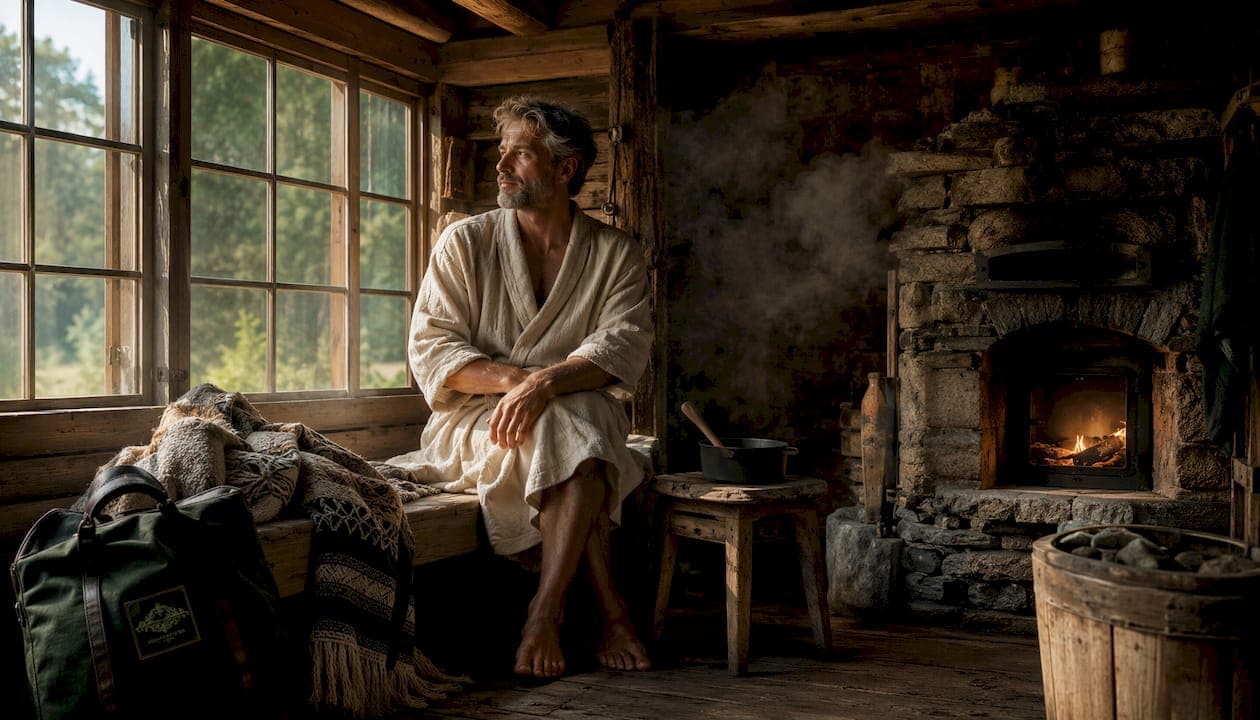
For a historic Swedish farmhouse stay, a traditional sauna is the better choice — and the Mayo Clinic Proceedings cohort evidence, the ritual of löyly, and clinician commentary from Dr Joy Hussain all point in the same direction. Infrared cabins have genuine merits, but they cannot replicate the sensory and cultural experience that defines a stay in a timber house built in the 1700s. Villa Sakis, a private Swedish log farmhouse in Bergslagen, offers exactly that: a traditional sauna as part of a whole-house retreat, where the ritual is as much a part of the stay as the pine forest outside.
Table of Contents
- How do infrared and traditional saunas compare for travellers?
- What does each sauna actually feel like?
- What does the health evidence actually say?
- Who should check with a clinician before using a sauna?
- What should you ask a host before you book?
- Energy use and running costs: what hosts and guests should know
- Which sauna suits your trip?
- Key takeaways
- Why a traditional sauna belongs in a place like this
- Villa Sakis: a private farmhouse stay with a traditional sauna
- Useful sources
How do infrared and traditional saunas compare for travellers?
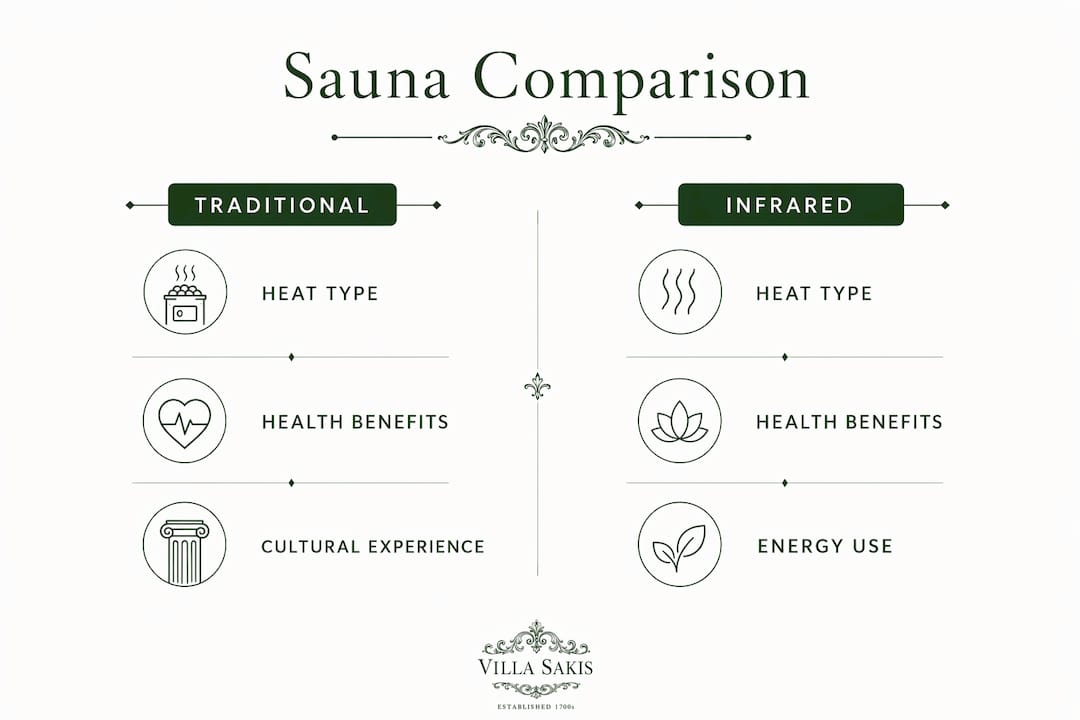
| Dimension | Traditional sauna | Infrared sauna |
|---|---|---|
| Heat type & feel | Hot air via convection; stones hold and radiate heat | Far-infrared panels heat body tissue directly; air remains cooler |
| Temperature & humidity | High temperature typical of traditional Finnish saunas; löyly adds bursts of steam | Moderate temperature; dry throughout |
| Preheat & session time | Longer preheat; sessions in rounds with breaks | Shorter preheat; single continuous session |
| Health evidence | Extensive long-term cohort data (Finnish protocols) | Promising short-term trials; no 20-year population studies |
| Safety/contraindications | Caution with cardiovascular conditions, pregnancy, alcohol | Same cautions; milder heat may suit lower heat tolerance |
| Authenticity & atmosphere | Central to Finnish/Swedish bathing culture; irreplaceable ritual | Modern wellness aesthetic; no cultural ritual equivalent |
| Maintenance & hygiene | Wood absorbs moisture; regular airing and wiping required | Easier to wipe down; no stone or water management |
| Energy use | 6–9 kW heater; 240V dedicated circuit | 1.5–2 kW on a standard outlet |
What does each sauna actually feel like?
The difference begins before you even step inside. A traditional sauna heats the room air through a wood or electric stove topped with stones. You breathe warm, slightly humid air, and the heat surrounds you completely. When water is poured over the stones, the resulting löyly, a burst of steam that briefly intensifies the heat and humidity, is the defining moment of the Nordic bathing ritual. It cannot be reproduced in an infrared cabin.
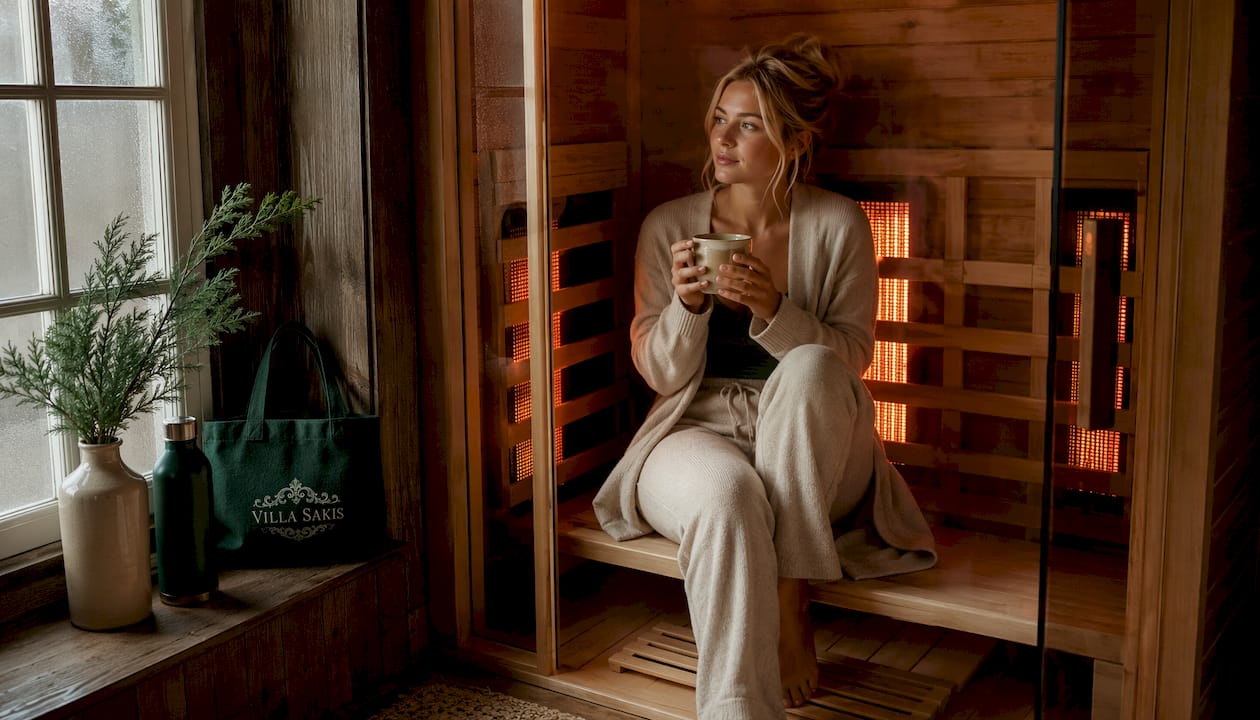
Infrared saunas work differently. Far-infrared wavelengths penetrate skin and heat body tissue directly, leaving the surrounding air noticeably cooler. Where you sit in relation to the panels matters: move away from them and the radiant warmth diminishes. The experience is gentler and drier, closer to sitting in warm sunlight than to the enveloping heat of a Finnish stove.
Practically, a traditional sauna needs 30–60 minutes to reach operating temperature. An infrared unit is ready in 10–20 minutes. Traditional sessions are typically taken in short rounds with cooling breaks; infrared sessions tend to run as a single, longer stretch of 30–45 minutes.
-
Traditional sauna: High air temperature, löyly possible, sessions taken in rounds with breaks
-
Infrared sauna: Moderate temperature, dry heat, single continuous session lasting longer
-
Preheat: 30–60 min (traditional) vs 10–20 min (infrared)
-
Position relative to panels matters in infrared; less so in a traditional room
Pro Tip: On your first evening, limit your initial round to five minutes, drink water before and after, and step outside or into cool air between rounds. This lets you gauge your tolerance before committing to a longer session.
What does the health evidence actually say?
The strongest long-term evidence sits firmly with traditional saunas. Large cohort studies30275-1/fulltext) reviewed in Mayo Clinic Proceedings link regular Finnish sauna bathing with reduced risks of cardiovascular disease and certain neurological outcomes. Those studies used traditional Finnish protocols at 80–100°C, and the associations cannot simply be transferred to infrared systems, which lack equivalent 20-year population data.
"Both sauna types can serve as a form of passive exercise that raises heart rate and improves circulation, notes Dr Joy Hussain, as cited by WebMD. "Traditional saunas have more robust long-term clinical data."
Infrared saunas do have credible shorter-term evidence: studies suggest benefits for chronic pain, blood pressure, and musculoskeletal conditions. Harvard Health notes possible short-term reductions in blood pressure after bathing, while cautioning that population studies may partly reflect broader healthy lifestyle differences rather than sauna use alone.
One claim worth setting aside: the idea that sweating in a sauna eliminates toxins. Sweat is predominantly water and salt, and measurable systemic toxin elimination via perspiration is not supported by evidence. The real benefits, cardiovascular support and recovery, are well worth having on their own terms.
Consistency matters as much as which type you choose. Regular use, rather than a single long session, is what the evidence rewards.
Who should check with a clinician before using a sauna?
Saunas are generally safe for healthy adults, but certain conditions call for a conversation with a doctor before you step inside. This applies to both sauna types.
- Cardiovascular disease or a history of heart attack
- Pregnancy
- Low or unstable blood pressure
- Recent heavy alcohol consumption
- Medications that affect thermoregulation or blood pressure
Practical rules for any traveller: start with five minutes, hydrate well before and after, avoid sudden cold-water immersion if you are unaccustomed to it, and supervise children at all times. If you are in any doubt about your health, consult a clinician before booking a property with a sauna.
Pro Tip: Ask the host for the sauna manual and emergency procedures when you arrive. Knowing where the off switch is and how to ventilate the room takes thirty seconds and matters.
What should you ask a host before you book?
Confirm these details in the listing or in a message to the host before you arrive. A few direct questions prevent the most common surprises.
Ask whether the sauna is traditional or infrared, and whether it is private to your booking or shared with other guests. Confirm the preheat policy: some hosts pre-heat on request, others leave it to guests. Check whether pouring water on the stones (löyly) is permitted, and ask about ventilation and cooling options nearby, such as a lake, outdoor shower, or cool room.
For a historic farmhouse, look for photos showing the stove, stones, and wood panelling. Host notes about the bathing ritual are a good sign. Ask about the cleaning policy and what guests are expected to do after a session: typically, a simple wipe-down of the benches and leaving the door ajar to air the room.
Bring a large towel, a water bottle, flip-flops, and a light robe. Traditional saunas in older properties sometimes require a little more preparation than a modern wellness centre, and that preparation is part of the pleasure.
Energy use and running costs: what hosts and guests should know
Running costs differ meaningfully between the two types. A traditional heater drawing 6–9 kW on a dedicated 240V circuit costs more per session to run than an infrared unit drawing 1.5–2 kW on a standard outlet. Hosts who offer a traditional sauna in a historic property have typically already absorbed the installation cost, but guests may notice it reflected in the nightly rate.
Host-side considerations for a traditional sauna:
- Dedicated 240V circuit and appropriate wiring
- Adequate insulation and ventilation to protect the building fabric
- Regular maintenance of stones and stove
For guests, the carbon intensity of a stay is partly shaped by whether the host uses renewable electricity. It is worth asking, particularly if sustainability matters to your travel choices. Timed pre-heating, where the host sets the sauna to reach temperature just before your session, reduces unnecessary running time and cost on both sides.
Which sauna suits your trip?
Choose the sauna that matches what you actually want from the stay. If authenticity, ritual, and the deepest long-term health evidence matter, a traditional sauna is the clear answer. If you run hot, have low heat tolerance, or want a gentler daily session, infrared's milder temperatures are easier to adopt.
A few short profiles help clarify the choice:
Solo recovery retreat. You want quiet, restorative heat after long walks in the forest. A traditional sauna, taken in short rounds with cooling breaks by the lake, fits this rhythm well. The ritual itself is part of the recovery.
Family weekend. Children and adults with varying heat tolerance are sharing the space. A traditional sauna at moderate temperature with brief sessions works for most groups; infrared's lower heat is an alternative if anyone finds 80°C genuinely uncomfortable.
Athletic recovery trip. You are focused on muscle recovery and circulation after training. Both types support this goal, but the traditional sauna's deeper research base30275-1/fulltext) and the option of contrast bathing (heat, then cool lake) make it the stronger choice for this purpose.
Key takeaways
Traditional saunas hold the strongest long-term health evidence and offer an irreplaceable cultural ritual; for a historic Swedish farmhouse stay, they are the more restorative and authentic choice.
| Point | Details |
|---|---|
| Evidence favours traditional | Long-term cohort studies used Finnish protocols at 80–100°C; infrared lacks equivalent 20-year data. |
| Ritual cannot be replicated | Löyly (steam from hot stones) is unique to traditional saunas and central to the Nordic bathing experience. |
| Safety applies to both types | Check with a clinician if you have cardiovascular conditions, are pregnant, or take medications affecting thermoregulation. |
| Ask before you book | Confirm sauna type, private use, preheat policy, löyly permission, and cleaning expectations with the host. |
| Villa Sakis offers the real thing | The private traditional sauna at Villa Sakis is part of a whole-house retreat in an 18th-century Swedish log farmhouse. |
Why a traditional sauna belongs in a place like this
There is a particular quality to stepping into a traditional sauna that has been part of a building's life for generations. The wood holds the warmth differently. The ritual of heating the stones, pouring the water, and then walking out into cool air beside a lake is not a wellness amenity you can replicate with a prefabricated infrared cabinet. It is woven into the house itself.
At Villa Sakis, the private traditional sauna is not an add-on. It sits within a farmhouse that has been cared for since the 1700s, surrounded by pine forest and meadow, with lake access a short walk away. The contrast between the heat inside and the cool outside is exactly what the Nordic bathing tradition was built around. Guests who arrive sceptical of the ritual tend to leave quietly converted. The experience is unhurried, sensory, and genuinely restorative in a way that is hard to find elsewhere.
For travellers who have read the evidence and want the sauna type that matches the studied protocols, and who also want the atmosphere that makes the ritual worth repeating, a traditional sauna in a historic timber house is the answer. The two things, evidence and atmosphere, happen to point in the same direction here.
Villa Sakis: a private farmhouse stay with a traditional sauna
The warmth of a traditional sauna is one thing. Finding it in a privately booked 18th-century Swedish log farmhouse, with no shared facilities and a lake outside the door, is another entirely.
Villa Sakis offers the whole house to one group at a time: a private traditional sauna, lake access, forest walks, self-catering kitchen, and timber rooms that have been part of the Swedish countryside since the 1700s. For those drawn to a traditional hammam or bathing ritual in heritage settings, the principle is the same: the place and the ritual together create something a modern wellness centre cannot.
- Private traditional sauna (exclusive to your group)
- Lake access and forest walks on the grounds
- Self-catering kitchen in a historic log farmhouse
- Whole-house booking: no shared guests, no shared spaces
Check availability at Villa Sakis and book the dates that suit your group.
Useful sources
- Cardiovascular and Other Health Benefits of Sauna Bathing: A Review of the Evidence30275-1/fulltext) — Mayo Clinic Proceedings
- Can regular sauna sessions support a healthy heart? — Harvard Health
- Saunas and Your Health: Benefits, Risks, and Safety — WebMD (includes Dr Joy Hussain commentary)
- Here's the science behind infrared heat, the new wellness trend — National Geographic
- Do infrared saunas have any health benefits? — Mayo Clinic
- Finnish Sauna vs Infrared Sauna: Honest Comparison — ThermalFinn (temperature, power draw, and installation data)
- Infrared vs Traditional Sauna — GQ (detox claim context)
- The house at Villa Sakis — Villa Sakis property detail and private sauna