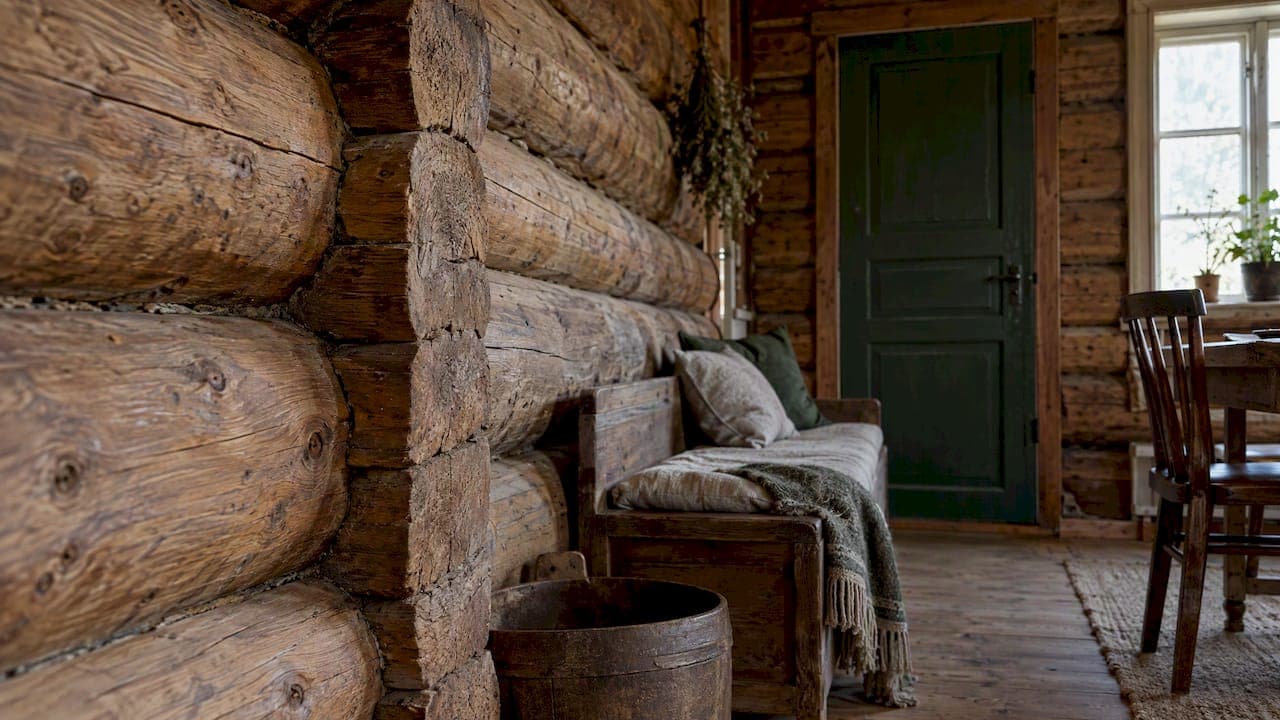
The feel of a log house, the timmerhus känsla Swedes talk about, comes from a handful of things working together: solid wood you can see and touch, a scent that lingers, softer sound, light that shifts across grain, and walls that carry the weight of their own age. It is not a mood that can be added with a few wooden accessories. It depends on how much timber is visible, how it is finished and how the room is used. Below we look at what the research says, where the romance meets reality, and what it is like to sleep inside one that has stood since the 1700s.
TL;DR
- A log house feels distinctive because wood is visible and tactile: grain, knots, colour variation, scent and changing light all register, and people commonly link interior wood with comfort, relaxation and warmth.
- Timber tends to soften sound, though impact noise and sound insulation can still be issues in some wooden homes.
- The feeling only holds when the wood is exposed. Timber hidden behind plasterboard often feels like any ordinary house.
- Honest limits exist: uninsulated log walls make modern energy rules harder to meet, and a heavy structure needs a sound foundation and a dry roof.
- The surest way to understand the feeling is to stay in one. Villa Sakis is a whole-house 1700s log farmhouse in Bergslagen, rented for private use.
Table of Contents
- What gives a log house its atmosphere
- Wood you can see, touch and smell
- Sound and air
- Warmth: the honest part
- When the timber is hidden, the feeling goes
- How long a log house lasts
- Our perspective
- Staying in a log farmhouse: Villa Sakis
- Making the most of a log house stay
- FAQ
- Sources
What gives a log house its atmosphere
Walk into a room built of solid timber and the first impression is rarely about any single feature. It is the sum: the warm tone of the walls, the slight unevenness of hand-worked surfaces, the faint resinous smell, and a sense that the room is quieter than it should be.
Swedish builders and architects describe this in different ways. One Swedish architectural example, a house with a visible spruce glulam frame, was praised in Swedish Wood's Trä magazine for creating rooms within rooms and lending warmth to the whole house. The frame was not hidden; it was the interior. A log house works on the same principle, only more directly, because the structure and the surface are one and the same.
A timber builder's description of rounded logs, on Tamme Timmerhus's site, speaks of a rhythmic pattern and a calm, harmonious impression. That is a builder's view and a pleasant one, but it matches what many visitors report in their own words: the horizontal courses of log give the eye something steady to rest on, like a slow, regular pulse.
Wood you can see, touch and smell
The most thorough evidence on why wooden interiors feel as they do comes from a 2020 peer-reviewed review by Alapieti, Mikkola, Pasanen and Salonen, The influence of wooden interior materials on indoor environment. It reports that people commonly associate interior wood with comfort, relaxation and warmth. The sensory side of timber is broad: texture under the hand, smell, colour variation and the way the surface catches light.
The same idea is set out in the Canadian Naturally:wood technical handbook, which lists grain, surface texture, smell, colour variation and changing reflectance as the qualities timber contributes to the experience of an interior. Hospitality writers make a similar point when they discuss the guest experience in hospitality: the sensory qualities of visible timber are exactly the kind of detail guests remember long after a stay.
Colour, grain and knots
The Alapieti review links yellow-red hues with perceived warmth, and notes that knots give wood a natural, rustic look. This is why an old pine log wall, darkened over generations to a deep honey or red-brown, feels so inviting on a grey day. A small Swedish holiday house described by Svenska Timmerhus leans on precisely this: the red tone, the rough surfaces and the visual pleasure of the material are presented as part of the appeal.
The lesson for anyone arranging a room is restraint. The review points out that the amount of visible wood, its finish, daylight and the balance with painted walls, stone, textiles and furniture decide whether the result feels calm and rich or visually excessive. Wood on every surface, floor to ceiling, can tire the eye. A log wall set against plain linen, a stone hearth and a pale painted ceiling usually feels better than wood everywhere.
Light that moves
Real wood does not reflect light evenly. The Naturally:wood handbook states that reflectance changes with grain direction and viewing angle, so surfaces look lighter or darker as you move. In practice this gives a timber room depth: a wall seems to shift through the day as the sun crosses it, and lamplight in the evening turns the same surface almost amber. It is one reason log rooms feel alive in a way flat painted walls do not.
Sound and air
The quiet of a log house is often the second thing guests mention. A 2023 peer-reviewed study by Jussila and colleagues, Consumer housing choices among residents of wooden housing, covering Finland and Sweden, found that residents commonly described wooden housing as quiet, acoustically softer and pleasant. The same study is honest that some residents also reported impact noise and sound-insulation problems. Timber is not a magic silencer; footsteps on a wooden floor can carry, and much depends on how the building is put together.
Air is a subtler matter. Builders often claim that timber "breathes" and keeps the air healthy, and that is exactly what it is: a builder's claim, not independent proof. Anecdotes are more reliable as colour than as evidence. In a 2015 report on residents of a Swedish wooden building, Monocle recorded that they noticed the quiet and the smell of freshly cut wood. One parent said a child with asthma breathed more easily, though the article itself treated the health explanation as unproven. We would put it the same way: many people find the air in a log house pleasant, and nobody should promise a cure.
What can be said with authority is that any house needs working ventilation. Boverket, the Swedish National Board of Housing, says a well-functioning ventilation system is important for supplying fresh air and removing polluted and humid air, and that ventilation must remain sufficient to clear moisture from activities such as showering. That applies as much to a log farmhouse as to a new apartment.
Warmth: the honest part
A log house feels warm to the eye. Whether it is warm in January is a different question, and the answer depends on the building.
The pages ranking for this subject tend to agree on one drawback: solid log walls do not insulate as well as a modern insulated wall. Boverket's 2023 report on exemptions from the energy rules for log houses says uninsulated timber walls can make it harder to meet Sweden's average thermal-transmittance requirement. New timber houses can meet it, with some limits on design, and the result also depends on the number of floors, the window area and the insulation elsewhere in the building. The same report notes that houses built with natural materials generally perform better in use than their calculated U-values suggest, thanks to greater thermal inertia and heat capacity.
Lived accounts add nuance. In one Swedish case recorded by Svenska Timmerhus, the occupants of an uninsulated timber house said it had not felt cold during a month at −25°C, and that the air felt fresher than in their previous home. A Byggahus account of a Swedish timber house heated with firewood and solar heat reports the opposite problem in some conditions: the glazed enclosure could become very warm in sunshine, and the air was at times too dry rather than damp. These are single households and a builder's own stories, so read them as texture, not as guarantees.
The practical conclusion for a holiday guest is simple. Heat is a daily, physical thing in an old log house: a fire, a sauna, a wool blanket, thick socks. For many people that is part of the charm, not a flaw.

When the timber is hidden, the feeling goes
One finding deserves more attention than it usually gets. In the Jussila study, residents of wooden homes whose timber was concealed behind plasterboard or other finishes often found the home little different from an ordinary building. Exposed timber, by contrast, shaped warmth and ambience.
This is why a genuine log interior is rare and worth seeking out. A modern "timber house" can be wrapped in layers that hide the wood entirely. In an 1700s farmhouse with the logs left honest, nothing stands between you and the material.
| What you experience | Exposed log walls | Timber hidden behind finishes |
|---|---|---|
| Look | Visible grain, knots, colour variation | Painted, uniform surface |
| Touch | Textured, slightly warm to the hand | Smooth, neutral |
| Scent | Noticeable, especially when warm | Faint or absent |
| Light | Shifts with grain and angle | Flat, even |
| Overall impression | Distinct, memorable | Much like conventional housing |
The table summarises the point made by the 2023 study and the Naturally:wood handbook. It is a guide to what to look for, not a measurement.
How long a log house lasts
Part of the feeling comes from age. Builders at Sydved point to Swedish timber houses several hundred years old, and explain what keeps them standing: a sound foundation to carry the heavy structure, and a roof that stays watertight, since water ingress through an inadequate roof is a major threat. Walls are solid wood, while floors and roofs can take natural insulation such as cellulose.
That matches common sense and the long record of old Swedish farmhouses. A log building lives on care, which is the real story of any house that has passed through generations. Walls that have been looked after for centuries feel different from walls that have been in place for ten years: slightly settled, the floor gently worn, the doorframes no longer square.

If you own an older timber house, the single most useful habit is checking before you change things. Boverket advises, before adding attic insulation, that you check for moisture damage, airtightness, ventilation ducts and attic ventilation, and then watch for condensation in the first winter after the work, as set out in its guidance on attic insulation.
Our perspective
We look after a log house that has been in careful hands since the 1700s, and we have learned that the feeling people come for is mostly made of small, slow things. It is the sound of a floorboard, the scent of a warm wall after the sauna, the way morning light moves across the logs while the kettle heats. None of it is staged.
We also think it is better to be plain about what an old house is. It is not a hotel and it is not a new-build with a wooden skin. It asks you to light a fire, to dress for the weather, and to let the day take its own pace. Guests who take that in tend to leave with the sense that they have been somewhere rather than merely stayed somewhere. That, to us, is the whole point of the place.
— Christian
Staying in a log farmhouse: Villa Sakis
Villa Sakis is a historic Swedish log farmhouse, established in the 1700s and set among meadows and pine forests in Bergslagen. It is let as a whole house, privately, for families, friends, couples and anyone who wants a quieter, older kind of trip. Inside are honest timber rooms, a private sauna, a self-catering kitchen and access to the lake, forest and meadows.
You can see the rooms and the setting on The House, and check availability and book directly on our stay page. If you would like a feel for the region before deciding, our journal article on what to expect from a Swedish countryside vacation is a good place to start.
Making the most of a log house stay
A few habits help the timber do its work.
- Arrive before dusk if you can. The first impression of the house is best taken in daylight, when the logs show their grain and colour.
- Spend an evening by the sauna. Warmth, wood scent and quiet go together. Our guide to a private sauna holiday in Sweden explains how to enjoy it, and our comparison of infrared and traditional saunas shows what suits a farmhouse best.
- Pack for the kitchen. The house is self-catering, so a self-catering packing list saves a surprising number of small frustrations.
- Leave screens to one side. Our ideas for family cabin activities that work offline suit the pace of a timber house well.
- Walk out before breakfast. The forest and meadows start at the door, and a short morning walk makes the warm interior feel even better when you return.
For those thinking about the wider picture, we have also written about renting a whole historic farmhouse and about how to plan a lakeside stay in Sweden.
FAQ
What does a log house feel like to be in?
Most people describe it as warm, quiet and grounded. Research links interior wood with comfort, relaxation and warmth, and the scent, grain and changing light add to that. The effect is strongest when the timber is left visible rather than covered.
What are the drawbacks of a log house?
The main one is thermal performance: Boverket says uninsulated timber walls make it harder to meet Sweden's energy requirement for new buildings, although new timber houses can comply with design limits. Heavy timber also needs a sound foundation and a watertight roof. Sound can be an issue too, as some residents in wooden housing report impact noise.
How long does a log house last?
With good care, a very long time. Swedish builders point to timber houses that are several hundred years old, and name the foundation and a leak-free roof as the key factors in keeping them sound.
Does a log house feel different from an ordinary house?
It can, but not automatically. A 2023 study of residents in Finland and Sweden found that timber hidden behind plasterboard or other finishes often felt little different from a conventional building, while exposed timber changed the warmth and ambience of the home.
Can I experience a genuine log house without owning one?
Yes. Villa Sakis is a whole-house rental in a log farmhouse dating from the 1700s, so you can spend a few days in the rooms, the sauna and the surroundings before deciding what you think of timber living.
Sources
- Labyrinthine, surprising and Nordic, Trä magazine (Swedish Wood)
- Timmerhus, Tamme Timmerhus
- The influence of wooden interior materials on indoor environment (Springer)
- Inside Wood: a technical handbook (Naturally:wood)
- What Is Guest Experience? A Guide for Hospitality Pros
- Fritidshus i oisolerat timmer, Svenska Timmerhus
- Consumer housing choices among residents of wooden housing (Taylor & Francis)
- Sweden's Timber High-Rises, Monocle
- Underhåll ventilation och se över styrningen, Boverket
- Utredning avseende behov av undantag från energireglerna för timmerhus, Boverket
- Att vistas i ett VISTE, Svenska Timmerhus
- Bor ekologiskt i Naturhus, Byggahus.se
- Drömmen om ett timrat hus, Sydved
- Tilläggsisolera vinden, Boverket