The fastest fix for a rain-soaked cabin day is a small kit and a loose plan: pack a folder of printable activity sheets, a deck of cards, and a simple craft box before you leave home, then rotate through activities in 30 to 45 minute bursts. What follows is the full list of activities, the packing checklist, and the timing logic behind it, along with a few habits Villa Sakis has picked up from years of hosting families through grey Swedish weeks.
TL;DR:
- Pre-pack a rainy-day kit with printable activity sheets, a deck of cards, craft supplies, and batteries to ensure quick access and avoid last-minute search delays.
- Rotate activities every 30 to 45 minutes to balance active, quiet, and group tasks, avoiding boredom and disengagement across different ages.
- Focus on simple, low-tech options like scavenger hunts, bingo, and quizzes that require minimal preparation, no broadband, and can be easily adapted for all ages.
- Limit screen time by preparing the activity kit beforehand and prioritizing rotation-based activities over constant use of electronic devices.
- Choose a spacious, family-friendly farmhouse with open layouts and a well-stocked craft and game shelf to facilitate diverse indoor activities during bad weather.
Table of Contents
- Inomhusaktiviteter i stugan: 20 ideas to try today
- Pack before you go: the rainy-day kit checklist
- How to structure the day: rotation and timing
- Low-tech favourites: scavenger hunts, bingo, and quizzes
- Cosy evening ideas: puzzles, story chains, and family rituals
- Where to buy or make things: printables and personalised finds
- Villa Sakis perspective: what actually works in the house
- Why the standard cabin activity list misses the point
- Book a farmhouse that's built for slow, indoor days
- Sources
Inomhusaktiviteter i stugan: 20 ideas to try today
A good rotation mixes movement, quiet focus, and shared laughter, so no single mood dominates the day. Here is a working menu, ordered roughly from active to calm.
- Indoor scavenger hunt – write 8 to 10 clues in advance; 20 to 30 minutes; works for ages 4 and up in teams of two.
- Bingo with themed cards – printable grids, dried beans or buttons as markers; 20 minutes; whole family.
- Family quiz night – questions tailored to kids' interests; 30 to 40 minutes; best from age 7 up.
- Cooking or baking project – pancakes, buns, or a simple stew; 45 to 60 minutes; all ages with supervision.
- Indoor mini-Olympics – sock curling, cushion long jump, balloon volleyball; 30 minutes; needs open floor space.
- Craft booklet or colouring pages – printed sheets, pens, scissors; 20 to 30 minutes; toddlers to age 10.
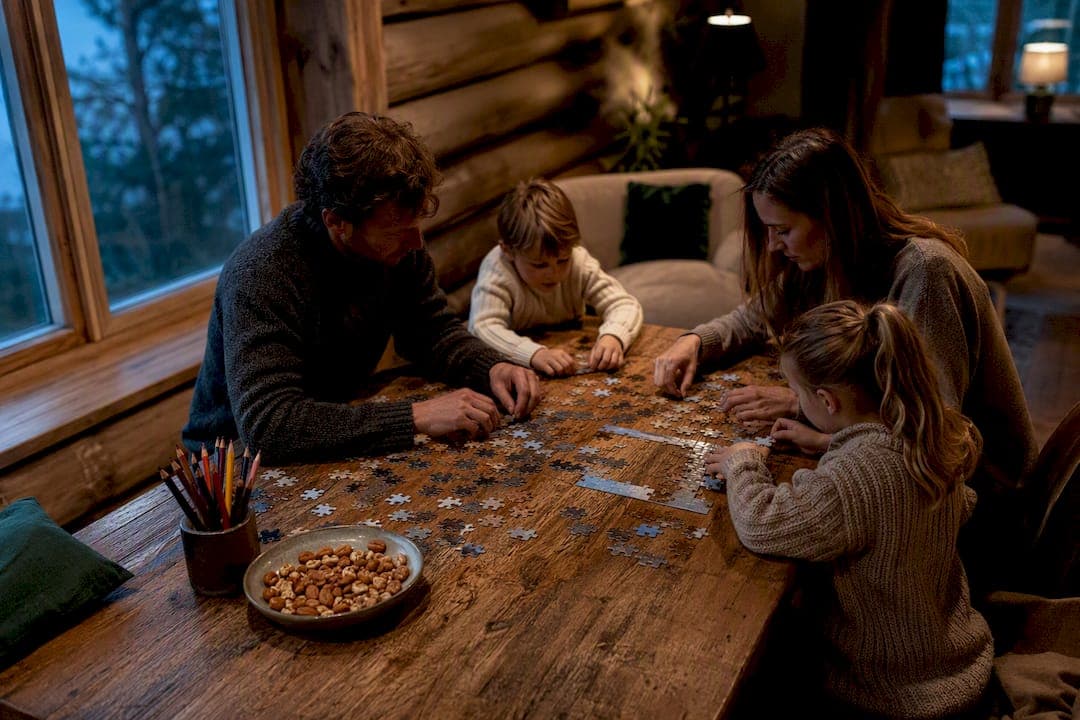
- Jigsaw puzzle challenge – 100 to 500 pieces depending on age; ongoing, 30 minutes per sitting.
- Card games – Uno, Kaptajn/Kasino, or a simple rummy; 15 to 30 minutes; age 6 up; see practical tips to organise a poker night for smooth home game ideas.
- Story chain – each player adds a sentence; no materials needed; 15 minutes; any age.
- Film night with a laptop or small projector – pre-download films; 60 to 90 minutes; evening slot.
- Shadow theatre – torch and a bedsheet; 20 minutes; loved by ages 4 to 10.
- Tabletop charades – written prompts in a bowl; 20 minutes; teens and adults especially.
- Balloon keep-it-up – one balloon, no furniture nearby; 15 minutes; younger children.
- Indoor yoga or stretch session – free video or printed poses; 20 minutes; all ages.
- Board game marathon – bring two or three favourites; 30 to 60 minutes each.
- Photo challenge – a printed list of objects to photograph indoors; 20 minutes; works well as a family cabin activity.
- Paper aeroplane contest – just paper; 15 minutes; any age.
- Guided painting session – watercolours or simple acrylics, one theme per session; 30 to 40 minutes.
- Memory or matching card game – printed or store-bought; 15 minutes; toddlers up.
- Baking + decorating – biscuits or a simple cake iced together; 45 minutes; a natural finale to a rainy afternoon.
Pack before you go: the rainy-day kit checklist
Nothing kills momentum faster than hunting for scissors while three children wait. Pack a dedicated folder or resealable bag with:
- Printed activity sheets, five to seven per child, chosen to avoid last-minute scrambling
- Pens, pencils, and a small set of colours
- Spare batteries for torches and games
- One small board game and at least one deck of cards
- Scissors, tape, and a basic craft kit (glue, paper, string)
- A spare torch for shadow theatre and evening games
- A USB stick loaded with printable PDFs, in case the cabin has no printer
Keep everything in a labelled folder or bag stored somewhere obvious, not buried in a suitcase. For a lasting keepsake rather than a disposable sheet, Smartphoto lets you order a personalised puzzle or family-themed card deck ahead of the trip, so the rainy-day kit doubles as something worth keeping.
How to structure the day: rotation and timing
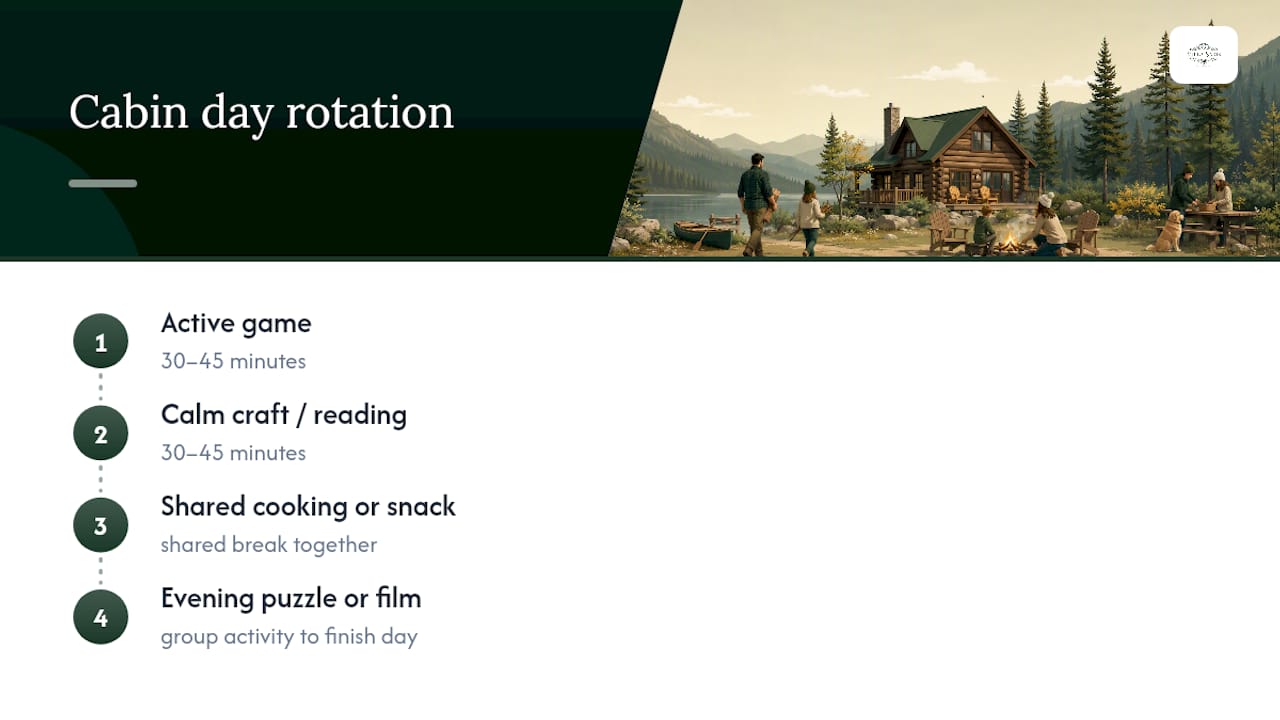
A simple rhythm works better than a rigid schedule. Try: an active game for 30 to 45 minutes, then a calm craft or reading spell for another 30 to 45 minutes, followed by shared cooking or a snack break, and a group puzzle or film in the evening. Rotating activity types in cycles of that length helps keep attention fresh across different ages, since younger children and adults alike tend to disengage once a single task runs too long.
Pro Tip: Let older children pick the next activity from two options you've already decided are fine. That small choice cuts pushback dramatically, and it costs you nothing.
Low-tech favourites: scavenger hunts, bingo, and quizzes
These need no broadband and barely any prep once the kit is packed.
- Scavenger hunt setup: write clues that point to objects already in the cabin (a lamp, a specific book, a window facing the forest), hide small tokens or sweets at each stop, and split into teams of two for balance across ages.
- Bingo: print themed grids (animals, colours, cabin objects) and use dried beans or buttons as markers; younger children can play alongside adults without needing to read.
- Themed quizzes: build questions around what the children already love, whether that's football, animals, or a favourite film series, and keep rounds short so no one loses interest halfway through.
- Space and safety: clear a run of floor for active rounds, keep toddlers on a simpler version with fewer steps, and let teenagers write their own bonus round to stay invested.
Cosy evening ideas: puzzles, story chains, and family rituals
Evenings suit slower activities. Sort puzzle pieces by colour or edge before starting, and set a 20-minute timer per session so no one burns out. Story chains work well with no materials at all: one person starts a sentence, the next continues it, and the results are usually funnier than anyone expects. For film night, charge devices in advance, check subtitles work, and pick something short enough that bedtime doesn't slide too late. Baking together, or setting up a popcorn station with two or three flavour toppings, turns a simple snack into its own evening event. If a sauna session follows, read our guide to sauna with children first, since heat tolerance and timing differ a great deal by age.
Where to buy or make things: printables and personalised finds
- Order a personalised puzzle or family card deck from smartphoto.se before the trip, so it arrives ready to unwrap on arrival.
- Load printable activity sheets onto a USB stick if the cabin has a printer, or print them at home and laminate the ones you'll reuse.
- Charity shops are a reliable source of cheap jigsaws and board games with all their pieces still intact.
- No printer, no problem: hand-draw a bingo grid or scavenger hunt list on plain paper; the children rarely mind the lack of polish.
Villa Sakis perspective: what actually works in the house
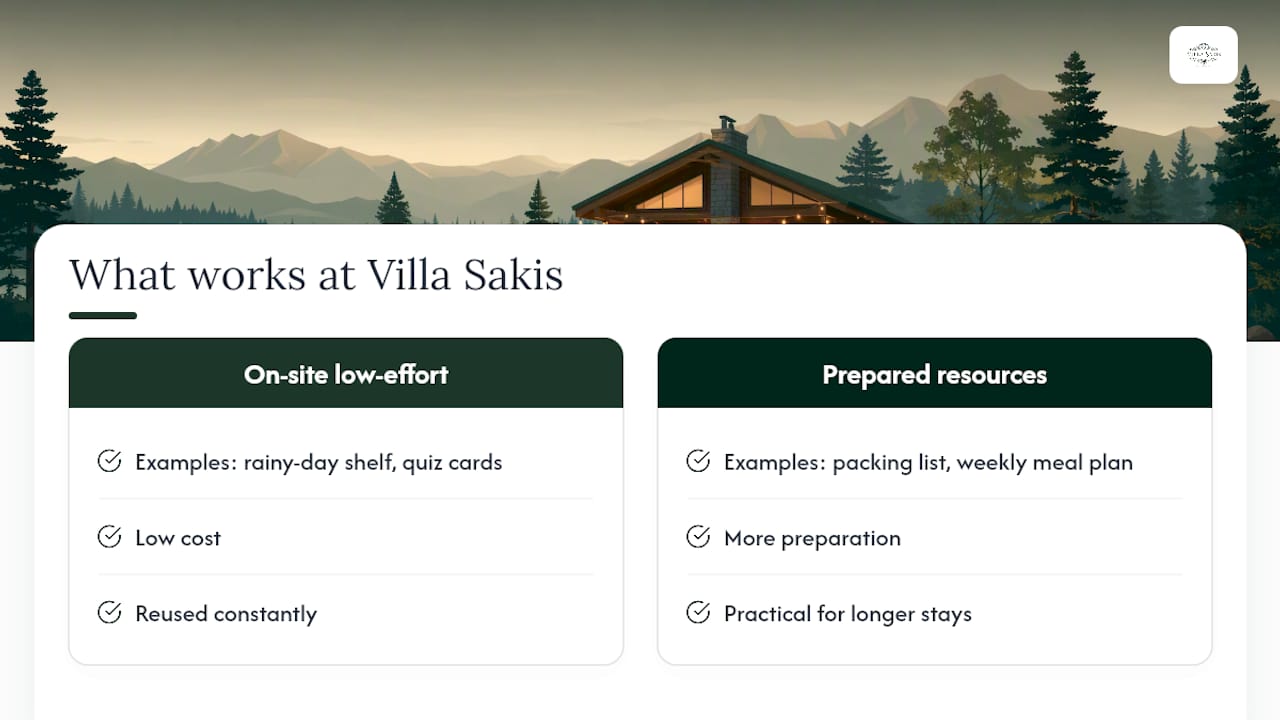
Guests at Villa Sakis tend to gravitate toward two things: a labelled rainy-day shelf near the entrance, stocked exactly as described above, and an evening quiz night using printed question cards left from a previous stay. Both cost little and get reused constantly. For more preparation, our cabin packing list and weekly meal plan cover the practical side of a longer stay.
Why the standard cabin activity list misses the point
Most guides to cabin entertainment read like inventories: buy this game, print that sheet, done. The gap is in the pacing, not the props. A pile of board games left untouched on a shelf does nothing; a 30 to 45 minute rotation with a clear handover point does the actual work of keeping four different age groups content in one small living room.
The overrated idea is screen-based entertainment as a fallback. It works for one film night, then flattens the rest of the stay, especially somewhere with patchy signal. The underrated move is preparing the kit before departure rather than at the cabin. A folder packed at home, with sheets already printed and a deck of cards already in the bag, removes the one decision point (what do we even have?) that causes most rainy-day arguments.
Prioritise the kit first, the schedule second, and the exact activity list last. Almost any reasonable mix of games works once those first two are sorted.
— Christian
Book a farmhouse that's built for slow, indoor days
A farmhouse like Villa Sakis is suited to exactly this kind of stay: a cabin holiday where the weather doesn't dictate the mood. Timber rooms and open living spaces give a family enough room to run a scavenger hunt in one corner and a quiet puzzle session in another, without anyone tripping over the other. A self-catering kitchen also means the baking and cooking activities on this list are genuinely easy to run, not just theoretical.

Read what to expect from a Swedish countryside stay to plan ahead, then browse the house for room layouts and amenities. When you're ready, check dates on the main Villa Sakis page, and pack that rainy-day folder before you go. It's the one preparation step that pays off every time the weather turns.
Sources
- 15 roliga familjeaktiviteter i stugan
- smartphoto — pussel
- Regnaktiviteter för barn | Inomhus och gratis | Zenframe