Taking children into a sauna is perfectly reasonable when adults set the right conditions. The short answer for healthy children: yes, with a lower temperature, shorter sessions, constant supervision, and careful cooling afterwards. There are no universally binding international rules on the subject, as Küng Wellness notes, so the responsibility sits with you as the parent. The good news is that families across Scandinavia have shared the sauna for generations, and the practical guidance is clear enough to follow confidently.
The top-line rules to hold in mind before you step inside:
-
Keep the temperature around 60°C for younger children rather than the 80°C many adults prefer, as Harvia’s family sauna guidance recommends.
-
Limit sessions to short bursts with cooling breaks between them, without specifying exact durations.
-
Stay within arm’s reach at all times, or keep very young children on your lap.
-
Offer fluids before, during, and after every visit.
-
Leave immediately if a child shows any sign of discomfort, however mild.
Pro Tip: Frame the sauna as play, not endurance. Children who associate the heat with calm, enjoyable time are far more likely to signal discomfort honestly rather than push through it.
Key takeaways
Children can safely enjoy a sauna when adults control the temperature, limit session length, supervise constantly, and cool down gradually with lukewarm water and proper hydration.
| Point | Details |
|---|---|
| Temperature for children | Set the sauna to around 60°C for children, roughly 20°C below typical adult preference. |
| Bench placement | Always use the lowest bench for young children; the temperature gradient is steep. |
| Session length | Start with 5 minutes for toddlers; school-age children can manage short sessions per round. |
| Cooling and hydration | Use lukewarm rinses, not cold plunges; offer water or diluted juice before, during, and after. |
| Villa Sakis | Offers a fully private sauna in a Swedish farmhouse, giving families complete control over conditions. |
Table of Contents
When can children use a sauna? Age-by-age guidance
Children heat up and cool down faster than adults because of their higher body-surface-area-to-mass ratio, as Küng Wellness explains. That physiological difference is the reason age-appropriate limits matter so much.
-
Infants (0–6 months): Many Finnish families introduce babies to the sauna from the earliest weeks, but international guidance is more cautious. If you choose to bring a very young infant, keep the temperature low, stay on the lowest bench, limit exposure to a few minutes at most, and watch for any sign of flushing or agitation. Consult your paediatrician first.
-
Toddlers (6 months–3 years): Short sessions on the lowest bench, with a parent holding the child throughout. The Sauna Guide’s age-by-age overview suggests very brief exposure for this group, with full rest between rounds.
-
Preschool (3–6 years): Sessions can extend to a length appropriate to the child’s ability to communicate discomfort reliably. Keep them on the lower bench and treat the visit as a gentle, playful ritual rather than a heat challenge.
-
School-age (6–12 years): Gradually increase time and, if the child is comfortable, allow a slightly higher bench position. Sessions of moderate length with a cooling break are reasonable.
-
Teenagers: Thermoregulation is closer to adult capacity. Standard adult guidance applies, though individual tolerance still varies.
-
When to avoid the sauna entirely: fever, acute illness, recent vomiting, or any known cardiac or respiratory condition. When in doubt, a quick call to your paediatrician costs nothing and removes the uncertainty.
What temperature and bench height work best for children?
The temperature gradient inside a sauna is steeper than most parents realise. At floor level the air may be 40°C; at the top bench it can reach 90°C or more. That difference alone makes bench placement one of the most consequential decisions you make before sitting down.
-
Recommended temperature for children: around 60°C, measured at bench height. Harvia advises this is roughly 20°C cooler than the 80°C many adults prefer, and it reduces the physiological load considerably.
-
Always use the lowest bench for infants, toddlers, and preschool-age children. The air there is meaningfully cooler and the risk of accidental contact with the heater is lower.
-
School-age children may move to the middle bench once they are comfortable and can communicate clearly how they feel.
-
Steam (löyly): adding water to the stones raises the perceived heat sharply and can startle or distress a child. Warn children before any steam is produced, keep bursts small, and avoid large throws of water while young children are present.
Pro Tip: Before your child’s first session, let them sit in the sauna for a minute or two with the door open and the heater off, so the space feels familiar rather than overwhelming.
How long should a session last, and how should you structure it?
Küng Wellness recommends two short sauna rounds with thorough rest between them for small children, rather than one longer continuous session. That structure suits children’s natural energy patterns and reduces the risk of over-exposure.
A simple session structure to follow includes entering the sauna at the appropriate temperature, settling on the correct bench, moving to the cooling area when the child wishes or discomfort arises, offering a lukewarm rinse and a drink, resting quietly, and repeating the session once if the child is comfortable.
If a child wants to leave early, go immediately. The sauna is not a test of willpower.
Safety checklist: what to watch for and when to stop
The most important safety rule is the simplest one: never leave a child alone in a sauna. Keep very young children on your lap; keep older children within arm’s reach throughout.
-
Heater safety: Harvia’s family sauna range includes lockable Xenio control panels and safety railings that prevent accidental contact with the heater stones. If your sauna has neither, keep children seated and away from the heater at all times.
-
Warning signs to stop immediately: unusual quietness or withdrawal, skin that is deeply flushed beyond a healthy pink, rapid or laboured breathing, dizziness, nausea, pallor, or any loss of consciousness.
-
If a child faints or becomes unresponsive: move them to cool air immediately, lay them flat, apply a cool (not ice-cold) cloth to the forehead and neck, and call emergency services if they do not recover within a minute or two.
-
Avoid sudden large steam bursts near children; the sharp rise in perceived temperature can cause panic and distress.
-
Check the sauna before entering: confirm the temperature, test that the door opens easily from inside, and remove any objects that could fall onto or near the heater.
Pro Tip: Agree a simple signal with older children before you go in, such as a thumbs-down, so they can tell you they want out without feeling embarrassed in front of others.
How to make a family sauna session genuinely enjoyable
The biggest mistake parents make is treating the sauna as something children must endure and gradually get used to. Harvia’s Swedish family guidance is clear: frame every visit as play, not heat training. Children who enjoy the experience will self-regulate far better than those who feel pressured.
-
Water play: small waterproof toys, a soft bucket for pouring water on feet, or a gentle spray bottle of cool water make the heat feel manageable and fun.
-
Waterproof books or quiet games give younger children something to focus on other than the temperature.
-
Sensory cooling: ice lollies during the cooling break, a bowl of ice for small hands, or a lukewarm mist spray are all genuinely effective at making breaks feel like a treat rather than a pause.
-
Music or soft lighting can transform the atmosphere for children who find the heat unsettling at first.
-
Active breaks: plan for movement between rounds. A short run around the garden, a paddle at the lake edge, or simply jumping on the spot suits children’s natural energy and makes re-entering the sauna feel like a choice rather than an obligation.
Pro Tip: Let children pour a very small amount of water on the stones themselves (with your hand over theirs). The sense of agency makes the whole experience feel safer and more exciting.
What to know about public pools and saunas in Sweden
Swedish simhallar (public swimming pools) often include saunas, but policies on children vary considerably between facilities. Checking before you arrive avoids disappointment.
-
Minimum age limits: many simhallar set a minimum age of 3–5 years for the sauna, and some designate certain sessions as adult-only. Ring ahead or check the facility’s website.
-
Family sauna times: larger pools often schedule dedicated family sauna slots with lower temperatures and shorter sessions, which are far better suited to children than standard adult sessions.
-
Parental supervision requirements: most Swedish facilities require a parent or guardian to accompany children under a certain age (often 12) in the sauna area. Confirm the specific rule with staff.
-
Practical checks on arrival: ask staff what the current temperature is set to, whether löyly is used and how frequently, and whether the heater has a guard or barrier.
-
Etiquette: public saunas are quiet spaces. Explain to children beforehand that voices stay low, that they should not run near the heater, and that other users deserve calm. Knowing where the changing rooms and cooling showers are before you enter reduces stress for everyone.
Cooling down and rehydrating after the sauna
The transition out of the heat is as important as the session itself. Abrupt cold plunges, while popular among adults, can be physiologically stressful for young children. A gradual, lukewarm approach is safer and more comfortable.
-
Rinse with lukewarm water rather than cold. Allow the body temperature to drop gently over several minutes before any cooler water is introduced.
-
Offer fluids immediately: water is ideal; diluted fruit juice works well for younger children who need a little encouragement. Avoid sugary drinks or anything carbonated straight after the sauna.
-
Watch skin tone and energy levels for 15–20 minutes after the session. A child who remains deeply flushed, unusually tired, or complains of a headache after resting and rehydrating warrants medical attention.
-
Dress warmly once the body has cooled, particularly in cooler months. Children lose heat quickly after a sauna and can feel chilled within minutes of leaving.
-
Rest before any further activity. The sauna is restorative precisely because it demands stillness afterwards. Build that quiet time into your plan.
A practical checklist and sample family session
A ready-to-use reference you can save on your phone or print before your next visit.
Pre-sauna checks
-
Child is healthy, well-rested, and has had a drink of water.
-
Sauna temperature confirmed at around 60°C (or lower for infants/toddlers).
-
Heater guard or safety rail in place; control panel locked if available.
-
Towels, cool water, and a snack for the break are ready outside.
In the sauna
-
Child sits on the lowest bench; parent stays within arm’s reach.
-
No large steam bursts; warn before any water is added to the stones.
-
Watch for warning signs throughout (see safety section above).
-
Leave the moment a child signals discomfort, without negotiation.
Post-sauna care
-
Lukewarm rinse, then rest in a cool area.
-
Offer water or diluted juice.
-
Monitor skin tone and energy for 15–20 minutes.
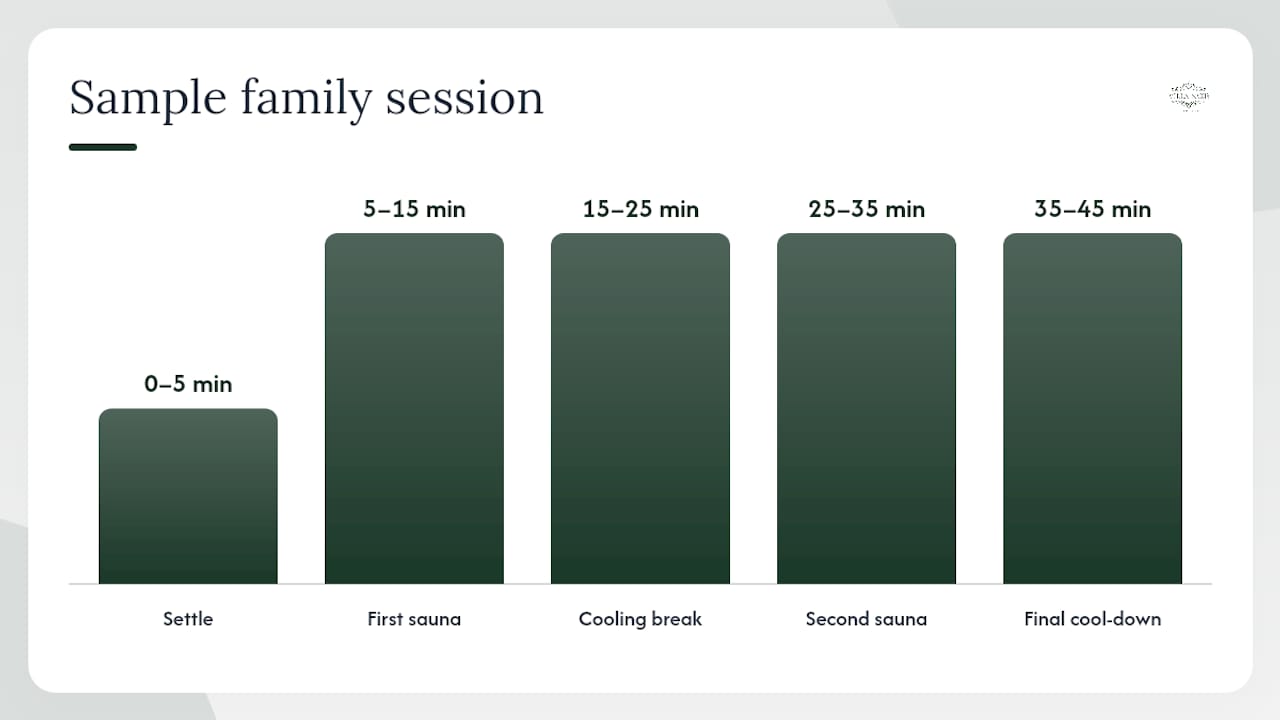
Sample 45-minute family session (school-age child)
| Time | Activity |
|---|---|
| 0–5 min | Settle in, sit on lower or middle bench, chat quietly |
| 5–15 min | First sauna round at around 60°C |
| 15 minutes or more | Cooling break: lukewarm rinse, water, light snack, outdoor movement |
| 25 minutes or more | Second sauna round (optional: small steam burst if child is comfortable) |
| 35 minutes or more | Final cool-down, dress warmly, rest |
For toddlers, compress this to a single 5-minute round followed by 20 minutes of rest. For teenagers, a second round of up to 20 minutes is reasonable.
Pro Tip: At Villa Sakis, the private sauna means you control the temperature, the steam, and the pace entirely. There is no queue, no stranger’s preferences to accommodate, and no pressure to leave. That freedom makes a genuine difference when you are calibrating the experience for a young child.
A host’s perspective on family sauna traditions
There is something quietly profound about a family sauna ritual. It is one of the few moments in a child’s day that is genuinely unhurried, away from screens, and structured around sensation rather than achievement. The Swedish tradition of bastu med barn is not about heat tolerance; it is about togetherness and the kind of slow, embodied attention that modern life rarely makes room for.
What strikes me most, having watched families use the private sauna at Villa Sakis, is how quickly children adapt when the conditions are right and the pressure is absent. A child who was hesitant at the door on the first evening is often the one asking to go back the following morning. The difference is almost always the same: a parent who followed the child’s pace rather than their own.
The guidance in this article reflects what works in practice. Lower temperatures, short sessions, play-based framing, and a lukewarm rinse afterwards are not compromises on the sauna experience. They are the experience, done well, for a family. The heat is the same; only the approach changes.
Villa Sakis: a private sauna setting built for families
Families who want to introduce children to the sauna without the uncertainty of a public simhall will find Villa Sakis a natural fit. The historic Swedish farmhouse in Bergslagen offers a private sauna that you control entirely: temperature, steam, timing, and pace are yours to set from the moment you arrive. There is no minimum age policy set by a stranger, no adult-only session to work around, and no shared changing room to navigate with a toddler.

Between sessions, the grounds offer lake access, open meadows, and pine forest for exactly the kind of active cooling break that keeps children happy and safe. The whole property is booked privately, so the rhythm of the day belongs to your family. Read more about what to expect from a Swedish countryside stay, or visit Villa Sakis to check availability for your family’s visit.
Sources
The guidance in this article draws on the following sources. For children with chronic health conditions, always consult a paediatrician before introducing sauna bathing.
-
Enjoying Sauna as a Family: Sauna tips for families with children | Harvia
-
Sauna for Kids: Age-by-Age Safety Guide for Children | Sauna Guide
This article provides general information and is not a substitute for professional medical advice. If your child has any health condition, consult a qualified healthcare professional before introducing sauna bathing.