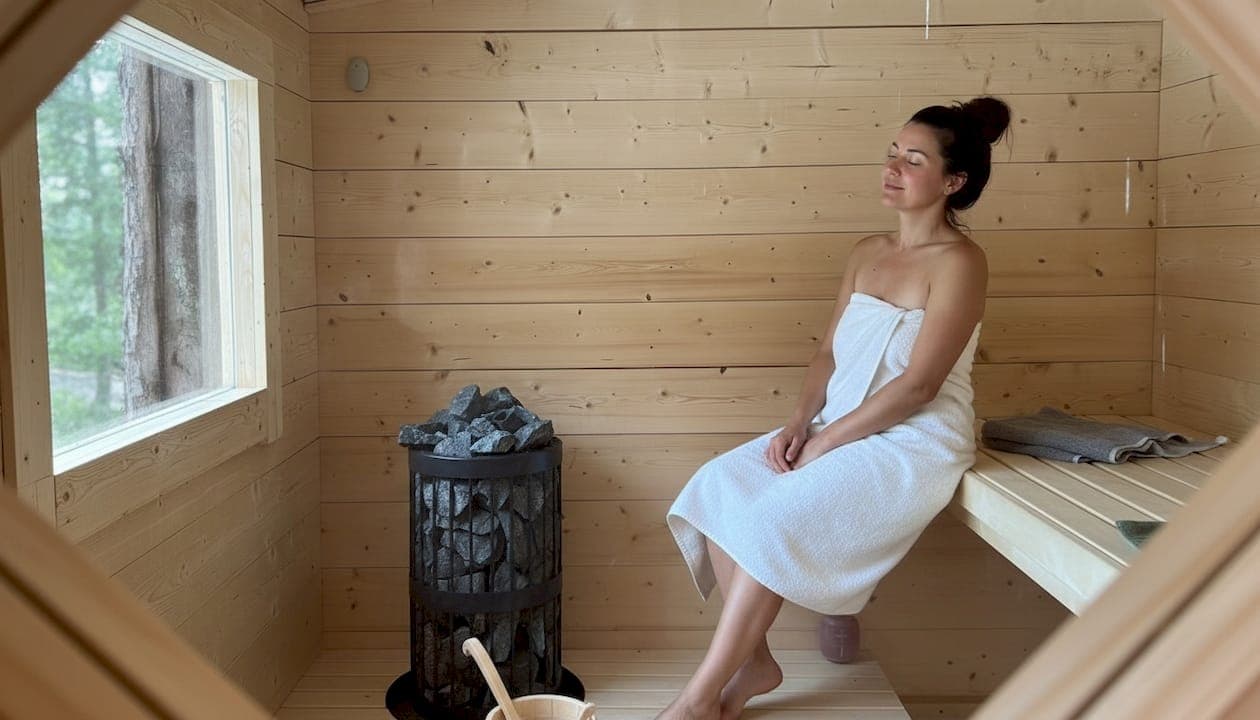
A private sauna is one of the quieter pleasures of a countryside stay, but a handful of medical conditions make it genuinely unsafe, and a few same-day situations make it unwise for anyone. The core sauna contraindications are: unstable angina, decompensated heart failure, severe aortic stenosis, recent myocardial infarction or stroke, and uncontrolled arrhythmias. If any of these apply to you or a guest in your party, the sauna is off-limits until a clinician explicitly clears you. Beyond those absolute limits, you should also skip a session today if you have a fever, an active infection, severe dehydration, alcohol in your system, or have recently been vomiting or unwell.
A few quick facts worth holding onto before you read further:
-
First-time users should limit sessions to 5–10 minutes; healthy adults commonly stay up to 20 minutes.
-
Hydration matters more than most guests expect: replace fluids with roughly two to four glasses of water after each session.
-
Alcohol is a strict no. Finnish and Swedish data consistently link alcohol to a significant proportion of sauna-related deaths, and toxicology reviews confirm it impairs both thermoregulation and judgement.
-
UK emergency number is 999. Keep it to hand.
Table of Contents
What are the absolute sauna contraindications?
Unstable cardiovascular conditions represent the clearest no-go territory. Heat raises heart rate and cardiac output substantially, causes peripheral vasodilation, and can trigger unpredictable drops in blood pressure or dangerous arrhythmias. For a heart that is already under strain, that physiological load is simply too much.
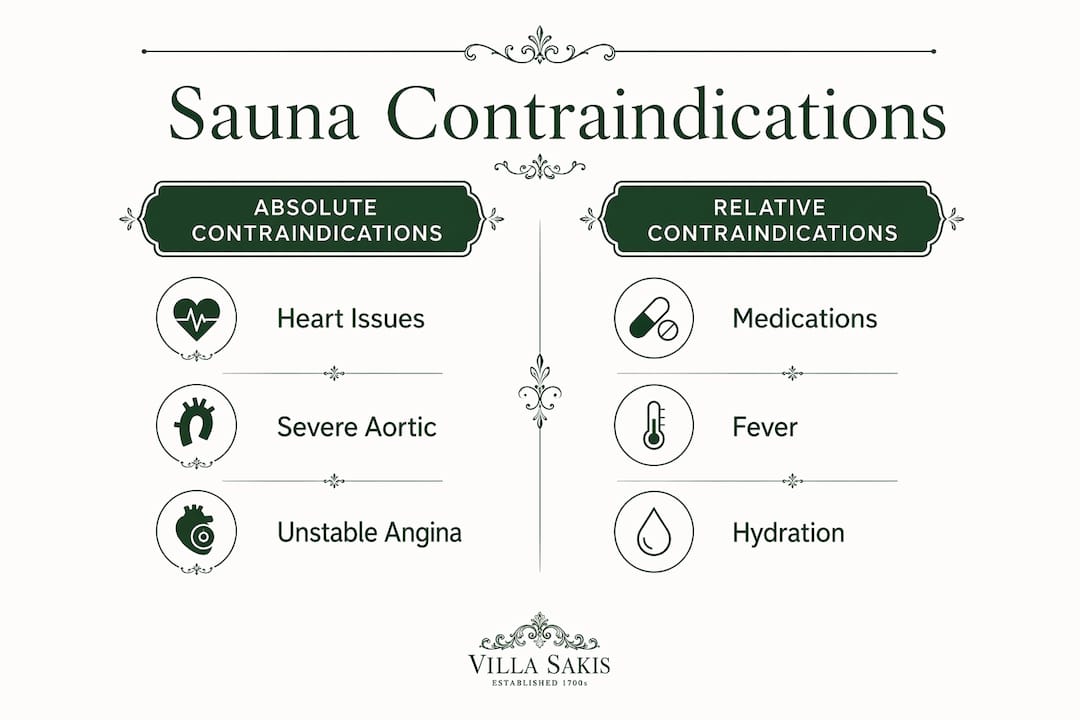
The conditions that constitute absolute contraindications, where you must not use a sauna until a cardiologist or clinician has cleared you, are:
-
Unstable angina — heat sharply increases cardiac workload
-
Decompensated heart failure — the heart cannot meet the added demand
-
Severe aortic stenosis — the valve cannot handle increased flow
-
Recent myocardial infarction — Brown University Health guidance notes that two weeks is a minimum before considering return, and only when the condition is stable and symptoms controlled
-
Recent stroke — the cardiovascular system needs time to recover
-
Hypertrophic obstructive cardiomyopathy (HOCM) — outflow obstruction worsens under heat-induced vasodilation
-
Recent major cardiac surgery or invasive cardiac procedures
Waiting periods after a cardiac event are always individualised. Finnish and European cardiology guidance typically references several weeks to months depending on the event and recovery trajectory. Never self-assess the timeline; that decision belongs to your cardiologist.
Which conditions are relative contraindications?
Relative contraindications are conditions that do not automatically rule out sauna use but require individual medical advice before you proceed. The key distinction is stability: a condition that is absolute when unstable can become relative once the clinical picture is settled, though reintroduction is typically at lower temperatures and shorter durations.
Common relative contraindications include:
-
Controlled but treated hypertension
-
Stable coronary artery disease
-
Controlled atrial fibrillation
-
Diabetes with peripheral neuropathy
-
Pregnancy, particularly the first trimester (elevated core temperature during early foetal development carries real risk)
-
Epilepsy or seizure disorder
-
Chronic kidney disease
-
Adults over 65 with no prior sauna experience
-
Low blood pressure
Medication interactions deserve particular attention. Several drug classes alter how your body responds to heat:
-
Diuretics (furosemide, hydrochlorothiazide) compound fluid loss significantly
-
Beta-blockers blunt the heart-rate response, masking early warning signs
-
Anticholinergics inhibit sweating, raising heat-stroke risk
-
Some antidepressants (tricyclics, MAOIs, lithium) affect thermoregulation
-
Anticoagulants (warfarin, apixaban) warrant a prescriber check
-
Stimulants (ADHD medications, pseudoephedrine) increase cardiovascular stress
-
Transdermal patches (nicotine, nitroglycerin) can have increased systemic absorption in high heat, risking unintended overdose
Pro Tip: Before your trip, take your medication list to a pharmacist and ask specifically about heat exposure. It takes five minutes and removes a genuine uncertainty.

When should you skip the sauna today?
Even guests with no chronic conditions should delay a session when certain same-day factors apply. Sauna exposure can lead to substantial fluid loss through sweating, and a body already under systemic stress from illness or dehydration cannot safely absorb that additional burden.
Avoid the sauna on any day when you have:
-
An active fever or acute infection (respiratory, gastrointestinal, or otherwise)
-
Severe dehydration, recent vomiting, or diarrhoea
-
Alcohol or recreational stimulants in your system. Alcohol and stimulants greatly raise the risk of thermoregulatory failure and sudden death when combined with heat.
-
A hangover (residual dehydration and impaired judgement still apply)
The practical rule: wait until your fever has been gone for 24–48 hours without medication, rehydrate fully before considering a session, and treat alcohol as a complete prohibition before and during sauna use, not a matter of moderation.
Practical safety rules for your private-rental sauna
A private sauna in a historic farmhouse is a different setting from a supervised spa. There is no attendant, and the responsibility for safe use rests with you. These rules are short enough to read on arrival.
Session and hydration guide
| User | Recommended session length | Hydration after |
|---|---|---|
| First-time adult | 5–10 minutes | 2–4 glasses of water |
| Healthy adult | Up to 20 minutes | 2–4 glasses of water |
| Child (supervised, aged 6+) | Up to 15 minutes | Water immediately after |
| Guest with a relative contraindication | As directed by clinician | Extra fluids; electrolytes if advised |
Arrival checklist
-
Locate the sauna controls and confirm the temperature range before heating.
-
Check for posted safety instructions or a host information sheet.
-
Confirm you have mobile reception or a way to contact the host quickly.
-
Identify the nearest first-aid kit.
-
Note the host’s emergency contact number and the address of the nearest hospital.
-
Never use the sauna alone if you have any medical risk factor.
-
Cool down gradually after a session. Rapid cold immersion can provoke dangerous blood-pressure surges or arrhythmias in people with cardiovascular conditions; a gentle cool-down is safer.
-
Wear footwear to and from the sauna to reduce slip risk.
-
Children must be supervised at all times and should not exceed 15 minutes.
-
Pregnant guests should consult their midwife or GP before using the sauna.
What are the warning signs, and what should you do?
Leave the sauna immediately and move to a cool area if you or anyone in your party experiences:
-
Chest pain or tightness
-
Severe shortness of breath
-
Sudden, severe dizziness or faintness
-
Confusion or loss of consciousness
-
Seizure
-
Persistent vomiting
If chest pain, collapse, or breathing difficulty occurs, call 999 immediately. Do not wait to see if symptoms pass. While waiting for help: lie the person down with legs slightly elevated if they are faint or dizzy, loosen tight clothing, and offer small sips of cool water only if they are fully conscious. The UK emergency number is 999.
For milder symptoms such as light-headedness or nausea, exit the sauna, sit quietly in a cool space, and sip water slowly. Contact the host if symptoms do not resolve within a few minutes.
Questions to ask your host before you book or arrive
A short conversation with your host before arrival can resolve most safety uncertainties. Ask:
-
Is the sauna private, or shared with other guests?
-
What is the maximum temperature, and how is it controlled?
-
Are written safety instructions posted in or near the sauna?
-
When was the sauna last serviced or inspected?
-
What is the cleaning protocol between guest stays?
-
Is there a prohibition on alcohol in or near the sauna?
-
Are children permitted, and is there an age limit?
-
Can the sauna be used after dark, and is solo use permitted?
-
What is the host’s emergency contact number, and how far is the nearest hospital?
-
Can you request a brief safety orientation on arrival?
Villa Sakis and guest sauna safety
Villa Sakis is an 18th-century Swedish log farmhouse with a private sauna, set within pine forest and meadow in Bergslagen. Because the property is booked as a whole house, your sauna use is entirely private. Safety guidance is available on arrival, covering session lengths, hydration, and cooling procedures. Guests with relevant medical conditions are warmly encouraged to disclose these before arrival so the host can advise appropriately and ensure the right information is to hand. The host is reachable throughout your stay for any questions or concerns.
Key takeaways
Absolute sauna contraindications require clinician clearance before use; same-day factors such as fever, alcohol, and severe dehydration apply to everyone regardless of baseline health.
| Point | Details |
|---|---|
| Absolute contraindications | Unstable angina, decompensated heart failure, severe aortic stenosis, recent MI or stroke: avoid until a clinician clears you. |
| Same-day avoiders | Skip the session if you have a fever, alcohol in your system, or are severely dehydrated. |
| Session and hydration | First-timers: 5–10 minutes; healthy adults: up to 20 minutes; drink 2–4 glasses of water after. |
| Medication check | Diuretics, beta-blockers, anticholinergics, and transdermal patches all warrant a prescriber review before sauna use. |
| Villa Sakis | A private historic farmhouse with a private sauna; safety guidance and host support are available throughout your stay. |
A note on caution and comfort
There is a tendency, when reading safety guidance, to treat it as either irrelevant or alarming. Neither response serves you well. The evidence on regular sauna use is genuinely encouraging for most healthy people, and cardiologists increasingly recognise that stable, well-managed heart disease is not the same as unstable disease. What the research does not support is the assumption that a positive population-level association translates into unconditional safety for every individual. The dividing line is always stability and clearance, not diagnosis alone. If you are uncertain, the conservative choice is not weakness; it is good judgement. A restorative stay in the Swedish countryside will still be restorative without a sauna session on day one.
A private sauna, thoughtfully

Villa Sakis offers something that most wellness stays cannot: a genuinely private sauna in a centuries-old farmhouse, surrounded by forest and meadow, with no shared facilities and no timetable. For guests who have read this guidance and are ready to plan their stay, the house details and availability are straightforward to check. If you have safety questions before booking, the host is glad to answer them directly. This is a place designed for slow, considered rest, and that ethos extends to how the sauna is offered and supported.
Useful sources
| Source | What it contributes |
|---|---|
| Brown University Health — Saunas and Your Heart | Absolute contraindications list, post-MI waiting guidance, and precautions for guests with heart disease |
| PubMed — sauna contraindications review | Clinical basis for absolute contraindications and transdermal patch absorption risk in heat |
| Harvard Health — saunas and your health | Physiological rationale: pulse rate, skin temperature, and blood-pressure response to heat |
| PMC review — sauna safety and cardiovascular considerations | Stability as the key clinical factor; cold-immersion risk after sauna |
| Healthline — how long should you stay in a sauna? | Session-length and hydration guidance for first-timers and healthy adults |
| Poison.org — toxicology and sauna safety | Alcohol and stimulant risk; thermoregulatory failure and sudden death |
| WebMD — saunas and your health | Older adults and children: supervision and conservative approach |
| Villa Sakis — the house | Property-specific details: private sauna, farmhouse layout, and host contact |
This article is general information, not medical advice. Confirm your own situation with a qualified clinician or your GP before using a sauna, particularly if you have any of the conditions described above.