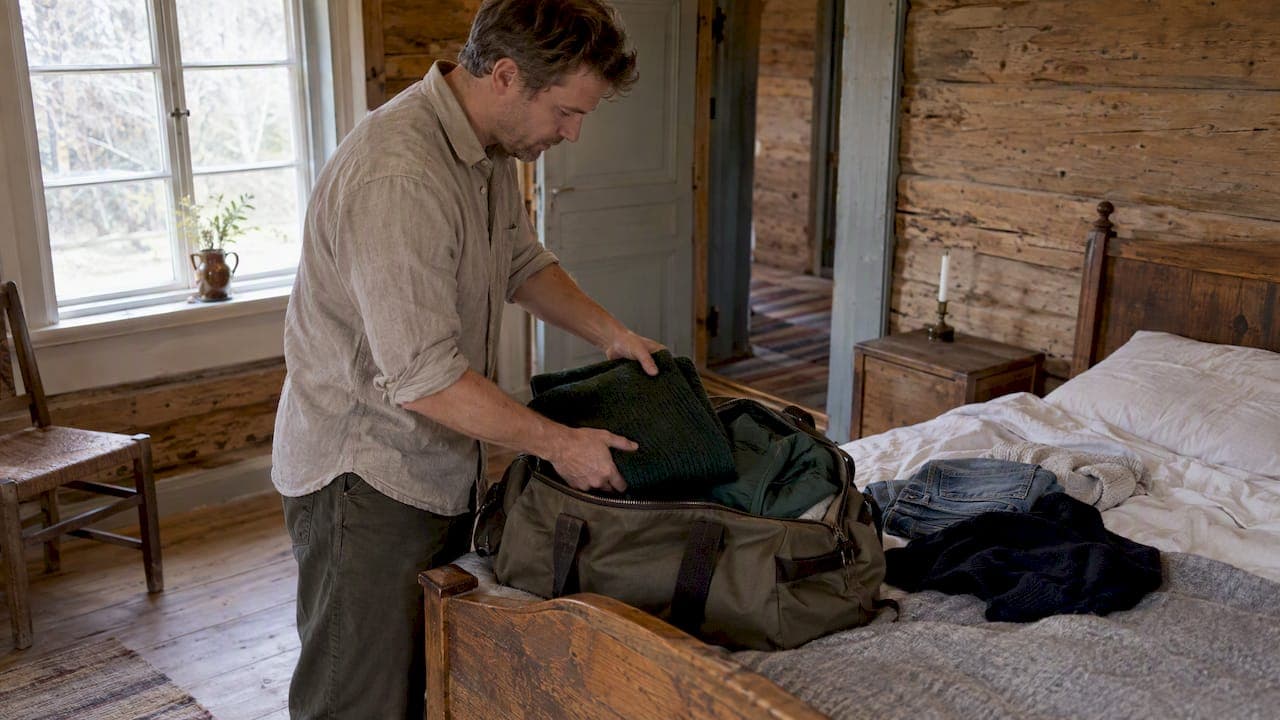
A self-catering stay in the Swedish countryside asks for less than you think, but it asks for the right things. Bring the small kitchen items that make cooking pleasant, wool and layers for changeable weather, a few things for the sauna and the lake, and a paper copy of the essentials. Leave the rest at home. Below is the list we hand to guests who book the whole farmhouse, with the reasoning behind it.
TL;DR
- Self-catering means you shop, cook and clean for yourselves: pack a short kitchen kit, a first food shop and a few spare basics, and confirm in advance what the house already provides.
- Choose wool and layers over cotton and quantity. A lighter bag leaves room for the slower pace you came for.
- For sauna and lake days, pack swimwear, a quick-drying towel if towels are not supplied, and sandals for wet stones and boards.
- Keep key contacts and directions on paper, and bring a powerbank and a headlamp: signal and power can be less dependable in a remote place.
- Learn the basics of the Swedish right of public access and of fire safety before you arrive. Both shape what you bring.
Table of Contents
- What self-catering really means in the countryside
- The kitchen: what to bring and what to buy on arrival
- Clothing: wool, layers and fewer items
- Sauna, lake and recovery
- Children, friends and mixed groups
- Evenings without a screen
- Safety and preparedness kit
- Outdoors: what to know before you walk out the door
- What to leave at home
- Our view: pack for the pace, not the plan
- A short checklist to print
- Stay with us
- FAQ
- Sources
What self-catering really means in the countryside
In a hotel, someone else has thought about breakfast. In a self-catering house, you have. The kitchen is yours, the table is yours, and the rhythm of the day is set by what you decide to cook and when. For many of our guests that is the whole appeal: a morning with porridge on the stove, an afternoon on the meadow, an evening in the sauna and a simple supper afterwards.
The practical consequence is that a self-catering packing list differs from a holiday list in three ways. It leans towards the kitchen, it plans for distance from the nearest shop, and it assumes you will be indoors, outdoors and in the water on the same day.
Before anything else, read your booking confirmation and house information closely. Houses differ in what they supply: bed linen, towels, cleaning products, kitchen staples. Do not assume. Ask the host, and pack to fill the gaps rather than duplicate what is already there.
The kitchen: what to bring and what to buy on arrival
A well-equipped kitchen still benefits from a few personal touches. Think of these as your small kit, not a full removal van.
Small items worth carrying
- A sharp paring or chef's knife you trust, wrapped safely
- Your preferred coffee or tea method, whether that is a filter, a stovetop pot or a tin of loose leaves
- Reusable containers and a few zip bags for leftovers and picnics
- A flask for lake and forest outings
- Tea towels and a dishcloth you like
- A corkscrew and bottle opener, which are easy to forget
- A small pepper mill and your favourite spices, since a fresh jar of everything adds cost and waste
The first food shop
Plan your first meal before you leave home, and buy the rest close to the house. Arriving tired with nothing to eat is the quickest way to spoil a first evening, so bring a simple supper in a cool bag: pasta, a jar of sauce, bread, cheese. Then shop properly the next morning.

If you want ideas for the week, our host-tested seven dinners for self-catering holidays and the weekly meal plan for a cabin holiday show how to shop once or twice rather than daily. Both are written around the way people actually cook on holiday: a few good staples, one or two ambitious meals, and plenty of leftovers.
A useful habit is to write the week's dinners on paper before shopping, then buy only what those dinners need plus breakfast and lunch basics. Countryside shops are fewer and further apart than in a city, so a list saves a second drive.
Pantry staples
Check with your host what is in the cupboards. If it is unclear, bring small quantities of oil, salt, flour, sugar and a stock cube or two. Do not carry kilos of anything. It is simpler to buy small packets near the house.
Clothing: wool, layers and fewer items
The Swedish Tourist Association (STF) builds its packing advice on layers: wool next to the skin, a fleece or softshell middle layer, and a waterproof shell. That guidance is written for mountain hiking with children, so you will not need hiking-level gear for a farmhouse stay, but the principle carries over beautifully to forest walks and cool evenings by the water.

Wool also deserves the place it has been given in the research: cotton cools the body when damp, while wool, merino especially, keeps its warmth when wet and resists odour. That matters when laundry is limited and you want to wear a favourite layer twice.
A sensible clothing core
| Item | Quantity | Why |
|---|---|---|
| Wool or merino base layers | 2 to 3 | Warm when damp, less washing |
| Fleece or wool jumper | 1 to 2 | Evenings, early mornings, after the sauna |
| Waterproof jacket | 1 | Rain can arrive at any time of year |
| Walking trousers or comfortable outdoor trousers | 1 to 2 | Forest and meadow paths |
| Indoor clothes and soft trousers | 2 | A house stay is largely indoors |
| Wool socks | 4 or more | Cold floors, wet grass, walking |
| Walking shoes or boots | 1 pair | Uneven, sometimes damp ground |
| Indoor slippers or thick socks | 1 pair | Old timber floors can be cool |
| Hat and light gloves | 1 each | Useful outside high summer |
STF's experience is that people tend to pack too many clothes. Their own rule of thumb for a multi-day hike is a pack of no more than roughly 10 to 14 kg, about 20 per cent of body weight. You are travelling to a house, not carrying everything on your back, but the lesson holds: if you cannot name when you would wear it, leave it behind.
Packing cubes or mesh bags help a great deal in a shared house. Give each person one for clean clothes and one for worn, and the house stays orderly without effort.
Sauna, lake and recovery
A private sauna and a lake nearby change what you pack. If you are staying with us, both are part of the stay, so a few specific items are worth bringing.
- Swimwear: one or two pairs, so one is always dry.
- Towels: a quick-drying towel for the lake and a larger one for the sauna. Confirm first what is supplied.
- Sandals or water shoes: useful on stones, jetties and wet boards.
- A sauna hat or head towel if you find the heat on the head uncomfortable.
- A reusable water bottle, since you should drink before and after the heat.
- A robe or a large wool jumper for the walk between the sauna and the house.
- A plastic bag for damp swimwear on the way back.
If the sauna is a main reason for your trip, our guide to a private sauna holiday in Sweden covers etiquette and routine in more detail. For the water, the host checklist for a lakeside stay in Sweden sets out what to look for and how to swim sensibly.
If you are combining training with your stay, add a pair of running shoes, a resistance band and a small mat. A meadow, a forest track and a lake make a surprisingly complete gym, and nothing needs to be heavy.
Children, friends and mixed groups
Whole-house stays suit families and groups because everyone has room. The packing then becomes a question of who brings what, so it helps to split the list rather than have each household pack everything.
For families, STF's own lists for children in the mountains are a good prompt for spare layers, even if your trip is gentler. The key points are an extra set of dry clothes per child, rain gear that actually fits and one comfort item for bedtime.
If you want a ready-made family version, we have written a separate packing list for a family cabin stay. For a wider North American perspective on a seasonal cabin checklist for families, one owner-written cabin packing list is worth a skim, though conditions in Sweden differ.
For groups of friends, agree a shared kit: one person brings board games, another the speaker and the coffee equipment, another the first-night supper. It reduces duplication and gives everyone a small role.
Evenings without a screen
A quiet house is easier to enjoy when you have something to do in it. We suggest a deck of cards, a paperback or two, a notebook and a puzzle. For children, our piece on offline activities for a family cabin offers ideas that do not rely on a connection.
This is also the moment to pack for digital rest. Bring a simple alarm clock so the phone can stay out of the bedroom, and a paper map or printed directions for the area.
Safety and preparedness kit
A remote house is a pleasure precisely because it is quiet and far from things. It also means help can be further away, and the Swedish Civil Contingencies Agency (MSB) is clear that fire safety rests on habits as much as on equipment. That brief guidance is written for campers but applies to anyone sleeping away from home.
A small kit is enough:
- A basic first-aid kit with plasters, bandages and antiseptic, plus any personal medication.
- A headlamp or torch with spare batteries. MSB's list for being self-sufficient for a week includes headlamps with extra batteries.
- A powerbank for your phone, which MSB also lists.
- Important contacts on paper, since MSB advises keeping them off-device in case of power or network failure.
- A bottle or two of drinking water for the first evening, if you are unsure of the supply.
- A battery or hand-crank radio, optional, but listed by MSB for preparedness.
This is not about expecting trouble. It is about arriving prepared so that you can then forget about it.
On arrival
MSB advises guests to locate fire extinguishers, fire blankets and exits as soon as they arrive, and not to assume that equipment works without a quick visual check. In a house that has stood since the 1700s, we would add: ask your host where the fire equipment is, and look at it together.
If you plan to use a fireplace or grill, bring dry wood or buy it locally, and keep fuel at least three metres from open flames, as MSB recommends. Used grill charcoal can stay a fire risk for up to three days, so it belongs in a non-combustible container outside. Never leave candles or cooking unattended, and charge devices on hard, non-flammable surfaces, as MSB's guidance advises.
Outdoors: what to know before you walk out the door
Sweden's right of public access, allemansrätten, lets you walk, swim and pass through the countryside freely, provided you show consideration. The Environmental Protection Agency describes it as a shared responsibility, not simply a free pass.
In practice, that means a few things for your list and your habits:
- Keep a respectful distance from private homes. Do not bathe, anchor or stay too near them, as the agency's rules on open fires and public access set out.
- Check signs in nature reserves and national parks, where fires or tents can be prohibited.
- Keep dogs leashed where required.
- If you plan to forage, remember the right does not cover everything: moss, lichen and bark from living trees are not included, and some plants are protected, according to the agency's questions and answers.
We have written a separate guide to the right to roam for farmhouse guests, which is worth reading the evening before you travel. Practical items to pack: a small rucksack, a refillable bottle, a bag for litter, insect repellent in summer, and a small pocket knife you are comfortable carrying.
What to leave at home
The best self-catering list is as much about subtraction as addition. STF's guidance favours durable, multi-purpose gear over items bought for rare scenarios, and a lighter pack leaves attention free for the scenery and silence.
Leave behind:
- Formal clothes, unless you have a specific occasion
- Multiple pairs of heavy shoes
- Full-size toiletries when travel sizes will do
- Appliances the kitchen already has
- Too many electronics. One tablet and one e-reader is plenty.
Our view: pack for the pace, not the plan
We have hosted enough stays to see the pattern. Guests who arrive with a bulging boot and a tight itinerary spend the first two days unpacking and the next two catching up on what they meant to do. Guests who arrive with a modest bag, a supper in a cool box and a wool jumper settle in by the first evening.
The farmhouse has been looked after by generations, and it asks for a certain kind of visitor: one who is happy to light the stove, cook slowly and walk to the water. Our advice is to pack for the day you hope to have. A thermos, a book, a towel for the lake, a layer for the evening. Everything else, you will either find in the house or realise you did not need.
Treat the list below as a starting point and cross out whatever does not apply to your group. The house will do the rest.
— Christian
A short checklist to print
- Booking confirmation, address and directions on paper
- Emergency contacts on paper, plus medication and first-aid kit
- Headlamp or torch, powerbank, spare batteries
- Supper for the first night, coffee or tea, small staples
- Knife, tea towels, containers, flask, bottle opener
- Wool base layers, jumpers, waterproof jacket, wool socks, walking shoes
- Swimwear, towels if not supplied, sandals, water bottle
- Books, cards, notebook, alarm clock
- Litter bag, insect repellent, small rucksack
Stay with us
If this list sounds like the kind of week you want, our 18th-century log farmhouse is available as a whole-house stay, with a private sauna, lake access, a self-catering kitchen and direct access to forest and meadows. You can see the rooms on the house page and check dates on our booking page. For what to expect from the region and the season, our journal piece on a Swedish countryside vacation is a good next read.
FAQ
What is the most important thing to bring to a self-catering house?
A plan for the first meal and the right layers. A simple supper means you can relax on arrival, and wool plus a waterproof shell cover most weather. Everything else can usually be bought or borrowed nearby.
Do I need to bring bed linen and towels?
That depends on the house, so check your booking confirmation or ask the host before you pack. Do not assume either way. If towels are not supplied, bring one quick-drying towel for the lake and a larger one for the sauna.
How much food should I bring from home?
Bring a first-night supper and a few small staples such as coffee, tea, spices and oil, then buy fresh food locally. Countryside shops can be a drive away, so write a dinner list before you shop to avoid a second trip.
Can I pick berries, mushrooms and flowers freely?
Not everything. The right of public access does not cover moss, lichen, bark from living trees or some protected plants, according to the Environmental Protection Agency. Check local restrictions if foraging is part of your plan.
Sources
- MSB: Sju dagar (self-sufficiency for a week)
- MSB: Brandsäker camping
- MSB: Checklista för säkerhet
- STF: Packlista fjällvandring med barn
- STF: Packlista fjällen med barn, vinter
- STF: Packlistor för vandring och friluftsliv
- Naturvårdsverket: Allemansrätten
- Naturvårdsverket: Eldning och allemansrätt
- Naturvårdsverket: Frågor och svar om allemansrätten