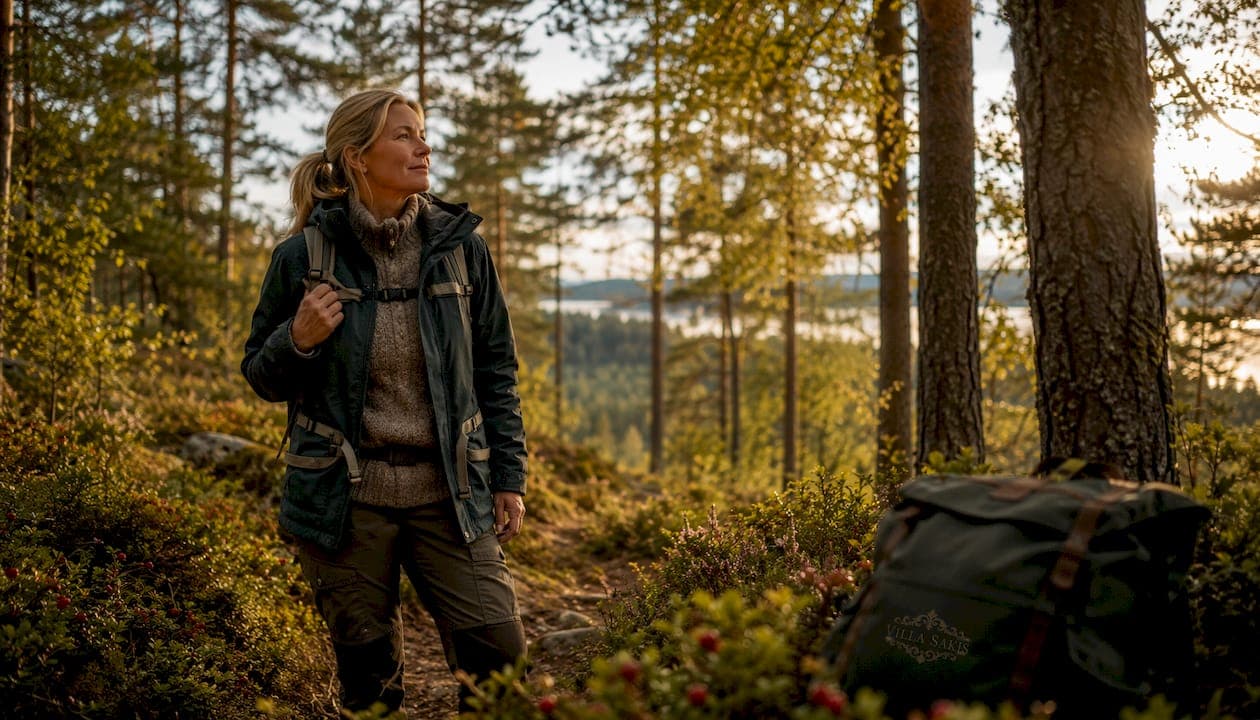
Allemansrätten, Sweden's right of public access, lets you walk, cycle, picnic, pick berries and mushrooms, swim, and camp on almost any land in Sweden, including privately owned countryside, provided you cause no harm and show respect. Hunting is excluded entirely. Most fishing requires a licence, though rod fishing is free along the entire coastline and on Sweden's five largest lakes: Vänern, Vättern, Mälaren, Hjälmaren, and Storsjön. Motor vehicles are never covered. If you are staying at a private rural rental such as Villa Sakis, the same rules apply to you as to any member of the public; booking the property does not extend your access beyond what Allemansrätten already permits.
Quick reference: dos and don'ts
- Do walk, hike, cycle, swim and rest on open land and water
- Do pick berries, mushrooms and flowers that are not protected species
- Do pitch a tent for one or two nights, well away from any dwelling
- Don't enter private gardens, cultivated fields or the private zone around a house
- Don't drive or park any motor vehicle off a public road or designated driveway
- Don't light fires without checking local rules, and never during dry-weather bans
Table of Contents
- What the freedom to roam in Sweden actually permits
- Where the right to roam does not apply
- Practical etiquette for guests at a private rental
- When you need a licence or permission
- How national parks and nature reserves change the rules
- Safety, seasonal hazards, and emergency contacts
- A pre-stay checklist for UK visitors renting a Swedish farmhouse
- Fishing and hunting exceptions and licences
- Camping near a private rural rental: distances and durations
- Using private roads and access ways during your stay
- Waste disposal and toilet use in nature
- Pet control beyond dogs
- Minimising disturbance to landowners and livestock
- What happens if you break the rules
- Key takeaways
- A host's perspective on using the land around Villa Sakis
- Stay at Villa Sakis and roam the surrounding countryside responsibly
- Useful sources and where to check local rules
What the freedom to roam in Sweden actually permits
Allemansrätten is built on a single guiding principle that Naturvårdsverket describes as "don't disturb, don't destroy." You may walk, jog, cycle on established trails, ride a horse, ski, kayak, and swim almost anywhere. Lakeshores, forests, meadows, and open hillsides are all accessible. You may rest, picnic, and pick berries, mushrooms, and wildflowers freely, as long as the species are not protected under Swedish law.
Two scenarios come up regularly for guests at a farmhouse like Villa Sakis. Walking to a nearby lake through a neighbouring field is permitted, provided you keep to the edge of any cultivated area and leave no trace. Picking blueberries or lingonberries from the forest edge is equally fine; the berries belong to the landowner in a technical sense, but the law prevents any landowner from stopping you collecting them on land where access rights apply.
The shared-responsibility principle is worth holding in mind throughout your stay. Allemansrätten is not an absolute legal right; careless or damaging behaviour can create personal liability. Treat it as a privilege extended in good faith.
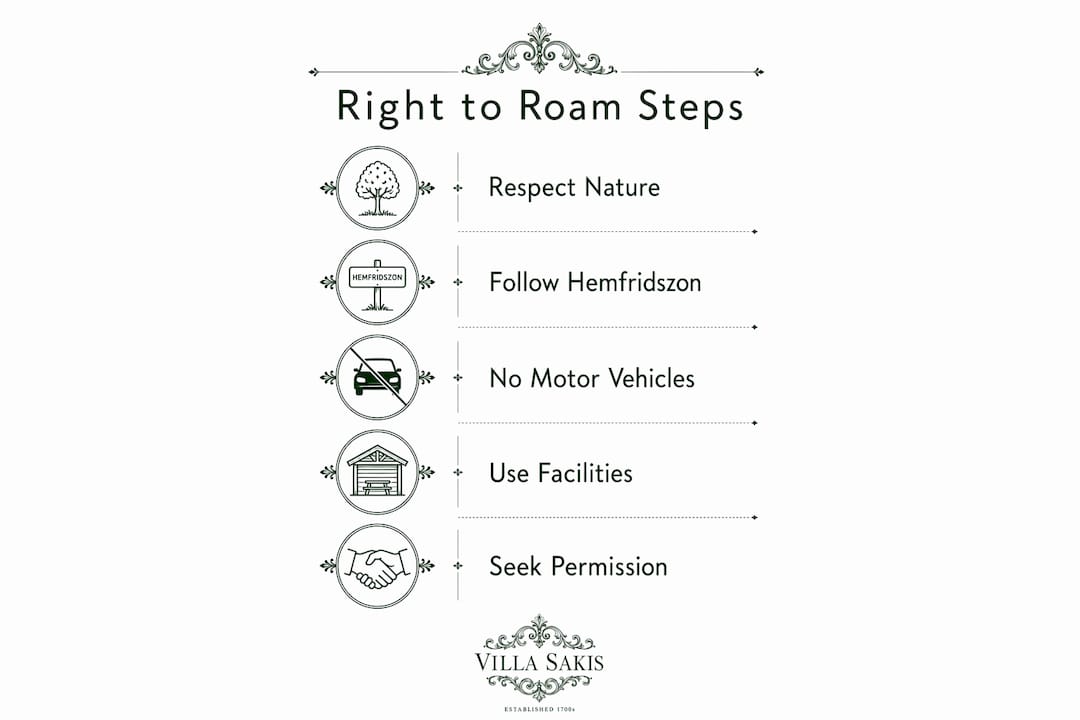
Where the right to roam does not apply
Several categories of land are off-limits, and guests at private rentals need to know each one clearly.
- Private gardens and the hemfridszon around any dwelling are excluded. This private protection zone is not a fixed distance; Naturvårdsverket guidance explains it varies with terrain and property layout. Many sources cite 70 metres, but in open ground the effective zone may be larger.
- Cultivated land — ploughed fields, crops, orchards, and kitchen gardens — must not be crossed or disturbed.
- National parks and nature reserves can restrict or expand general access rules; always check entrance signs and local authority websites before camping, lighting fires, or bringing dogs.
- Motor vehicles are prohibited on natural ground under the Terrängkörningslagen (terrain driving law). This includes campervans, ATVs, mopeds, and electric bicycles used off-road.
- Hunting is excluded entirely from public access rights.
- Most fishing requires a licence, with the coastline and five-lake exception noted above.
Misuse carries real consequences. Naturvårdsverket is clear that damaging behaviour can lead to liability, and landowners may report violations to the police under the Swedish Penal Code.
Practical etiquette for guests at a private rental
The most useful rule is simple: ask before you do anything that affects your host's land or privacy. When you arrive at a property such as Villa Sakis, take a few minutes to confirm where the grounds end and open countryside begins. Hosts know their land better than any map.
For everyday behaviour, keep these points in mind:
- Use established paths where they exist; avoid cutting across wet or fragile ground
- Keep noise low, particularly near the dwelling in the early morning and evening
- Do not collect firewood from the host's land without asking
- Leave a tent site exactly as you found it, including removing all pegs and guy ropes
- Park only on the host's designated driveway or a public road
Pro Tip: The hemfridszon on a rural property is often marked by natural features such as changes in ground cover, ditches, lines of trees, or hedges rather than fences. If the boundary is unclear, ask your host on arrival rather than guessing.
Booking a property does not expand your access rights beyond what Allemansrätten already grants the general public. Guests and hosts share an interest in keeping the surrounding land in good condition.
When you need a licence or permission
The one-sentence rule: if your activity affects property, wildlife, or is commercial or organised, you almost certainly need permission or a licence.
Specific cases requiring permission or a licence:
- Fishing with nets, trolling lines, or on salmon coasts requires a local fishing licence; check with the county administrative board (länsstyrelsen) or the host for local suppliers
- Organised tours or paid outdoor activities on another's land need landowner consent and may need a permit
- Multiple tents or stays beyond one to two nights in the same spot require the landowner's permission
- Collecting protected plant or fungal species is prohibited without a specific permit
| Water | Rod fishing without licence? | Notes |
|---|---|---|
| Entire Swedish coastline | Yes | Hand gear only |
| Vänern, Vättern, Mälaren, Hjälmaren, Storsjön | Yes | Hand gear only |
| All other inland lakes and rivers | No | Local licence required |
| Salmon coasts (certain areas) | No | Specific permit required |
Source: Naturvårdsverket fishing guidance
How national parks and nature reserves change the rules
Protected areas can both restrict and, occasionally, expand what Allemansrätten permits, so always check before you act. Typical restrictions in national parks include bans on open fires, requirements to keep dogs on leads throughout the year, and designated camping areas only. Nature reserves often post their specific rules at entrance points and on the relevant county or municipal website.
The Swedish Tourist Association advises checking local information before lighting fires or camping in any sensitive area. Municipal rules near towns and water can add further restrictions that are not obvious from the general law.
Safety, seasonal hazards, and emergency contacts
Keep a charged phone, tell someone your planned route, and have your host's number saved before you head out. Swedish countryside is generally safe, but a few seasonal hazards deserve attention.
- Ticks are active from spring through autumn; wear long sleeves, use repellent, and check skin after walks in long grass or woodland
- Ice on lakes and paths in winter can be deceptive; ask locals about current conditions before venturing onto frozen water
- Forest fire risk rises sharply in dry summers; check the Swedish Meteorological and Hydrological Institute (SMHI) fire-risk forecast before lighting any fire outdoors
- Livestock encounters are common near farmhouses; move calmly, keep dogs close, and never walk between a cow and her calf
- Safe drinking water from streams is not guaranteed; carry your own or use the farmhouse supply
In a life-threatening emergency, call 112 for Swedish emergency services. For non-urgent incidents, contact your host first; they can advise on local medical centres, the nearest pharmacy, or the municipal authority.
A pre-stay checklist for UK visitors renting a Swedish farmhouse
Plan before you pack. A short conversation with your host before arrival saves confusion on the ground.
Questions to ask your host:
- Where do the property grounds end?
- Is there a fire policy, and are outdoor fires permitted on site?
- Which paths or tracks are open to guests?
- Is there a local fishing licence supplier nearby?
- Where should guests park additional vehicles?
What to pack:
- Clothing layers (Swedish weather changes quickly, even in summer)
- Insect repellent and a tick-removal tool
- A portable camp stove (avoids the need for open fires in sensitive areas)
- Waste disposal bags and a small trowel for outdoor toilet use
- A basic first-aid kit
- Dog lead and waste bags if bringing a pet
For transport, park only on public roads or the host's driveway. Off-road parking on meadows, forest tracks, or beaches is illegal under Swedish terrain driving law, regardless of how remote the spot appears.
Fishing and hunting exceptions and licences
Hunting has no place within Allemansrätten. It requires a separate licence and landowner permission in every case, and guests at private rentals should not assume any hunting rights come with their booking.
Fishing is more nuanced. Rod fishing and hand-gear fishing are free along the full Swedish coastline and on the five largest lakes listed above. Everywhere else, a local licence is needed. Licences are typically available from local sports shops, petrol stations, or online through the county administrative board. Your host at a rural property can usually point you to the nearest supplier. For salmon fishing on designated coastal stretches, a specific permit applies regardless of the method used.
Camping near a private rural rental: distances and durations
The general rule is one to two nights in any single spot, well away from the nearest dwelling. The Swedish Tourist Association advises that tents should be placed well away from houses, and that multiple tents or extended stays require the landowner's permission. There is no single prescribed metre distance in the law; the hemfridszon around the dwelling is the practical guide, and on open terrain that zone may extend beyond the commonly cited 70 metres.
When staying at a farmhouse such as Villa Sakis, do not pitch a tent within the property's own grounds without asking. If you want to camp on open land nearby, keep a generous distance from any building, take everything with you when you leave, and check whether the land falls within a nature reserve with its own camping rules.
Using private roads and access ways during your stay
Private roads may be used on foot or by bicycle unless a sign explicitly prohibits it. Motor vehicles are a different matter: a private road can be closed to motor traffic by the landowner, and a sign saying "Enskild väg" (private road) with a vehicle prohibition means exactly that. Do not assume that driving to a scenic spot along an unmarked track is permitted; when in doubt, park on the public road and walk.
Guests at Villa Sakis should use the host's designated access route for vehicles and confirm on arrival whether any other tracks on or near the property are open to foot traffic.
Waste disposal and toilet use in nature
Carry all rubbish out with you. Allemansrätten carries a clear leave-no-trace expectation, and leaving litter on someone's land can constitute a violation. For toilet use in nature, move well away from any watercourse, path, or dwelling, dig a small hole with a trowel (roughly 15–20 cm deep), and bury waste fully. Carry used paper out in a sealed bag rather than burying it, as paper degrades slowly in cold or dry conditions.
Near a private farmhouse, always use the property's facilities where available. Outdoor toilet use should be a last resort, kept well away from the hemfridszon and any water source.
Pet control beyond dogs
Dogs must be kept on a lead from 1 March to 20 August to protect ground-nesting birds and young wildlife. Outside that period, dogs may run free on open land, but must be under control near livestock at all times. If a dog disturbs or chases livestock, the owner is liable.
Other pets brought to a rural property, such as cats, should be kept indoors or on a lead near farmland and woodland. Cats that roam freely can disturb ground-nesting birds and small mammals, and in some protected areas any free-roaming domestic animal may be prohibited. Check with your host and any local nature reserve rules before allowing pets outdoors unsupervised.
Minimising disturbance to landowners and livestock
The practical standard is simple: behave as a considerate guest, not as someone exercising a legal entitlement. Pass through fields at the edges, not across the middle. Close any gate you open. Give livestock a wide berth and never walk between a mother animal and her young. Keep voices and music low near farmhouses, particularly in the early morning and evening.
When walking near Villa Sakis or any private rural property, the host's daily life continues around you. A brief word of acknowledgement if you encounter the host or neighbouring farmers goes a long way. The spirit of Allemansrätten is mutual care, not extraction.
What happens if you break the rules
Allemansrätten is not an absolute right, and violations can have real consequences. Entering a private garden or the hemfridszon without permission is a trespass under the Swedish Penal Code. Damaging cultivated land, cutting trees, or leaving litter can result in a civil claim for damages from the landowner. Driving off-road is a criminal offence under the Terrängkörningslagen, carrying fines and potential confiscation of the vehicle. Fishing without a licence where one is required can result in a fine from the county administrative board.
For guests at a private rental, the most common source of conflict is misreading the hemfridszon boundary or assuming that a booking extends private access. Neither leads to a criminal record in most cases, but both can damage the relationship with your host and, in serious cases, result in a formal complaint. The simplest protection is to ask before you act.
Key takeaways
Allemansrätten gives visitors broad outdoor access in Sweden, but the hemfridszon, motor vehicle prohibition, and fishing licence rules are the three limits most likely to affect guests at a private rural rental.
| Point | Details |
|---|---|
| Core permission | Walk, cycle, swim, pick berries and mushrooms, and camp briefly on almost any land. |
| Hemfridszon caution | The private zone around a dwelling varies with terrain; ask your host to clarify the boundary on arrival. |
| Fishing and hunting | Rod fishing is free on the coastline and five largest lakes; all other waters need a local licence; hunting is always excluded. |
| Motor vehicles | Off-road driving and parking are illegal under Swedish terrain driving law; use public roads or the host's driveway. |
| Villa Sakis | Guests are encouraged to explore the surrounding grounds and forest responsibly; the host will clarify boundaries and local rules on arrival. |
A host's perspective on using the land around Villa Sakis
There is something worth saying plainly to guests who arrive curious about the land around them. Allemansrätten is generous, and the forests and meadows here are genuinely open to you. What we ask is that you carry that freedom lightly.
The Villa Sakis journal has written at length about what a Swedish countryside stay asks of its guests: a slower pace, a quieter footprint, and a willingness to observe before acting. The historic log farmhouse has stood since the 1700s partly because each generation has treated the surrounding land with care. That continuity matters.
On arrival, please ask about the property boundaries. The hemfridszon around the house is not marked by a fence, and in open meadow it extends further than guests sometimes expect. For fires, always check the current fire-risk forecast and ask us directly; we will tell you honestly whether conditions are safe. Take your rubbish with you from any walk. If you bring a dog, keep it on a lead near the meadows during the nesting season.
The land here rewards patience. Walk to the lake in the early morning, pick berries from the forest edge in the afternoon, and leave the place as quiet as you found it.
Stay at Villa Sakis and roam the surrounding countryside responsibly
For travellers who want to experience Allemansrätten from a base that already understands it, Villa Sakis offers something specific: a historic 18th-century log farmhouse in Bergslagen with direct access to forest, meadows, and a lake, and a host who will walk you through local boundaries and fire rules on arrival. There is no guesswork about where the hemfridszon ends or which paths are open to guests.
Check current availability at Villa Sakis and read what guests can expect from the surrounding landscape before you book. The property is available for whole-house rental, and the host is available to answer questions about local fishing licences, nature reserve rules, and seasonal conditions before your stay.
Useful sources and where to check local rules
Before your trip, a few minutes with these official sources will confirm any site-specific rules for fires, camping, and fishing.
- Naturvårdsverket: the right of public access — the primary English-language overview of Allemansrätten, including the shared-responsibility principle and key exclusions
- Naturvårdsverket handbook (English, A4) — detailed guidance on hemfridszon, motor vehicles, and organised activities
- Naturvårdsverket pocket guide — compact version covering the hemfridszon boundary question specifically
- Swedish Tourist Association: public access rights — practical traveller guidance on camping distances, mountain areas, and host advice
- Villa Sakis: Swedish countryside vacation guide — pre-arrival reading on what to expect from a stay in the Swedish countryside, written from the host's perspective
For protected areas, check the entrance signage on arrival and the relevant county administrative board (länsstyrelse) website for site-specific rules on fires, dogs, and camping. Municipal websites often carry seasonal fire bans and local access restrictions that are not reflected in the national guidance.