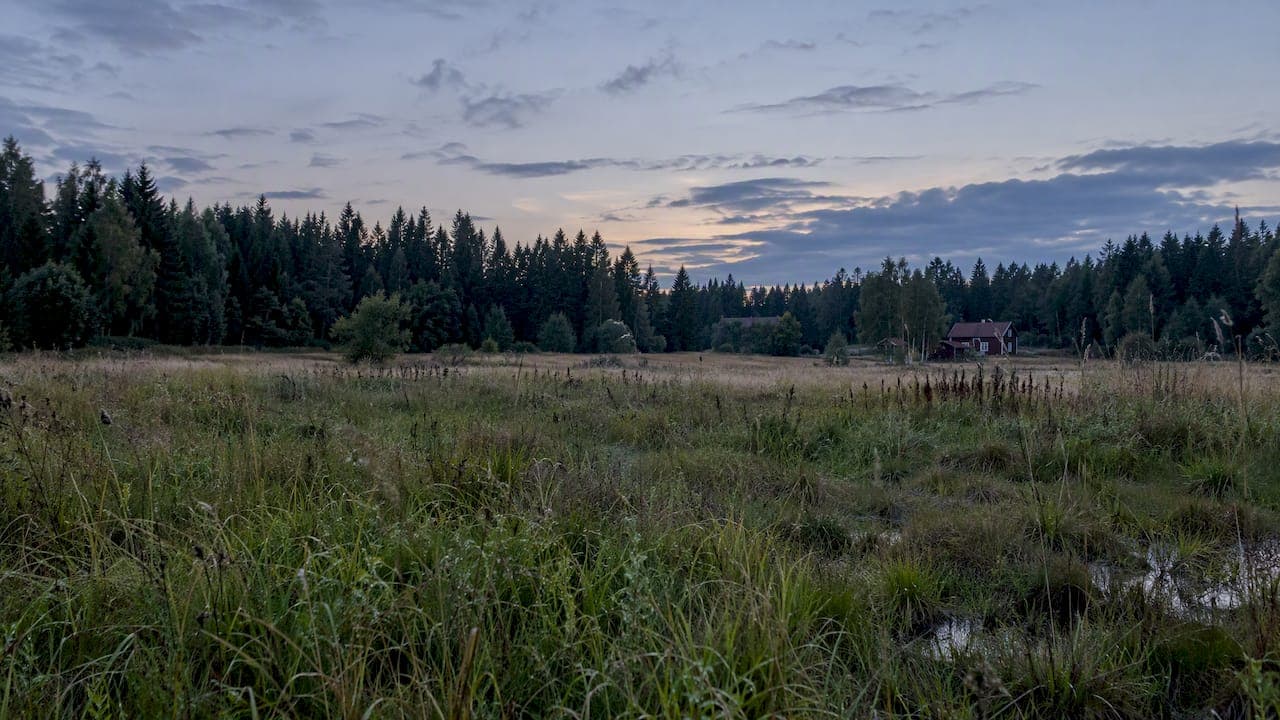
An evening routine in nature works because the landscape does much of the winding down for you. Light falls, the air cools, sound thins out, and the body takes the cue. All you need to add is a simple order of events: a last walk, something warm, dim light, no screens, and a bed that is dark, quiet and cool. Below we describe how we shape evenings at a Swedish countryside house, what the official sleep guidance supports, and what to know if you want to sleep outdoors under allemansrätten, the Swedish right of public access.
TL;DR
- Start the evening outdoors: a short walk at dusk, then dimmer light and no screens for about an hour before bed, as 1177 advises.
- Keep the order the same each night. Regular times matter more than any single ritual.
- Warmth is the centre of the evening: a sauna, a fire (where it is safe and permitted), a hot drink.
- Sleeping outside is possible in Sweden, but protected areas such as nature reserves have their own rules. Check before you go.
- With children, make the routine small and playful: a lantern walk, a song, a story, a last look at the sky.
Table of Contents
- Why evenings feel different in the countryside
- What the sleep guidance actually says
- A simple evening, hour by hour
- Evenings with children
- Evenings for couples and friends
- Fire, warmth and safety
- Sleeping outdoors in Sweden: what you can and cannot do
- Perspective: why we keep evenings plain
- Staying with us
- A sample evening, from dusk to bed
- Common obstacles and small fixes
- FAQ
- Sources
Why evenings feel different in the countryside
In a city, the evening is negotiated against street light, traffic and a phone that never closes. In the Swedish countryside, especially among meadows and pine forest, the day has a visible end. The sun drops behind the trees, the colours flatten, birdsong gives way to a few late calls, and the air over a lake or meadow turns cooler and damp.
That shift is the real material of an outdoor evening routine. You are not forcing relaxation. You are arranging a few small habits so that they line up with what the evening is already doing.
The habits themselves are not exotic. They are the same ones sleep guidance describes everywhere: a quiet hour before bed, lower light, a cool and dark bedroom, steady times. Nature simply makes them easier to keep, because there is less competing for your attention.
What the sleep guidance actually says
It helps to know which parts of an evening routine rest on evidence, so that you keep those and treat the rest as pleasure.
The Swedish health portal 1177 says adults usually need 7 to 9 hours of sleep and that regular habits can improve sleep health. It recommends winding down before bedtime, lowering the lighting and switching off screens about an hour before you go to bed.
Its sleep school adds two further points. If you have trouble sleeping, keep bedtime and rising time as regular as you can. And dimmed light in the evening, together with a dark, quiet and cool bedroom, can make it easier to fall asleep.
That gives us four anchors for any evening routine, indoors or out:
- A fixed rhythm: similar times each night.
- A wind-down hour with no screens.
- Low, warm light.
- A dark, quiet, cool place to sleep.
Everything else in this article is a way of arranging those four things in a pleasant setting. If you are trying to move your body clock after travel or a hectic season, evenings are only half the picture: the morning counts as much, and we write about that in shifting your sleep clock with morning light outdoors and in a two-week circadian reset plan.
A simple evening, hour by hour
This is a template, not a timetable. Shift it earlier or later with the season: in a Swedish midsummer the sun sets very late, and in autumn dusk comes early. What stays constant is the order.

Late afternoon: finish the active part of the day
The last proper effort of the day is best done while there is still daylight: a run, a swim, a long walk, chopping kindling. If you are travelling with a fitness plan, put the hardest session here rather than late at night. In summer, keep strenuous outings away from the hottest hours and move them toward the cooler end of the day, a principle explained well in this guide to avoiding midday heat outdoors.
Early evening: cook and eat without hurry
A self-catering kitchen is underrated as part of a wind-down. Cooking together, setting a table, and eating at a pace that allows conversation all signal the end of the working day. Keep the meal simple and warm. Many guests find that a long supper, with the window open to the meadow, does more for the mood than any app.
Dusk: the walk
The single most useful habit is a short walk as the light goes. Twenty to thirty minutes is enough. Walk a loop you know, so there is no navigation to think about. Leave the phone in the house or, if you carry it for safety, keep it in a pocket.

What you are doing is letting the eyes adjust to falling light and giving the mind something undemanding to do. Notice the temperature change at the edge of the forest, the smell of cut grass or pine, the first stars on a clear night.
An hour before bed: warmth, then dim
This is where warmth does its work. A sauna, a wood-burning stove, a hot drink or a blanket on the porch all do the same job: a pleasant lift in temperature before the body is allowed to cool down for sleep. At our house the private sauna and the lake sit a short walk apart, so many guests finish with a sauna and a quick dip, then dress warmly and sit outside for a while.
A note of caution where it matters: if you have heart or blood-pressure problems, are pregnant, or are unwell, speak to your doctor or district nurse before using a sauna or cold water, and never swim alone in the dark. Keep lake swims to daylight or well-lit, shallow, familiar spots.
After the warmth, lower the lights. Use lamps, candles in lanterns where it is safe, or the glow of the stove rather than ceiling light. Put screens away. This is the hour 1177 suggests, and in a log house with timber walls and little ambient noise it is easy to keep.
Last thing: write it down, then sleep
Some people like to jot tomorrow's one or two tasks on paper, or note three things they saw that day. It is a small way of closing the day. Then go to bed at your usual time, in a room that is cool, dark and quiet. In an old timber house that often means opening a window a little before you turn in.
Evenings with children
Children take to outdoor routines readily, provided they are short and repeated. The trick is to give them a role.
- A lantern walk. Let a child carry a small battery lantern on a short loop. It turns "time to go in" into an adventure with an end.
- Closing the day. Ask them to check the garden: chairs in, bikes put away, a goodnight to the trees.
- Sky watching. Count the first three stars, or find the moon. It takes five minutes and ends in stillness.
- No mobile phones. Friluftsfrämjandet's Skogsmulle material describes nature play built on imagination, creativity, movement and discovering the surroundings without a mobile phone. Its Skogsknopp groups for the youngest follow a gentle pattern of song, a snack, a walk and exploring at the child's own pace, a good model for an evening too.
A few quiet games that need nothing but the dusk: "I hear with my little ear", a whispering relay, shadow shapes with a torch, or a slow search for the smallest living thing in the grass. For rainy evenings we keep a separate list in our guide to offline cabin activities, and for daytime ideas, 1 kilometre play loops around a base camp work well for small legs.
If the children are sleeping badly on holiday, be patient. A change of place, long light and new beds all unsettle sleep for a night or two. Keep the routine identical and it usually settles. More on this in sleeping well on holiday.
Evenings for couples and friends
Adults need a routine less than a reason to slow down. A few ideas that have nothing to do with productivity:
- Cook one dish together, slowly, and eat it late.
- Take the same dusk walk in silence for the first ten minutes.
- Sauna, then a swim, then tea on the porch.
- Agree that phones live in a basket from a set time.
For couples, we have written a longer piece on how a short stay can restore you, in a private romantic nature weekend. If you want a fuller plan that combines training, sauna and sleep over several days, see our four-day nature wellness semester.
Fire, warmth and safety
A fire is the oldest evening ritual there is, and also the one that most needs care. Rules vary by place and season, and in dry periods local fire bans can apply. Always check current restrictions with your local authority or the rescue service before lighting anything outdoors, keep water close, never leave a fire unattended and make sure it is fully out before bed.
Those of us who host guests have our own checklist, which we share in three checks before lighting a fire pit. If you are staying somewhere with a fire pit, ask your host how and where to use it. If you are out on the land, remember that in nature reserves lighting a fire is often restricted or forbidden.
Sleeping outdoors in Sweden: what you can and cannot do
Some readers want more than an evening outside: they want the night itself under the open sky. Sweden makes this possible, with limits.
Tents, shelters and allemansrätten
The Swedish Environmental Protection Agency explains that you may pitch a tent in nature for a single night or so. To stay longer in one place, or to pitch several tents, you need the landowner's permission. The right also carries a duty: show consideration for animals, nature, the landowner and the people you meet. Keep a good distance from houses, and never camp on someone's garden or cultivated land.
Is it allowed to sleep in a nature reserve?
Not necessarily. Protected areas such as national parks and nature reserves have their own regulations, and these can restrict allemansrätten so that you may not camp at all. The county administrative board of Skåne notes that rules for protected nature vary between areas and often limit things like fires and tenting, and that the visitor is responsible for checking them. In practice, look up the reserve's page on the county administrative board's website, or the signs at the entrance, before you unroll anything.
Toilet matters
The Environmental Protection Agency's advice, if there is no toilet nearby, is to choose a spot far from water, paths, buildings and grazing animals. Dig a hole for faeces, cover it over and deal with the toilet paper properly. Never leave wet wipes behind. Do this before you settle in for the night, not in the dark.
Is it safe to sleep in a hammock in the forest?
It can be, with sensible choices, though the main risks are cold and the trees themselves. A retailer's guide to hammock sleeping recommends lying diagonally rather than straight, hanging the hammock in a gentle curve between two trees, and adding a tarp above for rain and wind. It also stresses insulation underneath, either a sleeping mat or an underquilt, since air flowing below you will otherwise chill you through the night.
Our own additions: look up before you hang. Avoid dead branches, leaning or rotten trees, and any spot under heavy limbs in wind. Choose living, sturdy trunks, hang low enough to step out of safely, and tell someone where you are. In a forecast of storm, sleep indoors.
Perspective: why we keep evenings plain
We look after a farmhouse that has stood since the 1700s, among meadows and pine forest in Bergslagen. Generations have lived through its evenings, and what strikes us is how little they needed. A stove, a lamp, a meal, the sound of the forest settling.
When guests ask what they should "do" in the evening, our honest answer is: less than you think. Do not build a programme. Choose three small things and repeat them: a walk at dusk, something warm, the lights turned low. The timber rooms are quiet and the nights are dark, and those two facts do more work than any technique we could offer.
We also notice that people sleep best when the evening has a clear shape and no pressure. A routine is a handrail, not a test. If one night you stay up late talking on the porch, that is part of the restorative value of being here, and the routine will be waiting the next night.
— Christian
Staying with us
If you would like to try this for yourself, Villa Sakis is a whole-house rental: a historic Swedish log farmhouse with timber rooms, a private sauna, lake access, direct access to forest and meadows, and a self-catering kitchen, so your evenings are entirely your own. You can read about the house, check availability, or go straight to booking the whole farmhouse. For an idea of what a stay involves, our journal has a piece on what to expect from a Swedish countryside vacation, and we have also written about a slow start to the day in the countryside, the natural partner to a good evening.
A sample evening, from dusk to bed
To make this concrete, here is how a single evening might run on a typical late-summer day. Adjust the times to your own sunset.
| Time | What | Why |
|---|---|---|
| 17:30 | Last active outing: swim, run or walk | Effort while there is still daylight |
| 18:30 | Cook and eat together | A clear end to the day, no rush |
| 20:00 | Walk a familiar loop | Falling light, gentle movement |
| 20:45 | Sauna, then a short dip or a hot drink outdoors | Warmth before the body cools for sleep |
| 21:30 | Lights low, screens away | The wind-down hour 1177 recommends |
| 22:15 | Jot tomorrow's plan, open a window, go to bed | Regular time, cool and dark room |
In autumn, simply move everything earlier and let the stove take the place of the late light. In winter, the same sequence works around a fire and a long, early evening indoors.
Common obstacles and small fixes
"I cannot stay off my phone." Put it in a different room, and give yourself something to hold instead: a book, a mug, a pack of cards. Do not rely on willpower alone.
"I wake too early because the light is so long." In northern summers, a sleep mask or heavy curtains helps. A regular rising time matters more than the exact bedtime.
"I am not tired at the usual time." Do not force it. Stay with low light and something quiet, such as reading or a hot drink, and go to bed when you are sleepy. Over several days the body adapts.
"Mosquitoes and midges." At dusk near water they are active. Long sleeves, a light fire smoke upwind, or simply sitting indoors by an open window with a net will save the mood.
"The children will not settle." Shorten the programme and keep it identical every night. Calm repetition beats clever new activities.
FAQ
Is it allowed to sleep in a nature reserve?
Often not, or only under conditions. Each protected area has its own regulations, which can limit tenting and fires. The county administrative board for your region publishes them, and you are responsible for checking before you go.
Is it permitted to go to the toilet outdoors?
Yes, if there is no toilet or outhouse nearby. Choose a place far from water, paths, buildings and animals, dig a hole, cover it and take care of the paper. Never leave wet wipes behind.
Is it safe to sleep in a hammock in the forest?
It can be, if you hang it between sturdy living trees, in a gentle curve, with a tarp above and insulation below. Check for dead branches overhead and avoid it in strong wind. In stormy weather, sleep indoors.
How long before bed should I stop using screens?
The Swedish health portal 1177 recommends turning screens off about an hour before bed and lowering the lights. Use that hour for a walk, warmth, a book or a conversation.
What are good screen-free evening activities for children outdoors?
Keep them short and repeated: a lantern walk, sky watching, whispering games and a last tour of the garden. Friluftsfrämjandet's nature-play material builds on imagination, movement and discovering the surroundings without a phone.
Sources
- Sömnen är viktig för hälsan, 1177
- Sömnskola, råd för att sova bättre, 1177
- Allemansrätten, Naturvårdsverket
- Toalettbestyr i naturen, Naturvårdsverket
- Frågor och svar om natur och allemansrätt, Länsstyrelsen Skåne
- Skogsmulles naturbok, Friluftsfrämjandet
- Skogsknopp Humlorna, Friluftsfrämjandet
- Sova i hängmatta, Naturkompaniet