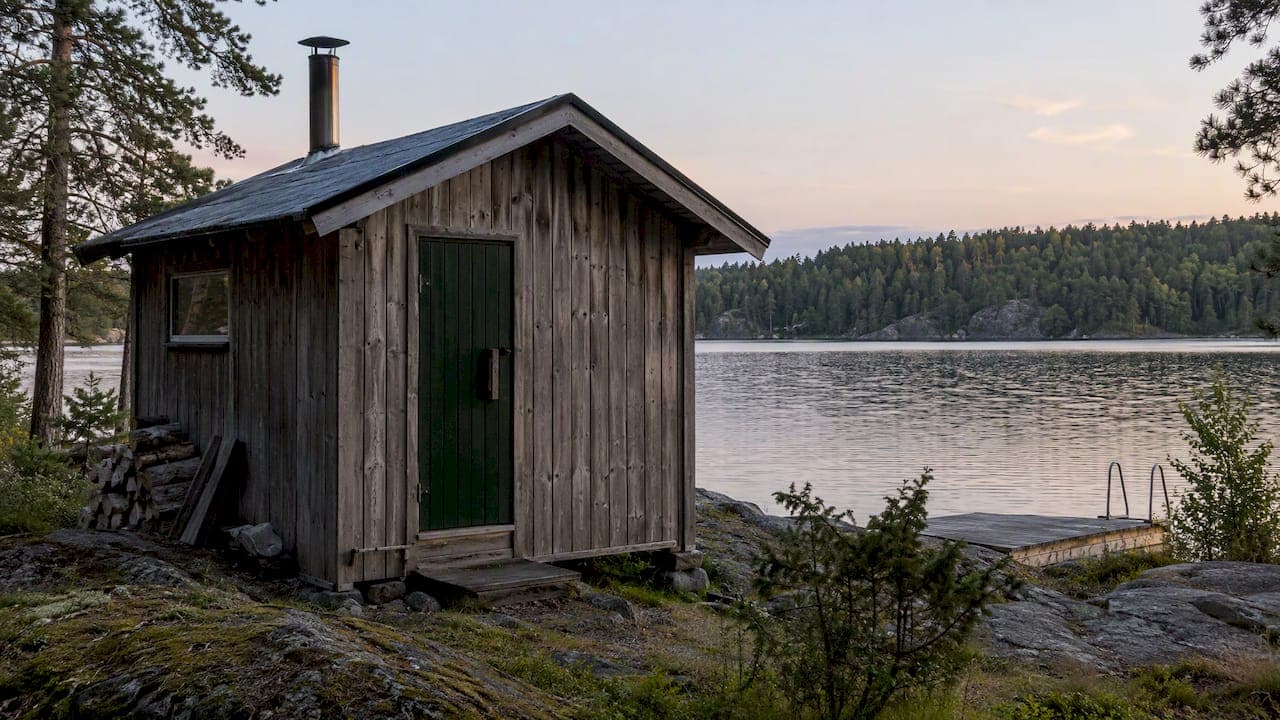
An evening sauna by a lake (kvällsbastu vid sjö, as Swedes say) is one of the simplest rituals in the country and one of the easiest to get wrong by hurrying it. Heat the sauna while the light is still gold, keep the rounds short, enter the water slowly, and leave time afterwards for the quiet. Below we cover timing, rhythm, safety, etiquette and what to look for in a place that offers all of this privately.
TL;DR
- Start about an hour before sunset: the sauna needs time to come up to temperature, and the best light over the water is short.
- Keep it gentle: a few rounds of heat, a slow entry into the lake, and a proper rest between them. The sauna is for comfort and re-warming, not for making a risky dip safe.
- If you have a heart condition or take medication that affects blood pressure or fluid balance, speak to your doctor before alternating hot and cold.
- Respect the lake and its neighbours: swim where it is allowed, stay out of other people's private zone, keep voices low after dark.
- At Villa Sakis, a historic log farmhouse with a private sauna and lake access, the whole house is yours, so the evening runs at your pace.
Table of Contents
- Why the evening is the right time
- Planning the evening hour by hour
- A rhythm that works for most healthy adults
- Safety: what to know before you go in
- Etiquette: the unwritten rules of a lakeside evening
- Public sauna, rented raft or a house of your own?
- Our perspective
- Planning an evening sauna at Villa Sakis
- What to pack for the evening
- A slower reading of the same ritual
- FAQ
- Sources
Why the evening is the right time
Morning saunas are bracing. Midday saunas are social. The evening sauna is the restorative one. Heat loosens the shoulders after a day of walking, cycling or simply sitting in the sun, and a cool swim afterwards draws a line under the day. Many people find they wind down more easily afterwards, though we would not promise that as a rule: sleep is personal, and a very hot session late at night can leave some people wide awake.
There is also the matter of the light. In a Swedish summer the evening lasts long, and the lake turns still as the wind drops. In spring and autumn the dusk arrives earlier and the air is crisp, which makes the contrast with the sauna sharper and the first cup of tea afterwards better. In deep winter the same ritual becomes something quite different, and we would treat it as a separate, more careful activity.
If you want a wider look at the idea of a sauna holiday, our guide to a private sauna holiday in Sweden goes into what to expect from the format as a whole.
Planning the evening hour by hour
The pleasure is in the pacing, so it helps to have a loose plan. This is the sequence we suggest to guests, and you should shift it to suit the season and the group.
Before sunset: heat and preparation
Light the stove or switch on the heater about an hour before you want to go in, depending on the sauna you have. Bring in towels, drinking water and a seat pad. Eat something light an hour or two before: a heavy meal and a hot sauna rarely agree, and neither does an empty stomach.
Walk down to the shore while the sauna heats. Look at the water, the jetty or the entry point, the depth near the edge and the footing. Doing this in daylight, rather than in the dark with wet feet, is the single most useful safety habit we know.
The first round: arrive slowly
Shower or rinse first, then sit on a lower bench for the first round. Ten to fifteen minutes is plenty for the first visit. Nobody is keeping score. Come out when you feel ready, not when you feel you have endured enough.
The water: a calm, deliberate entry
Walk in. Do not dive or jump in the dark, and do not swim alone if you are unsure of the water. Cold water shocks the body whatever the sauna has done beforehand: a warm body does not cancel the first gasp. Keep the first dip short and stay within your depth and within easy reach of the shore.
The rest: the part most people skip
Sit wrapped in a towel or robe, drink water, and let your breathing settle. The rest is the point of the ritual, not an interval before the next round. Then repeat as it feels right: two or three rounds is a comfortable evening for most.

A rhythm that works for most healthy adults
There is no single correct routine, and anyone who tells you there is has not met enough different bodies. As a starting point, here is a simple structure. Our separate piece on a Nordic routine for recovery and sleep sets out the thinking behind short heat rounds and brief cold exposure in more detail.
| Step | What to do | Roughly how long |
|---|---|---|
| Rinse | Wash, remove jewellery, drink a glass of water | 2 to 3 minutes |
| First heat round | Lower bench, relaxed breathing | 10 to 15 minutes |
| Cool-down | Slow entry into the lake or a cool rinse | Under a minute to a couple of minutes |
| Rest | Towel, water, sit still | 5 to 10 minutes |
| Second round | Choose your bench, listen to your body | 10 to 15 minutes |
| Final rest | Warm clothes, hot drink, no rush | As long as you like |
The timings are a comfortable guide for a healthy adult, not medical advice. Shorten everything if you feel dizzy, queasy or unusually tired, and get out of the heat at once if you feel unwell.
Safety: what to know before you go in
The sauna and the lake are both gentle in the right hands and unforgiving when ignored. The points below are the ones we think matter most.
Heart, blood pressure and medication
Switching quickly between hot and cold puts a load on the circulation. The national health service guidance at 1177 says that whether it is safe to quickly get hot or cold, as in a sauna or winter swim, differs from person to person, and that you should talk to your doctor if you have heart problems. The same applies if you take medicines that affect blood pressure or fluid balance, or if you have any history of vascular trouble. Do not assume it is fine because a friend does it every week.
Alcohol
Avoid alcohol before and during the sauna and swim. It affects judgement and makes cold harder for the body to manage. Save the glass of something for after you are dry, warm and out of the water.
Cold and re-warming
Body temperature below 35 degrees is called hypothermia, and 1177 describes it as potentially very serious. Shivering and confusion are early warnings. If you are properly chilled, warm up gradually with dry clothes and a warm drink rather than jumping straight into the hottest bench. The advice on frostbite and cold injury from 1177 is also sensible: get indoors, out of the wind, and change into dry clothes.
One local information service on bathing water makes a point we agree with: the sauna should be seen as comfort and re-warming, not as a way to make a risky swim safe.
Water temperature is not what the air tells you
A warm evening does not mean a warm lake. SMHI explains that lakes are warmed mostly by the surrounding air and the sun, with the warmer surface water then mixed downwards, so temperature varies with season and depth. SMHI has also pointed out that a summer can have a cold, lumpy middle: its own comparison of 2020 and 2021 showed July 2020 was far from inviting. Do not plan a swim on the calendar alone. We have written a short guide, five live checks to tell if a Swedish lake is safe to swim, and another on why local signs can beat websites for cold bathing.
Fire, stoves and embers
If your sauna is wood-fired, the stove, the chimney and the ground around it deserve a calm look every time. Keep water close, never leave a fire unattended and follow any fire ban declared locally. The Swedish Environmental Protection Agency's guide to the right of public access notes that open fires on bare rock are a poor idea because the stone can crack. For hosts and guests alike, our note on three checks before lighting a fire pit covers the practicalities.
Children
Children heat and cool faster than adults and should have shorter, cooler visits with an adult beside them. We have set this out in a practical family guide to sauna with children and a two-minute lake safety briefing for parents. Read both before the first evening, not during it.
Etiquette: the unwritten rules of a lakeside evening
Swedish lakes are shared places, and good manners are mostly a matter of noticing who else is there.
- Know where you may swim. The right of public access lets you swim and land at most shores, but it does not cover the private area close to someone's home. The guiding principle is not to disturb and not to destroy.
- Keep the sound down. Water carries voices a long way in the still of evening. Neighbours, wildlife and other guests all benefit from low voices after dark.
- Leave no trace. Take every towel, bottle and wrapper back with you. The same agency's guide to the right of access when paddling confirms that the principle applies on water as well as on land.
- Use the sauna you have. A sauna near a lake is not automatically public or open to everyone, and access, fees and opening times vary. That is part of why a private one is so much simpler.
There is a quiet bonus here. If you came to switch off, the discipline of keeping a light footprint is part of what makes the place restful. Calm is partly something you give to a landscape, not only something you take from it.
Public sauna, rented raft or a house of your own?
There are several ways to get a sauna evening by Swedish water, and each suits a different trip. We will describe them by type.
| Option | What it suits | Things to weigh |
|---|---|---|
| Public or club sauna at a bathing place | A quick visit, meeting locals, a first taste | Set hours, shared space, queues in busy periods |
| Rented floating sauna or lakeside sauna package | A special occasion with a group | Fixed time slots, often charged per session and per person |
| A lakeside cabin with its own sauna | A weekend away | Quality varies, check who else uses the shore |
| A whole house with private sauna and lake access | Several evenings, family or friends, a proper slow stay | You manage your own timing, wood and tidying |
The case for the last one is simple: nobody is waiting for your slot, and you can take the sauna three evenings running at the pace you like. Our guide to what to check for a true lakeside stay in Sweden lists the questions to put to any host: how close the water really is, how you reach it, whether it is a shared shoreline, and what the sauna is heated by.
Our perspective
We look after an old house, and an old house teaches patience. Villa Sakis is a Swedish log farmhouse that dates from the 1700s, cared for by generations, with meadows and pine forest around it. Guests who come to us are rarely after a list of attractions. They want a long evening that does not end because someone has another booking.
That shapes how we think about the sauna. We do not see it as an event or a challenge. We see it as a way of closing the day: warm timber, a few quiet rounds, the lake afterwards, then the porch or the kitchen table. The pine forest and the meadow are part of the same evening, in the smell of the air as you walk back and the silence that settles over the farm.
Our advice is the same each time. Go slowly. Keep the cold short and the rest long. Look at the water in daylight before you go near it in the dark. And if your health gives you any reason for doubt, ask your doctor first. It costs nothing and it keeps the evening something to look forward to.
— Christian
Planning an evening sauna at Villa Sakis
Villa Sakis is let as a whole house, so the farmhouse, the private sauna, the lake access and the surrounding forest and meadows are for your group alone. The rooms are honest timber, there is a self-catering kitchen for the supper before or after, and the days can be as slow or as active as you wish: a walk or training session in the morning, a long lunch, and the sauna as the evening's centre.
You can see the rooms and the setting on the house page, check which dates are open on the availability page, or go to the booking page for the whole farmhouse when you are ready. If you are weighing up what a stay in the area involves, our journal piece on what to expect from a Swedish countryside holiday is a gentle place to start.
What to pack for the evening
A short list saves a lot of fumbling in the dusk.
- Two towels each, one for the sauna and one for after.
- Flip-flops or water shoes for the path and the lake bottom.
- A warm hat and dry, loose clothes for the rest.
- A bottle of water, plus a flask of something hot.
- A head torch or lantern, so the path back is easy on tired feet.
- A bag for any rubbish, so nothing is left at the shore.
If you are interested in the wider case for contrast and recovery, our overview of cold water therapy for wellness travellers looks at it in more depth, and our note on a cosy private sauna weekend covers hygiene and short sessions.
A slower reading of the same ritual
It is tempting to turn the sauna into another thing to optimise: more heat, colder water, longer rounds. The people who seem to get the most from it do the opposite. They make the transitions calm. They notice the temperature of their own skin, the way the water goes quiet at dusk, the sound of the stove ticking as it cools.
For anyone recovering from a hard year, or simply wanting a few days away from a screen, that is the real offer of an evening sauna by a lake. It is a small, repeatable ritual with a beginning, a middle and an end, and it fits neatly into a day spent outdoors. The temperature extremes are a detail. The stillness is the substance.

FAQ
How long should I stay in the sauna before going into the lake?
For a healthy adult, ten to fifteen minutes is a comfortable first round, and you should leave earlier if you feel dizzy or unwell. Keep the lake dip short and enter slowly rather than jumping in. Rest properly between rounds.
Is it safe to go from a hot sauna into cold lake water?
It depends on the person. The health service at 1177 says that the safety of quick changes between hot and cold varies individually, and that anyone with heart trouble should talk to a doctor first. A sauna does not remove the shock of cold water, so enter calmly and stay near the shore.
Can I swim anywhere by a Swedish lake?
Mostly yes, but not everywhere. The right of public access allows swimming from most shores, though it does not extend to the private area around someone's home. Always check local signs and any water-quality notices before you go in, as conditions change.
What is the best time of year for an evening sauna by a lake?
There is no single best month. Summer evenings are long and the water is usually mildest, but SMHI notes that lake temperatures depend on season, depth and weather, so a given summer can surprise you. Spring and autumn give a sharper contrast and quieter shores, and call for more care with the cold.
Can I have a private lakeside sauna evening with a group?
Yes, if you book a place that is let as a whole. At Villa Sakis the whole farmhouse, with its private sauna and lake access, is booked for your group's own use, so you set the timing yourselves.
Sources
- 1177: Hjärtinfarkt, can I use a sauna or cold water?
- 1177: Köldskador
- Badinformation: Vinterbad och bastu
- SMHI: Vattentemperatur i sjöar
- SMHI: Bästa hemestermånaden för havsbadaren
- Naturvårdsverket: Allemansrätten, en vägledning
- Naturvårdsverket: Allemansrätten, paddling