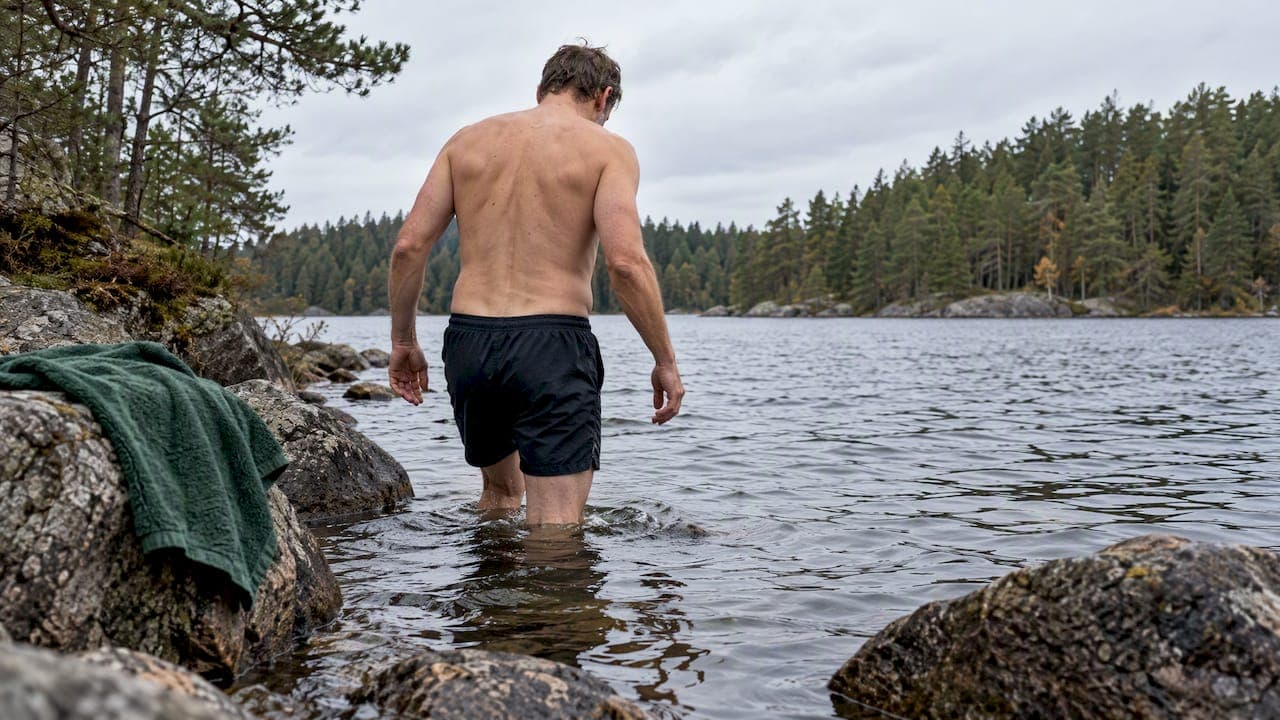
Yes, cold bathing in a lake is widely practised and easy to start, best done at designated bathing spots, piers and sheltered coves. Look up the spot in the Swedish bathing-water service Badplatser och badvatten from Havs- och vattenmyndigheten, and read the official guidance at 1177 before you go. If you have a heart, circulatory or breathing condition, speak to your doctor first.
TL;DR:
- Choose a maintained pier, shallow sandy exit, or ladder, and avoid slippery banks or reedy shores where cold hands could prevent an unaided exit.
- Online classifications rely on municipal samples and may lag behind current conditions, so heed site signs and skip swimming after heavy rain or visible algae.
- Warm up on land, enter slowly, keep early dips brief, and leave immediately if uncontrollable shivering begins; never swim alone or force rapid breathing.
- A 2025 review of 11 studies involving 3,177 participants found stress reduction 12 hours later, while evidence for lasting clinical benefits remains limited.
Table of Contents
- Which lake spots suit cold bathing best?
- How do you check water quality before you swim?
- What should you bring, and how do you ease in?
- What does the evidence say about health, and who should ask a doctor?
- Why we like to help guests bathe by the lake
- Book a quiet lakeside stay at the farmhouse
- FAQ
- Sources
Which lake spots suit cold bathing best?
A good kallbad i sjö starts with the entry, not the water. The best places let you step in calmly and leave quickly, with somewhere to warm up nearby. These are the spot types worth looking for:
- Maintained bathing pier: a firm surface, a handrail and usually a sign with local information.
- Sandy bay with a shallow exit: you can wade in slowly and step out without climbing.
- Sheltered cove: calmer water and less wind on your skin when you leave.
- Bathing house ladder: a fixed ladder gives a secure exit, and some bathing houses keep a managed hole open in winter.
- Floating jetty with a ladder: deep water at your own pace, with a clear way back up.
- Rural beach with parking and changing space: a dry place to get dressed matters more than it sounds.
Avoid steep, slippery banks, reedy shores where you cannot see the bottom, and anywhere you could not climb out unaided with cold hands.
For local lists, community pages and outdoor magazines are a good starting point, and municipal websites tell you which sites are officially maintained. Check the municipal page before you travel, because ladders are removed and piers closed outside the season.

If you like to plan a whole day around the swim, a calm lakeside stay helps; see our guide to combining lodging and gastronomy for ideas on planning your self-catered wellness stay. Our own notes on checking whether a lake is safe to swim cover what to look at before you step in.
How do you check water quality before you swim?
Sweden's designated bathing sites, known as EU-baths, are classified from bacterial sampling that municipalities carry out, and the national service Badplatser och badvatten shows each site's classification and any local warnings. The agency's annual bathing water quality report explains how this monitoring works. Most designated sites are rated excellent, good or satisfactory, which is reassuring but not a guarantee for any single day.
Good to know: laboratory results lag behind real events, so official online information is not real-time, and signs at the water can be more current than any website.
What to do on the day:
- Check the municipal page and the Badplatser och badvatten entry for the site.
- Read any warning sign at the entrance before you undress.
- Skip the swim if you see an algal bloom, floating rubbish or a strange smell.
- Postpone after heavy rain, as runoff can carry bacteria into the water for a time.
Water temperature matters here too. Our checklist on reading lake temperature and conditions explains what to look at beyond the number on a thermometer.
What should you bring, and how do you ease in?
Cold bathing is simple, but a few items make it comfortable and safer. Pack a quick-dry towel, warm dry layers in wool or technical fabric, a hat, sturdy shoes, a plastic bag for wet things and a thermos with a hot drink. Avoid cotton against your skin afterwards, as it stays damp and cold.
A sensible first routine:
- Warm up on land with a short walk, so you start with a warm body.
- Walk in slowly and let your breathing settle before going deeper.
- Keep the first dips brief and build gradually over several visits.
- Never hold your breath or force fast breathing, and get out at the first sign of shivering you cannot control.
- Leave by your planned exit, dry off and dress quickly, starting with your top half and hat.
Pro Tip: Put your warm clothes in the order you will put them on, and open the thermos before you swim, because cold fingers are clumsy.
Gradual exposure and brief immersions are standard advice, and a doctor's check beforehand is recommended because cold water affects blood pressure, heart rate and circulation. For a structured way to build tolerance, see our beginner open-water plan.
What does the evidence say about health, and who should ask a doctor?
Evidence on cold-water immersion is encouraging in places but limited. A 2025 systematic review and meta-analysis of 11 studies with 3,177 participants found effects that depend on timing: an acute inflammatory response straight after immersion and a reduction in stress 12 hours later, with mixed results for immune markers.

The review's stress finding: a reduction in stress 12 hours after immersion, alongside a short-term rise in inflammation.
A 2026 literature review describes cold immersion as an acute stress response on the body and notes that evidence of lasting clinical benefit is limited. It advises caution, especially for people with cardiovascular or respiratory risk.
If you have a heart, circulatory or breathing condition, talk to your doctor before cold immersion.
The initial moments in cold water can bring a cold-shock response, with a gasp, a fast heartbeat and a jump in blood pressure. That is why we keep early dips short and calm. Never swim alone, never stay in long, and avoid aggressive breathing techniques that some trainers promote. If you have cold injuries that do not heal, or severe symptoms, contact 1177 or a health centre. Our piece on cold water therapy for wellness travellers looks at the benefits in more depth.
Why we like to help guests bathe by the lake
Our whole-house farmhouse has lake access and a private sauna, and for many guests that combination is the point of the stay. We tell guests which nearby entry points we trust, what to check on the day, and how to warm up gradually rather than rushing from lake to hot bench. Nothing here is a promise of benefits, only a calm setting and honest guidance. If a supported lakeside swim sounds right, we would be glad to host you.
— Christian
Book a quiet lakeside stay at the farmhouse
The House is our whole-house log farmhouse with lake access and its own sauna, so you can swim, warm up and rest at your own pace without sharing the space. Slow, unhurried routines are easier when everything you need is a short walk away. See availability and book your stay directly with us.

This article is general information, not a substitute for advice from a qualified doctor. Consult a qualified healthcare professional about your own circumstances before acting on anything here.
FAQ
How long can you stay in a cold lake?
Keep early dips brief and build up gradually over several visits. Brief immersions, measured in minutes rather than prolonged soaks, are standard advice. Leave as soon as you shiver uncontrollably or feel unwell.
Which cities have bathing houses?
Many coastal and lakeside towns have a bathing house with ladders and changing rooms. Municipal websites list which ones are open and when, and opening seasons vary. Check the local page before you travel.
Who should not bathe in cold water?
People with heart, circulatory or respiratory conditions should speak to a doctor before cold immersion. A 2026 literature review advises particular caution for those groups. Nobody should swim cold water alone.
Is it safe to swim after heavy rain?
It is best to wait. Runoff can carry bacteria into the water, and lab results arrive after the event, so signs and your own eyes are the better guide. Look for warnings at the site before you swim.
Sources
- Effects of cold-water immersion on health and wellbeing: A systematic review and meta-analysis | PLOS One
- [Sveriges badvattenkvalitet 2026
- Cold Water Therapy: Benefits of Cold Showers, Baths, Immersion Therapy
- Köldskador - 1177