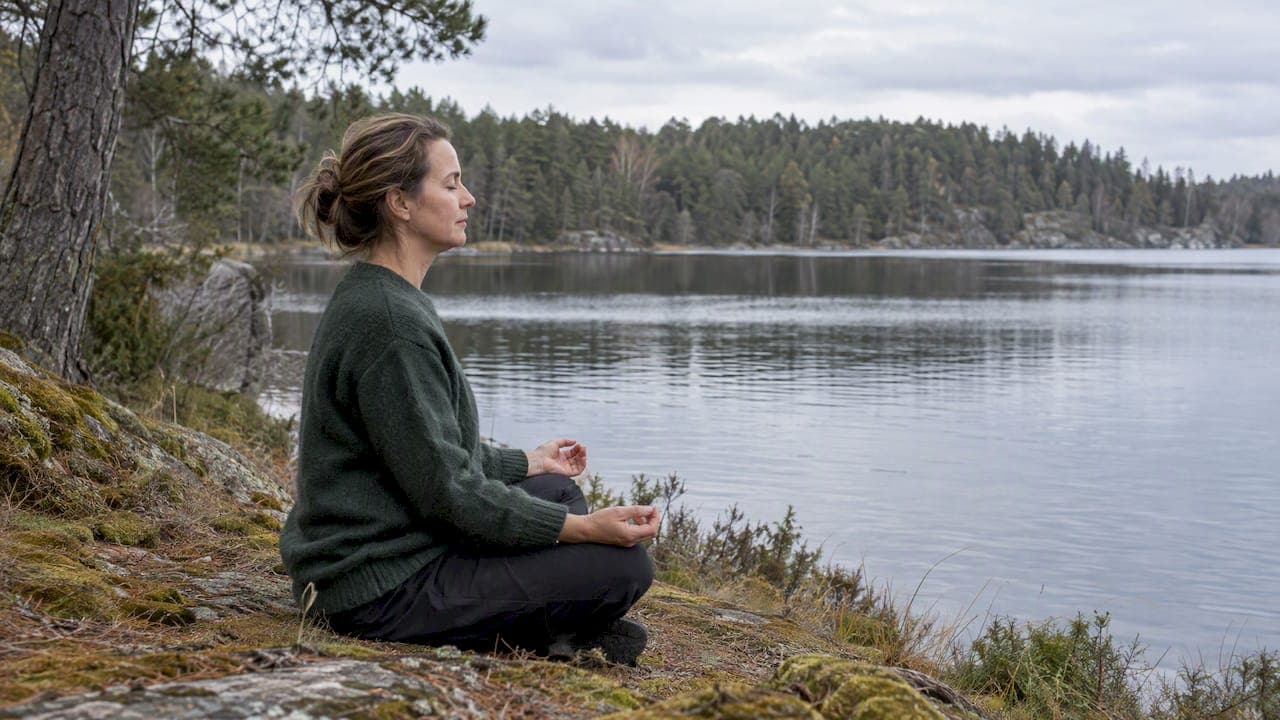
A short guided meditation by the lake, ten or twenty minutes, reliably helps most listeners relax and feel more present. Find a safe spot near the water, settle in, and follow the timed script below: choose ten minutes for a quick reset or twenty when you have longer to sink into the practice.
TL;DR:
- A course that taught mindfulness in nature had higher practice adherence than conventional training, and gains in attention and mindfulness persisted six months.
- A study found that water views during meditation lowered heart rate by about 7.3%, with better mood and sustained attention than forest or rock views.
- A small pilot favored brief, structured nature mindfulness over unstructured walks for wellbeing and stress reduction, but the sample was too small for firm conclusions.
- Choose one safe, level shoreline spot and a consistent daily time; repeated short sessions are more useful than occasional longer practices.
- Choose stable, level ground away from slippery edges, keep your phone within reach, and check your footing before standing, especially when meditating alone.
Table of Contents
- Why meditating near water helps you relax and stay present
- A guided lakeside meditation script: 10 and 20 minute versions
- Setting up safely: where to sit, what to bring
- Making lakeside meditation a lasting habit
- Lakeside mindfulness in practice at Villa Sakis
- What the evidence actually tells you to prioritise
- A private lakeside setting for your own practice
- FAQ
- Sources
Why meditating near water helps you relax and stay present
Sitting by a lake does something that a quiet room rarely manages on its own. Attention settles faster, the mind wanders less, and mood tends to lift within the same short session. Part of this comes from what researchers call restoration skills training, or ReST: mindfulness taught in natural surroundings rather than indoors. In a five-week course, ReST participants kept up their practice at far higher rates than those trained conventionally, and the gains in sustained attention and dispositional mindfulness held up at six months. The setting itself seems to do some of the work, offering what researchers describe as soft fascination, the kind of gentle, effortless interest that lets focus settle without strain.
Water appears to add something beyond nature in general. A controlled study found that watching water landscapes during meditation reduced heart rate by around 7.3%, a stronger effect than forest or rock views produced, alongside greater mood improvement and longer sustained attention.

Heart rate can drop by roughly 7.3% when meditation includes a view of water, compared with other natural landscapes, according to the same study. That single detail explains why a lake, rather than any quiet outdoor corner, makes such a good setting for this kind of practice.
A recent pilot trial also found that brief, structured nature-based mindfulness sessions showed point estimates favouring well-being and lower perceived stress over unstructured outdoor walks, though the sample was too small to call it conclusive. Structure, in other words, seems to matter almost as much as the setting.
A guided lakeside meditation script: 10 and 20 minute versions
Settle onto your mat or blanket, feet flat or legs crossed, hands resting loosely. Close your eyes or let your gaze soften on the water's surface.
- 0:00 to 0:45, settle and breathe. Take three slow breaths, feeling the air move in through the nose and out through slightly parted lips. Notice the ground beneath you.
- 0:45 to 3:00, sensory arrival. Listen for the sound of water meeting the shore, feel the air on your skin, notice any birdsong or rustling reeds. Let each sense arrive one at a time rather than all at once.
- 3:00 to 7:00 (10-minute version) or 3:00 to 14:00 (20-minute version), open awareness. Picture the lake's surface as it is right now: ripples, stillness, light on the water. When a thought pulls your attention away, simply notice it and return to the sound of water lapping the shore.
- 7:00 to 9:00 (10-minute) or 14:00 to 18:00 (20-minute), breath and body scan. Bring attention gently down through the shoulders, chest, and hands, syncing each exhale with a small release of tension.
- 9:00 to 10:00 (10-minute) or 18:00 to 20:00 (20-minute), closing. Wiggle your fingers and toes slowly, take one deeper breath, and open your eyes before standing. If you are near the edge, check your footing before you rise.
If your attention keeps drifting, do not fight it. Simply notice where it went and guide it back to the water's sound, which is there to use as an anchor throughout.
Pro Tip: Record yourself reading the script once, slowly, so you can simply press play and close your eyes on future visits.
Setting up safely: where to sit, what to bring
A good lakeside spot does most of the work before the meditation even begins. Look for stable, level ground a short distance back from the water's edge, ideally with some natural shelter from wind, such as a line of trees or a low bank.
- Bring a mat or blanket, a warm layer even in summer, a water bottle, and a small dry bag for your phone and keys.
- Choose a spot that is not directly at a steep or slippery edge, particularly if you are meditating alone.
- Keep your phone within reach rather than tucked away, in case you need to call for help or check the time.
- Check the forecast beforehand and dress in layers, since temperatures by open water can shift quickly once you are sitting still.
- In warmer months, a little insect repellent saves you from swatting through the session.
A few minutes spent choosing the right spot almost always pays off in how settled you feel once you begin.
Making lakeside meditation a lasting habit
The sound of water works well as a sensory anchor: whenever your mind wanders, return to it rather than trying to force stillness. Some people find a short phrase, repeated silently on the exhale, does the same job.
- Pick a consistent time and place, since the same bench or patch of shoreline helps the habit take root faster than a new spot each time.
- Use ten minutes for a daily practice you can keep up easily, and twenty minutes on days when you have the time to go deeper.
- On cooler days, swap stillness for a slow, mindful walk along the shore, pausing every few steps to notice the water.
- A brief, cold dip before or after the practice can sharpen the senses for those who find it bearable.
A warming cup of tea afterwards, something like the herbal blends from Yugen Teas, rounds the practice off nicely and gives the mind a gentle, ritual marker that the session has ended.
Pro Tip: Keep the same closing phrase or gesture every time, such as a slow breath and open palms, so your body learns to recognise the end of practice as clearly as the start.
Lakeside mindfulness in practice at Villa Sakis
We care for a log house set among meadows, pine forest, and direct lake access, and we see how naturally a short meditation fits into a quiet stay. Christian has written for the Villa Sakis journal on silence and its effects on health, drawing on forest bathing and self-guided retreat practices observed at the house.
Guests tend to fold a lakeside session into quiet hours, often first thing or in the hour before dinner, using the same spot each day rather than searching for somewhere new. The routine itself seems to matter as much as the view.
What the evidence actually tells you to prioritise
The research points to a simple hierarchy, and most advice on this topic gets the order wrong. Setting matters less than people assume, and structure matters more. A beautiful view with no plan rarely produces the same calm as a plain patch of ground paired with a short, repeatable script.

Water adds a measurable edge over other natural settings, but it is not the decisive factor. The decisive factor is showing up with the same short practice often enough that your body starts to recognise it. Ten minutes, repeated daily, will likely do more for your sense of presence than one long session attempted occasionally.
If you take one thing from this, let it be this: choose your spot once, choose your length of practice, and stop negotiating with yourself each time about whether today is the day to begin.
— Christian
A private lakeside setting for your own practice

Some readers prefer to build this habit somewhere quieter than a public shoreline allows. At Villa Sakis, our grounds include direct lake access, open meadows, and the kind of stillness that makes a self-guided schedule easy to keep.
- Lake access means you can meditate at any hour without sharing the shore.
- A self-guided rhythm, quiet mornings, an open afternoon, suits both the ten and twenty-minute scripts above.
- Our journal has further planning notes for a nature-immersion stay, including longer wellness itineraries.
If a stay built around this kind of practice appeals, The House is where to start planning one.
FAQ
Can you lie down while meditating?
Yes, lying down is fine for a body scan or relaxation-focused session, though sitting upright tends to help more with sustained attention, which is the main aim of a short lakeside practice. Choose whichever position lets you stay comfortable without falling asleep.
Where can I find meditation retreats near water?
Self-guided options are often the simplest starting point: a quiet stay with lake access, such as the one we offer at Villa Sakis, lets you build your own schedule around the scripts in this guide. For a structured, bookable retreat, check listings for wellness or nature-immersion programmes in your region.
What is the difference between mindfulness and meditation?
Mindfulness is the broader skill of noticing the present moment without judgement, while meditation is a structured practice, often involving breath or sensory focus, used to build that skill. A guided lakeside session is a form of meditation that trains mindfulness through sustained attention.
Which free meditation app is good for beginners?
Several Swedish-language apps and platforms, including Insight Timer, offer free lakeside and water-themed guided tracks suitable for beginners. Short video formats, such as ten-minute flow practices, are another accessible starting point if you prefer not to use the written script above.