
What mindfulness actually does for burnout
Mindfulness is the practice of paying attention to the present moment with curiosity and without judgment. Not clearing the mind. Not achieving a state of perfect calm. As Amanda McNab, a licensed clinical social worker at the University of Utah's Huntsman Mental Health Institute, puts it: "the goal isn't to clear your mind — it's to notice it."
Burnout, classified by the World Health Organization as an occupational phenomenon, has three defining features: emotional exhaustion, growing cynicism or depersonalization toward work, and a reduced sense of personal effectiveness. These are not simply signs of being tired. They reflect a nervous system that has been running in overdrive for too long, with no meaningful recovery.
Mindfulness addresses burnout at this physiological level. By activating the parasympathetic nervous system, it pulls the body out of the chronic fight-or-flight state that sustains burnout. It also builds the capacity to notice early warning signs before exhaustion becomes collapse, and it restores a sense of agency that burnout systematically erodes.
- Reduces emotional exhaustion by creating space between a stressor and your reaction to it
- Interrupts the stress cycle by returning attention to the present rather than replaying worries
- Activates the parasympathetic nervous system, shifting the body from stress to rest
- Improves emotional regulation, making it easier to respond rather than react
- Restores a sense of control, which burnout tends to strip away gradually
A systematic review of 49 randomized controlled trials found that mindfulness-based interventions significantly reduced burnout indicators in 67% of those trials, with emotional exhaustion showing the most consistent improvement.
How to recognize burnout and why mindfulness targets it so precisely
Burnout does not arrive all at once. It accumulates. Recognizing its symptoms early is where mindfulness practice becomes most useful, because awareness is the first intervention.
Common burnout symptoms include:
- Emotional exhaustion: feeling drained before the workday begins, with no reserve left for the people or tasks that matter
- Cynicism and depersonalization: a growing indifference toward colleagues, clients, or the work itself, sometimes tipping into quiet hostility
- Reduced efficacy: a persistent sense that effort no longer produces results, even when it objectively does
- Physical fatigue: disrupted sleep, tension headaches, and a body that feels perpetually braced
- Irritability and reduced motivation: small frustrations land harder; tasks that once felt meaningful now feel hollow
Mindfulness targets these symptoms through several specific mechanisms. Regular practice trains you to notice the early signals of exhaustion before they compound. It interrupts the rumination loops that amplify stress, particularly the replaying of difficult interactions or anxious anticipation of what comes next. Over time, it builds what researchers call psychological flexibility, the ability to hold difficult emotions without being consumed by them.
The depersonalization component of burnout responds particularly well to practices that cultivate warmth and connection, which is why loving-kindness meditation is often recommended alongside standard breath-focused techniques. Emotional exhaustion, by contrast, responds most directly to deactivation practices that calm the nervous system rather than engage it further.
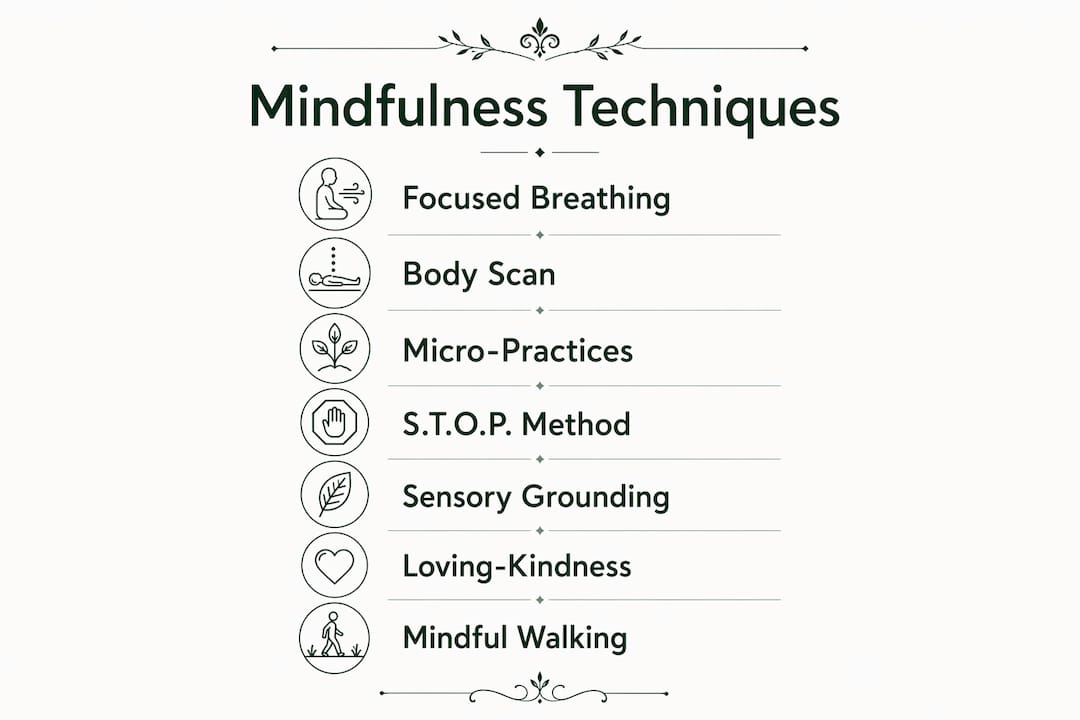
1. Focused breathing with an extended exhale
Slow, deep exhaling directly stimulates the parasympathetic nervous system, reducing the fight-or-flight response that sustains burnout. The practice is simple: inhale for four counts, exhale for six to eight. Even three cycles of this pattern can shift your physiological state noticeably. Attach it to an existing transition, the moment before opening your laptop, the pause before a meeting, the walk from your car to the office door.
2. Body scan
The body scan is a practice of moving attention slowly through the body, from the top of the head to the soles of the feet, noticing areas of tension or discomfort without trying to fix them. For people in burnout, this practice often reveals how much physical tension has been normalized. A ten-minute body scan before sleep tends to improve sleep quality, which is one of the first casualties of chronic work stress.
3. Micro-practices attached to daily transitions
Brief micro-practices integrated into existing routines are more effective for burnout recovery than lengthy dedicated sessions. The key is attachment: link a one-minute practice to something you already do. Wash your hands with full attention to the sensation of water and soap. Eat the first few bites of lunch without a screen. These are not trivial gestures. They create repeated moments of nervous system recovery throughout the day.
4. The S.T.O.P. method
S.T.O.P. stands for Stop, Take a breath, Observe, and Proceed. It is a four-step micro-practice that takes under two minutes and can be used anywhere. Stop what you are doing. Take one conscious breath. Observe your thoughts, physical sensations, and emotional state without judgment. Then proceed with whatever comes next. Used consistently, it interrupts the automatic pilot mode that burnout thrives on.
5. Sensory grounding
When the mind is caught in a stress spiral, grounding it in immediate sensory experience is one of the fastest ways to interrupt the cycle. Notice five things you can see, four you can touch, three you can hear. This is not a distraction technique. It is a deliberate redirection of attention to the present, which is precisely what mindfulness trains.
6. Loving-kindness meditation
Loving-kindness practice involves silently directing phrases of goodwill toward yourself and others: "May I be well. May I be at ease." For people experiencing depersonalization, this practice rebuilds the sense of warmth and connection that burnout erodes. Starting with yourself matters. Self-compassion is not indulgence; it is the foundation that makes sustained care for others possible.
7. Mindful walking
A slow, deliberate walk outdoors, with attention on the sensation of each step, the quality of light, the temperature of the air, functions as both movement and mindfulness practice. Research from Harvard Health confirms that rhythmic physical movement combined with present-moment awareness activates the relaxation response, reducing stress hormones while lifting mood.
Pro Tip: Mindfulness for burnout is about permission to pause, not performance. If a ten-minute session feels like one more thing to accomplish, shorten it to two minutes. The practice works through repetition and gentleness, not duration or effort.
What the science says about mindfulness and burnout
The evidence base for mindfulness as a burnout intervention has grown considerably over the past decade, and the findings are specific enough to guide real decisions about how to practice.
| Intervention type | Key finding | Source |
|---|---|---|
| Systematic review of 49 RCTs | 67% showed significant burnout reduction; emotional exhaustion most impacted | PubMed |
| Programs exceeding 16 hours | 86% showed significant improvement in burnout indicators | PubMed |
| Meta-analysis of mindfulness-based interventions | Effects maintained over months; informal daily practices showed strongest retention | Wholeosophy review |
| Micro-practice integration | More effective than lengthy sessions for burnout recovery when attached to daily transitions | PMC |
The 86% effectiveness rate for programs exceeding 16 hours does not mean you need to enroll in a formal course to benefit. It means that consistency over time matters more than any single session. Mindfulness-Based Stress Reduction (MBSR), the eight-week program developed by Jon Kabat-Zinn, remains the most studied format and the one most frequently used in the RCTs reviewed. Its structure, roughly 2.5 hours per week plus daily home practice, falls within the range that research consistently associates with meaningful burnout reduction.
One important caveat: mindfulness supports nervous system recovery but cannot replace genuine rest or structural changes in the workplace. If the conditions producing burnout remain unchanged, mindfulness helps you cope more skillfully, but it does not resolve the source.
How often and when to practice for real burnout recovery
Frequency matters more than duration. A two-minute practice done daily builds more resilience than a forty-five-minute session done once a week, particularly during active burnout when long sessions can feel like another obligation.
- Morning: a brief breath-focused practice before checking messages creates a boundary between rest and reactivity
- Before meetings: thirty seconds of slow exhale breathing lowers cortisol and improves the quality of attention you bring
- Midday: a body scan or sensory grounding exercise during lunch interrupts the accumulation of tension
- After work: a mindful walk or five minutes of quiet sitting signals to the nervous system that the workday has ended
- Evening: a body scan before sleep supports the nervous system recovery that burnout disrupts
Track presence, not performance. Rather than measuring how long you meditated or how still your mind was, simply note whether you paused at all. A small journal entry, "I stopped twice today," is more useful than a perfect session log. The goal is to build a pattern of recovery moments woven through the day, not to achieve a meditation milestone.
Common obstacles and how to meet them:
- "I don't have time." Attach practices to transitions you already make. No extra time required.
- "My mind won't stop." That is the practice. Noticing the wandering mind and returning is the exercise, not a sign of failure.
- "It feels pointless." The effects of mindfulness accumulate slowly. Two weeks of daily micro-practices often produces the first noticeable shift.
How physical movement and sound calm the burnout-stressed nervous system
The vagus nerve is the body's primary pathway for parasympathetic activation, and it responds to specific physical inputs: slow breathing with an extended exhale, humming, chanting, gentle movement, and even the release of emotional tears. Physical movement and sound calm the nervous system by stimulating this nerve, shifting the body from a state of chronic stress activation toward genuine rest.

Seated yoga, tai chi, and qigong are particularly well-suited to burnout recovery because they combine slow movement with breath awareness, engaging both the body and the attention simultaneously. Humming or chanting, even quietly, creates a vibration in the chest and throat that directly stimulates vagal tone. These are not esoteric practices. They are physiological tools with a clear mechanism.
For people deep in burnout, the idea of adding movement can feel counterintuitive. The body is already exhausted. But the distinction is between activating movement, which depletes, and deactivating movement, which restores. A ten-minute slow walk in a forest or along a quiet path is categorically different from a high-intensity workout. The former signals safety to the nervous system; the latter can extend the stress response.
Pro Tip: Try humming softly for two minutes while you make your morning coffee. It sounds small, but the vagal stimulation is real and the effect on your baseline calm is cumulative over days.
Adapting mindfulness when burnout looks different for you
Not everyone arrives at burnout from the same direction, and not every mindfulness practice fits every person or situation. Adapting the approach to your specific experience is not a compromise. It is good practice.
People with high anxiety alongside burnout often find that body-focused practices initially increase discomfort. Starting with sound-based practices, like humming or listening to ambient natural sounds, tends to be gentler. Those who are primarily exhausted rather than anxious often respond well to the body scan and to loving-kindness, both of which are low-effort and restorative rather than activating.
For people who find seated meditation frustrating, movement-based mindfulness, walking, gentle yoga, or even mindful dishwashing, offers the same core benefit: sustained, nonjudgmental attention to present experience. The format is less important than the quality of attention brought to it.
Cultural and personal context also shapes what feels accessible. Some people find guided audio recordings helpful, particularly when starting out. Others prefer silence. Apps like Insight Timer offer a wide range of guided practices at no cost, which makes experimentation low-stakes. The practice that you will actually return to tomorrow is always the right one.
Bringing mindfulness into your workday without disrupting it
The most sustainable mindfulness practices for work are invisible to colleagues and require no special equipment or dedicated space. They live in the margins of the day.
Before opening your email in the morning, take three slow breaths. Before a difficult conversation, use the S.T.O.P. method. When you notice irritability rising, pause and name the emotion silently: "This is frustration." Naming an emotion activates the prefrontal cortex and reduces the intensity of the limbic response, a process neuroscientists call affect labeling.
Longer practices, like a ten-minute body scan at lunch or a mindful walk between tasks, can be built in gradually. The key is to treat them as non-negotiable recovery time rather than optional extras. Job crafting, the practice of adjusting tasks, relationships, and the cognitive framing of your work, pairs naturally with mindfulness. When you can see your work more clearly, you can shape it more intentionally.
The goal is not a mindful workplace in the abstract. It is a workday that contains enough recovery moments to prevent the accumulation of stress that becomes burnout.
How to track your progress in burnout recovery
Progress in burnout recovery is rarely linear, and the signs of improvement are often quieter than the signs of deterioration. Tracking them requires a different kind of attention.
The Maslach Burnout Inventory, the most widely used clinical measure of burnout, assesses emotional exhaustion, depersonalization, and personal accomplishment across three subscales. While the full instrument is used in research settings, its core questions, "How often do I feel emotionally drained?" and "How often do I feel I'm making a difference?" offer a useful self-check. Revisiting these questions weekly, even informally, gives you a baseline to compare against.
Simpler signals are equally informative. Sleep quality tends to improve before mood does. Irritability decreases before motivation returns. Noticing these small shifts, rather than waiting for a dramatic recovery, keeps the practice grounded in reality. A brief daily note, one sentence about how present you felt or how many recovery pauses you took, builds a picture over weeks that a single self-assessment cannot.
Emotional exhaustion vs. depersonalization: different symptoms, different practices
Emotional exhaustion and depersonalization are both components of burnout, but they respond to different mindfulness approaches, and conflating them leads to practices that feel unhelpful.
Emotional exhaustion is fundamentally a depletion state. The nervous system has been running too hot for too long. The practices that help most are deactivating ones: slow breathing, body scans, restorative movement, and extended time in quiet natural environments. The aim is to reduce arousal, not to process emotion or generate insight.
Depersonalization is more complex. It often develops as a protective response to emotional exhaustion, a kind of numbing that shields against further depletion. Practices that address it need to gently rebuild the sense of warmth and connection that burnout has suppressed. Loving-kindness meditation is the most researched approach here. Self-compassion practices, which involve treating yourself with the same care you would offer a close friend in difficulty, address the self-critical dimension that often accompanies depersonalization.
The practical implication: if you feel numb and disconnected, add loving-kindness to your practice. If you feel depleted and overwhelmed, prioritize deactivation. Most people in burnout need both, in different proportions at different stages of recovery.
How mindfulness builds resilience alongside burnout recovery
Resilience is not a fixed trait. It is a capacity that grows through practice, and mindfulness is one of the most direct ways to build it.
Regular mindfulness practice strengthens the prefrontal cortex's ability to regulate the amygdala's stress response. Over time, this means that stressors that once triggered a full stress cascade begin to produce a more measured reaction. You still feel the pressure. You simply recover from it faster.
This is the longer arc of overcoming burnout with mindfulness: not just reducing current symptoms, but building a nervous system that is less vulnerable to future depletion. Paired with structural changes at work, adequate sleep, and genuine rest, mindfulness becomes part of a recovery that holds. The practices described throughout this article are not a temporary fix. They are a way of relating to experience that, with repetition, becomes the default.
A restorative place to practice: Villasakis

Sometimes the most direct path through burnout is a complete change of environment. Villasakis is an 18th-century Swedish log farmhouse set among pine forests and open meadows in Bergslagen, available as a private whole-house rental for families, couples, and small groups seeking genuine restoration. The timber rooms are quiet, the sauna is wood-fired, and the surrounding forest offers exactly the kind of slow, unhurried space where the practices described here can take root without the pressure of ordinary life crowding in.
A burnout recovery retreat does not need to be a structured program. Sometimes it is simply a few days in a place where the pace is slower, the air is clean, and the only obligation is to rest. Villasakis offers that, along with lake access, forest walks, and the particular stillness of a Swedish countryside that has been welcoming people back to themselves for generations. Read more about the house and its grounds to see whether it fits what you are looking for.
Key Takeaways
Mindfulness reduces burnout most effectively when practiced consistently through brief, low-effort techniques integrated into daily transitions, supported by evidence from 49 randomized controlled trials.
| Point | Details |
|---|---|
| Consistency over duration | Daily micro-practices outperform occasional long sessions for burnout recovery. |
| 67% of randomized controlled trials show improvement | Emotional exhaustion responds most strongly to mindfulness-based interventions. |
| Match practice to symptom | Use deactivating practices for exhaustion; loving-kindness for depersonalization. |
| Track presence, not performance | Note recovery pauses taken each day rather than session length or mind stillness. |
| Mindfulness has limits | It supports nervous system recovery but cannot replace rest or workplace changes. |