What is a nature immersion retreat, and why does it matter?
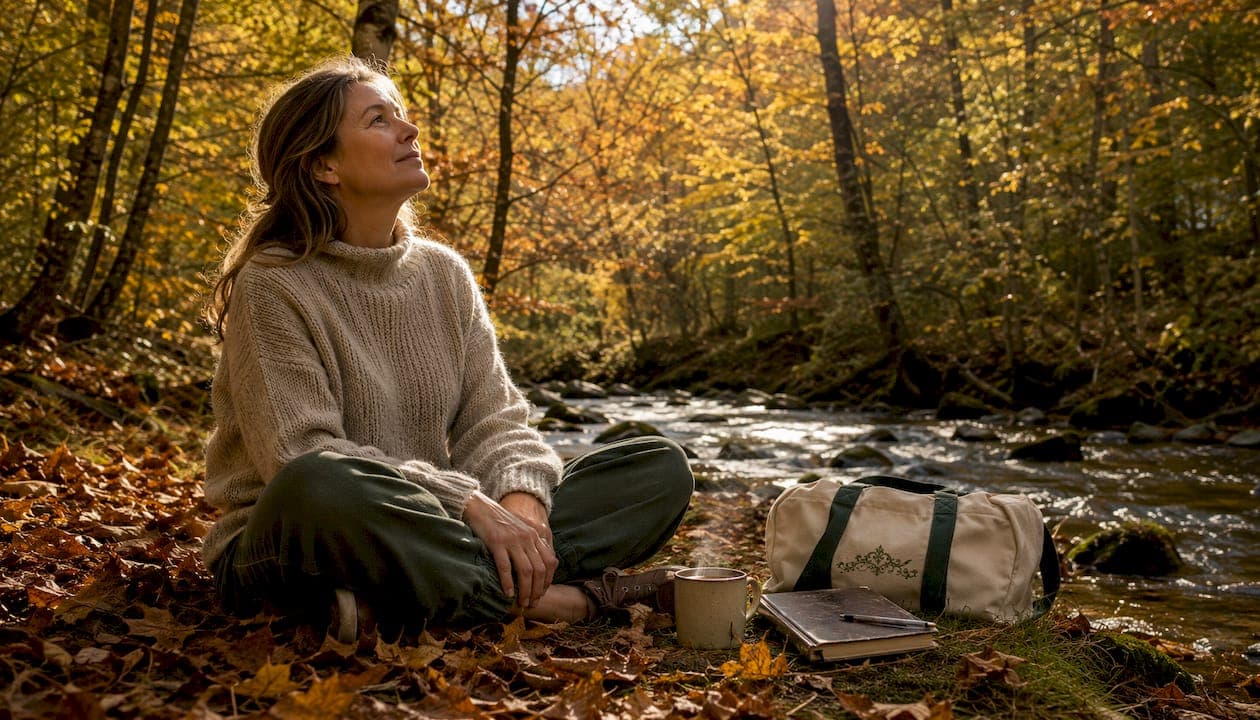
A nature immersion retreat is a deliberately designed experience of deep, mindful engagement with natural environments, structured to restore mental, physical, and emotional well-being. It goes well beyond a weekend hike or a casual afternoon in the park. The difference lies in intention: active sensory engagement with the living world around you, guided by awareness rather than distraction.
Nature guides and mindfulness scholars describe immersion as the practice of fully inhabiting a natural setting through all five senses, present to texture, sound, scent, and movement in a way that modern life rarely allows. This is what separates a nature immersion retreat from passive outdoor recreation:
- Passive outdoor activity: Moving through nature with attention elsewhere, phone in hand, destination in mind
- Nature immersion: Pausing to notice the weight of a pine branch, the shift in air temperature near water, the particular silence of a meadow at dusk
- Guided immersion: A structured sequence of sensory invitations, reflective pauses, and gratitude practices led by a trained facilitator
- Retreat setting: Multi-day immersion in a private, historic countryside property, away from urban noise and digital pull
For travelers seeking restorative privacy in authentic rural settings, the retreat format offers something rare: uninterrupted time in a place that holds its own quiet history.
Table of Contents
- Scientific health benefits of mindful nature immersion
- How to engage mindfully during a nature immersion retreat
- What travelers can expect at a historic countryside retreat
- Safety considerations during a nature immersion retreat
- Villa Sakis: a historic Swedish countryside retreat for nature immersion
- Key Takeaways
- Villa Sakis offers the private countryside retreat you are looking for
Scientific health benefits of mindful nature immersion
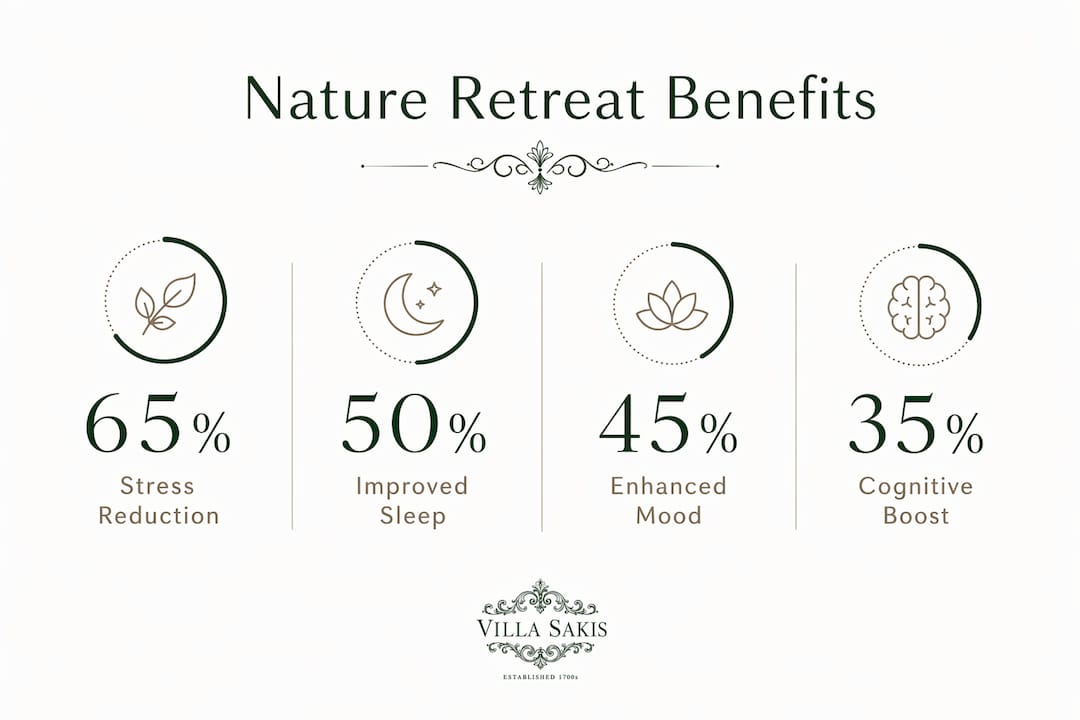
The evidence here is clear and growing. A 2019 systematic review and meta-analysis of 25 studies involving 2,990 participants found that nature-based mindfulness interventions produced statistically significant improvements across psychological, physiological, and interpersonal health, with a medium effect size (g = 0.54, p < 0.001). Forest and wild nature settings consistently outperformed gardens and urban parks.
"Spending focused time in nature decreases stress hormones, calms the nervous system, boosts the immune system, clarifies thinking and improves mood. For caregivers and changemakers, these nature-derived benefits may be particularly welcomed as their work often leaves them depleted and in need of rejuvenation." — The Uplands Center
A 2026 narrative review of mindfulness-based nature interventions found that across diverse study designs, these programs consistently reduced stress, anxiety, depressive symptoms, and rumination, while improving sleep, vitality, and self-regulation. Most studies also reported enhanced nature connectedness, which researchers identify as an important mediator of long-term well-being and even pro-environmental behavior.
One particularly telling finding: five-day residential retreats conducted entirely outdoors produced medium to large reductions in distress, comparable to effects typically reported for standard eight-week mindfulness-based stress reduction courses. Immersive exposure to natural settings appears to accelerate therapeutic effects, especially for people experiencing acute stress. The benefits of a well-designed outdoor wellness retreat are not subtle or slow-building. They tend to arrive quickly, and with practice, they last.
How to engage mindfully during a nature immersion retreat
The shift from simply being outside to genuinely immersing yourself in nature is a practiced one. Experienced nature guides use structured sequences of attentional shifts and sensory invitations to catalyze the psychological mechanisms that make immersion restorative: perceptual sensitivity, decentering, and non-reactivity.
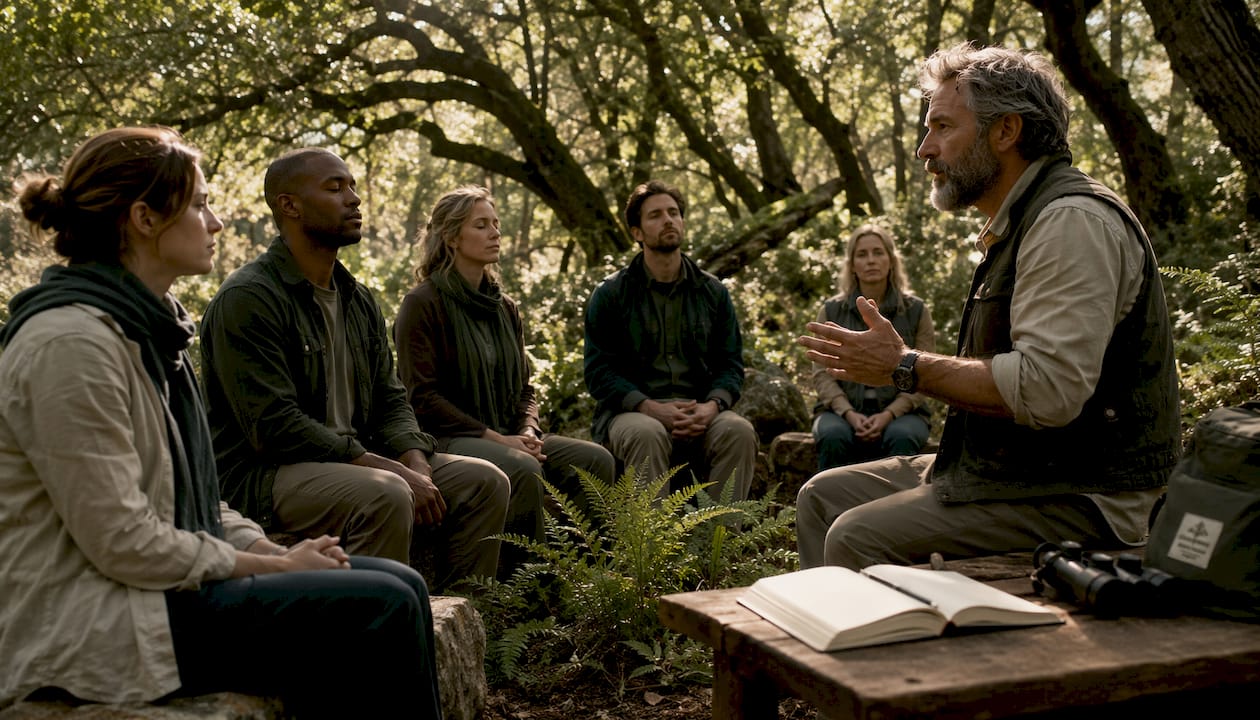
A standard guided walk typically runs 2–4 hours and follows a recognizable arc. It opens with a gratitude expression, moves through sensory invitations such as noticing motion in the environment or touching leaves and bark, and closes with a reflective "sit spot" phase, sometimes followed by a tea ceremony. Each stage asks you to bring your attention somewhere specific, then release it.
Recommended mindful practices during a forest bathing experience or guided retreat:
- Gratitude opening: Share one thing you are grateful for before the walk begins; this redirects attention away from daily preoccupations
- Sensory noticing: Identify five things you can hear, four you can feel, three you can smell
- Slow walking: Move at half your normal pace, letting your gaze soften rather than fix on a destination
- Motion awareness: Watch what moves in the environment, wind in grass, a bird's flight path, light shifting through canopy
- Sit spot reflection: Choose one place, sit or stand still for ten minutes, and simply observe without narrating
- Nature journaling: Write or sketch what you notice; the act of recording slows perception further
- Mindful touch: Place your hand on bark, soil, or water and stay with the sensation for a full minute
Pro Tip: Decentering, the practice of observing your own thoughts as passing events rather than facts, is one of the three core mechanisms that mindful engagement in nature activates. When a worry surfaces during a walk, try naming it quietly ("there's a thought about work") and returning your attention to the nearest sound. This is not avoidance. It is the practice itself.
Mindfulness scholars note that this kind of meaning-making in nature fosters self-expansion and a felt sense of identity connected to the living world, which deepens the restorative quality of the experience well beyond what passive observation achieves.
What travelers can expect at a historic countryside retreat
A well-run nature escape program in a historic rural property has a rhythm that feels almost old-fashioned, and that is precisely the point. Days are unhurried. Mornings begin with stillness: coffee on a timber porch, the sound of birds before the world gets loud. Structured activities, whether a guided meadow walk, a forest bathing session, or a quiet sit by the water, occupy the middle hours. Afternoons often open into unstructured time for reading, sketching, or simply resting.
What to bring and how to prepare:
- Clothing: Layers for variable temperatures, waterproof footwear for wet grass and forest paths, a hat for both sun and cold
- Mindset: Leave the itinerary loose; the value of immersion retreats in natural settings comes from surrendering the schedule
- Technology: A deliberate digital detox, even partial, meaningfully deepens the experience
- Journal or sketchbook: For sit spot reflections and seasonal observations
- Safety basics: Inform someone of your location and planned routes, carry water, and know the terrain before venturing far from the property
Historic countryside properties add a layer of meaning that newer venues rarely replicate. The age of the building, the generations of care visible in worn timber and tended meadows, creates a quiet continuity that grounds the experience. Sustainability practices matter here too: respecting the land by staying on paths, avoiding disturbance to wildlife, and leaving no trace are not rules so much as natural extensions of the immersive mindset.
Safety considerations during a nature immersion retreat
Safety during a nature immersion retreat is mostly about preparation and awareness, not fear. The most common risks in rural and forested settings are weather exposure, getting disoriented on unfamiliar terrain, and underestimating physical demands. A few straightforward practices address all of them.
Always tell someone your planned route and expected return time before heading into forest or open meadow. Carry water, a charged phone, and a basic first aid kit even on short walks. Dress for the actual weather, not the forecast, since conditions in open countryside and dense forest can shift quickly. If you are unfamiliar with the property's grounds, walk the main paths first before exploring further. Tick awareness is relevant in many forested regions, particularly in Scandinavia and parts of the American Northeast and Midwest: check skin and clothing after time in long grass or underbrush. For travelers with health conditions, consult a physician before undertaking extended outdoor programs. The goal of a restorative retreat is to return home feeling better, and a little preparation makes that outcome reliable.
Villa Sakis: a historic Swedish countryside retreat for nature immersion
Villa Sakis is an 18th-century Swedish log farmhouse set within private meadows and pine forests in Bergslagen, a region of Sweden shaped by centuries of quiet rural life. The house has been cared for across generations, and that continuity shows in the honest timber rooms, the proportions of the windows, the way afternoon light moves through the old wood. It is the kind of place that asks you to slow down simply by existing.
The property's natural grounds offer direct access to forest paths, open meadows, and lake water, the full range of environments that research identifies as most restorative for mindful engagement. A private sauna supports the physiological recovery that complements time outdoors. There is no program to follow, no group schedule to keep. The retreat unfolds at your own pace, shaped by the land and the season.
For travelers drawn to the idea of a forest bathing experience or a quiet outdoor wellness retreat, Villa Sakis offers something that purpose-built wellness centers rarely can: genuine historical character, private grounds, and the unhurried atmosphere of a working countryside property that has been a place of rest for three centuries.
Guests consistently describe leaving Villa Sakis feeling genuinely restored, not merely rested. The combination of authentic architecture, surrounding nature, and the absence of urban noise creates the conditions that mindfulness-based nature research identifies as most effective for psychological renewal.
Key Takeaways
A nature immersion retreat works because it combines deliberate sensory engagement with natural environments, producing measurable improvements in stress, mood, and well-being that passive outdoor time alone does not reliably achieve.
| Point | Details |
|---|---|
| Immersion vs. passive exposure | Active, mindful sensory engagement drives the restorative benefits, not simply being outdoors. |
| Scientific backing | A 2019 meta-analysis of multiple studies found a medium effect size for nature-based mindfulness interventions. |
| Residential retreats work fast | Five-day outdoor retreats produced distress reductions comparable to standard eight-week mindfulness programs. |
| Core mindful practices | Gratitude openings, sensory noticing, slow walking, and sit spot reflection are the structured tools that deepen immersion. |
| Villa Sakis | An 18th-century Swedish log farmhouse with private forest, meadows, and lake access, offering a self-directed nature immersion stay in an authentic historic setting. |
Villa Sakis offers the private countryside retreat you are looking for
The research is clear: the most restorative nature experiences happen in private, wild, or forested settings, away from urban noise, with enough time and space to actually slow down. Villa Sakis is built for exactly that.
This is a whole-house rental in a genuine 18th-century Swedish farmhouse, surrounded by pine forest and open meadow, with a private sauna, lake access, and no shared spaces. You set the pace. You choose the walks. The historic house and its grounds do the rest. Whether you are recovering from burnout, planning a restorative family stay, or simply ready for a slower, older kind of trip, Villa Sakis offers the kind of quiet that is increasingly hard to find.
Check current availability and plan your stay in the Swedish countryside.