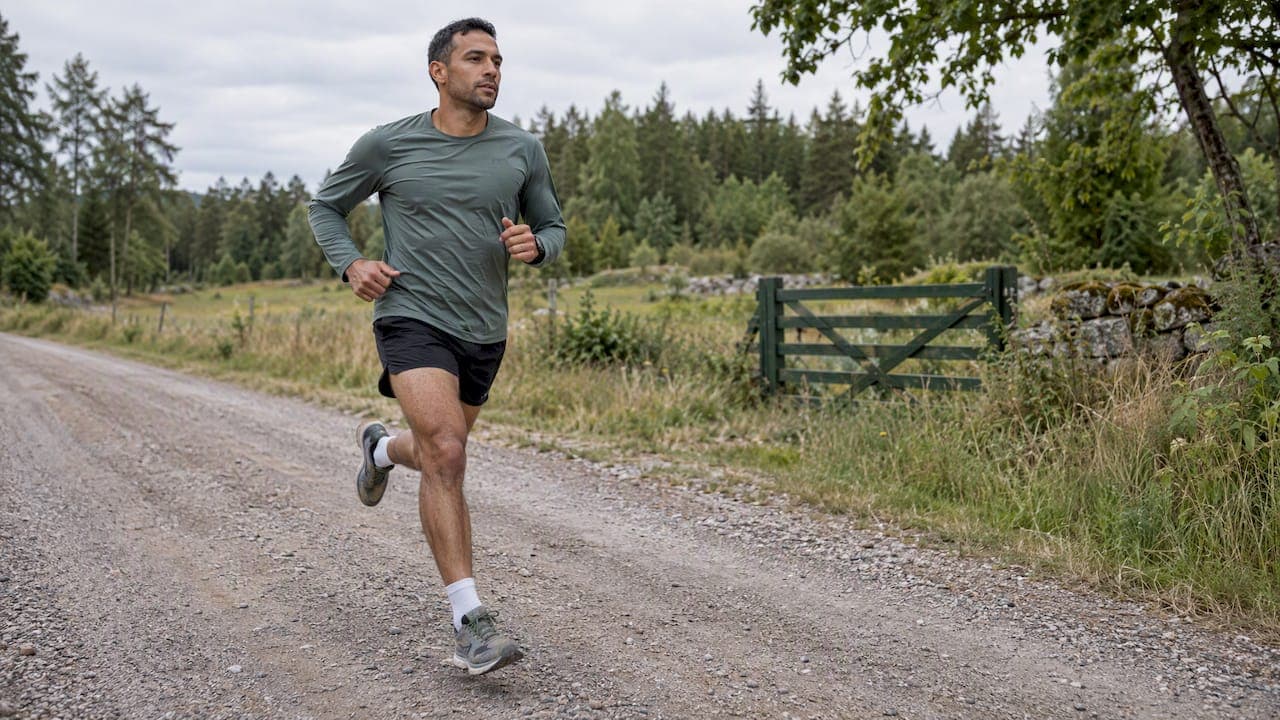
A gravel road is the kindest introduction to running outside the city. It is firmer and faster than a forest trail, softer and more varied than asphalt, and in much of Sweden it starts at the garden gate. For most runners a versatile, well-cushioned road shoe with a little extra grip is enough. Shorten your stride, look a few metres ahead, run by feel rather than by watch, and keep your eyes and ears open for the occasional car.
Below we go through how gravel differs from the surfaces on either side of it, what to put on your feet, how to adjust your running, how to share the road, and what changes in winter. We also describe how we think about it at Villa Sakis, where the roads around an old farmhouse in Bergslagen make good running country.
TL;DR
- Gravel sits between asphalt and trail: less technical than a trail, more forgiving than a road, but it asks more of your ankles and stabilising muscles.
- A cushioned road shoe with moderate outsole grip suits most gravel roads. Deep trail lugs are rarely needed, and trail shoes are fine on short stretches of asphalt.
- Take short, quick steps, scan a few metres ahead, walk the steepest or loosest sections without guilt, and judge effort by feel.
- On a quiet bygdeväg, run facing oncoming traffic, carry a phone, tell someone your route and bring a lamp in the dark months.
- Studded shoes earn their place on icy and compacted-snow roads in winter, not on bare gravel.
Table of Contents
- What makes a gravel road different
- Choosing shoes for gravel
- How to run on loose or uneven gravel
- Sharing the road: safety on a Swedish bygdeväg
- When studded shoes make sense on gravel
- Is gravel good training?
- Perspective: why we think gravel is the right surface for a restorative run
- Finding routes when you are away from home
- Run from the door at Villa Sakis
- FAQ
- Sources
What makes a gravel road different
Gravel running takes place on unpaved but runnable ground. It is less technically demanding than trail running, which is why running guides describe it as an accessible bridge for road runners who want nature without roots and rocks. Swedish running sites make the same point: beginners can start on gravel roads and exercise tracks before moving to technical trails.
Three things set it apart from asphalt.

Impact. Gravel is more forgiving than asphalt, absorbing more impact but returning less energy than a road. In practice, legs often feel fresher after a gravel hour than a tarmac one, and the same effort gives a slightly slower pace.
Stability. Loose stones shift under the foot, which asks for more stability and agility and challenges the neuromuscular system, according to the same Salomon guide. Your calves, ankles and hips do quiet extra work with every step. That is a benefit if you build up gradually and a cost if you do not.
Variety. One road can be hard-packed in the middle, soft at the edges, corrugated near a bend and sandy on a hill. Retailers' shoe guides describe gravel as anything from hard-packed to porous and uneven, and that is the honest summary: you run the road in front of you, not an average one.
What the research says about speed
Does gravel make you slower in a way that matters? A study on terrain and running critical power found that critical power did not differ significantly across track, road and gravel, while W' (the work capacity above that threshold) was higher on track than on gravel and running patterns differed. In plain terms, your sustainable aerobic effort is similar, but short, hard efforts feel costlier on loose ground. For a holiday runner it means one thing: do not compare your gravel pace with your tarmac pace.
Choosing shoes for gravel
The most common question is whether you need special shoes at all. Usually you do not. Versatile shoes with road-like cushioning and a little added outsole grip are ideal for gravel, and deep trail lugs are normally unnecessary. If most of your running is on asphalt and gravel roads, a well-cushioned everyday trainer will do the job.
What to look for
- A closed, snug upper. Small stones in a shoe cause discomfort and blisters. Constructions that are sock-like or accept gaiters help keep grit out on gravel.
- Moderate grip. Enough tread to hold on a loose downhill, not so much that it feels like walking on pegs on a hard-packed stretch.
- Cushioning you already trust. A holiday is a poor moment to try something radically new.
- Protection under the forefoot. Sharper stones are felt more in a very thin sole.
Can you wear trail shoes on asphalt?
Yes, within limits. Trail shoes can be used on short sections of asphalt, but frequent use on hard surfaces may wear the lugs faster and feel less comfortable than a dedicated road shoe. Another review advises against making trail shoes your main pair for regular high-mileage road workouts. For a gravel road that links to a tarmac stretch, trail shoes are a sensible compromise. In wet, snowy or icy conditions they can even be the better choice, since they may offer better traction and weather protection than road shoes.
How to run on loose or uneven gravel
Good gravel technique is mostly a matter of being a little less ambitious than you would be on a road.
- Shorten your stride. Short, quick steps improve balance when the surface moves. Swedish trail guidance recommends shortening strides and taking quick steps on uneven ground.
- Look ahead, not down. Scan a few metres in front of you for soft patches, washboard ridges and larger stones, rather than watching your feet.
- Run by feel. The terrain demands more effort and constant adaptation, so chasing strict pace targets is discouraged. Let breathing set the pace.
- Walk when it makes sense. On a steep or unstable section, walking is a normal part of gravel training and helps the body adapt.
- Stay light on corners and descents. Gravel collects at the outside of bends. Keep your weight over your feet and avoid braking hard.
A simple first week
If you normally run on asphalt, treat the first few gravel outings as an adaptation period. Run for 20 to 30 minutes at an easy effort on the firmest road you can find. Add distance before you add pace. By the third or fourth run the small muscles around the ankle will have caught up, and the road starts to feel less like an obstacle and more like a rhythm. Anyone with a history of ankle, Achilles or knee problems should speak to a physiotherapist or doctor before adding a lot of uneven-ground mileage.

Sharing the road: safety on a Swedish bygdeväg
Many gravel roads in the Swedish countryside are quiet, but they are not closed. Tractors, timber lorries, residents and holiday visitors all use them, often faster than you expect, and dust or a crest can hide you.
- Face the traffic. On roads shared with vehicles, it is generally recommended to run facing oncoming traffic so you can see how close vehicles are.
- Know the road type. On a Swedish bygdeväg, the Swedish Transport Administration explains that motorists may briefly use the widened shoulder when meeting or being overtaken, if it is safe, while pedestrians and cyclists are meant to use it. That means a car may move towards you exactly where you are running, so be ready to step aside.
- Carry a phone and tell someone. A phone, a word to someone about your route, and a lamp for the dark part of the year are the basic precautions Swedish running guidance gives.
- Keep one ear free. If you run with headphones, leave one out or keep the volume low.
- Wear something visible. Gravel roads in forest are shaded, and low sun in autumn makes dark clothing hard to see.
If you want a fuller picture of what to wear in woodland and by water, our clothing guide for forest and lake covers layers and footwear.
When studded shoes make sense on gravel
Not on summer gravel, and rarely on bare winter gravel. Studs come into their own when a gravel road turns to compacted snow or glare ice, which in much of Sweden happens for weeks at a time. Shoes with carbide studs cast directly into the rubber bite into ice without the need to fit separate traction devices, and they stay in place season after season.
A few practical notes:
- Studded shoes are loud and uncomfortable on bare tarmac and dry gravel. If your route alternates between ice and bare ground, choose a moderate stud pattern or carry the shoe for the icy section only if that is realistic for you.
- Plain trail shoes are often enough for wet gravel, light snow and loose slush.
- Slip-on traction devices are an alternative to studded shoes if you only need grip a few times a season.
That answers the question "can you run with studs?": yes, and on winter gravel roads it is often the difference between running and staying inside.
Is gravel good training?
For most people, yes. The softer surface is a welcome change from a week of pavement, the uneven ground trains small stabilising muscles, and the effort-based approach suits easy aerobic running. Gravel is also a sensible place to practise the mental side of running: no traffic lights, no kerbs, fewer glances at the watch.
A few ways to use it:
- Easy long runs on a hard-packed road, with walking breaks on hills.
- Steady efforts on the smoothest section, judged by breathing.
- Strides and short hills on firm ground, where footing is reliable.
- Cross-training days that pair a short run with strength work. Our 20 to 30 minute outdoor workouts need no equipment at all.
A note on benchmark questions such as whether five kilometres in 35 minutes is good: on gravel, times mean little. They depend on how loose the road is, the weather and the slope. Use time on feet and how you feel afterwards as your measure.
Perspective: why we think gravel is the right surface for a restorative run
We look after a farmhouse that has stood since the 1700s, and the roads around it were made for horses and carts long before they were made for running shoes. Those same roads, along with the meadow edges and pine forest, are where our guests tend to go for their first morning run.
We have come to think of gravel as the surface that slows you down in the right way. You cannot hurry on it, and after a few days you stop trying. The watch matters less, the sound of your steps and the wind in the pines matter more, and the run becomes part of a restorative day rather than a task in it. Guests who come to train, to recover from a demanding year, or simply to move every day without a screen often tell us the same thing: the quiet is the training aid.
Our advice is modest. Bring the shoes you already run in, start easy, vary between road and forest, and finish with the sauna. If you want to take the forest side further, our runner's guide to forest trails picks up where gravel ends, and sauna for athletes explains how heat fits into recovery.
— Christian
Finding routes when you are away from home
On holiday, the best gravel route is rarely a famous one. Look at the map for small roads that leave the village, loop back through forest or along a lake, and avoid the through roads that carry timber lorries. A loop of 5 to 10 kilometres with a shorter out-and-back option is enough to build a week around. Choosing one base and radiating routes from it works anywhere, as shown in planning a hike hub with local stays.
If you also ride, the same roads suit bikes: our beginner gravel cycling loops of 15 to 40 km start from the farmhouse. Travelling with children? Short loops work better than long outings, as we explain in our guide to 1 kilometre play loops.
Run from the door at Villa Sakis
Villa Sakis is a whole-house rental: an 18th-century log farmhouse in Bergslagen with timber rooms, a private sauna, lake access, and meadows and pine forest directly outside. You can run from the door, swim afterwards, use the sauna and cook in your own kitchen, with nobody else in the house. Guests who plan a training week should read our six checks before booking a countryside training retreat, and you can see the house and book on the Villa Sakis stay page.

The house is also listed on Airbnb, and you can read more about what to expect from a countryside stay in our journal.
FAQ
Is running on gravel harder than running on asphalt?
Usually it feels harder at the same pace, because loose stones move underfoot and your stabilising muscles work more. It is also gentler on impact, since gravel absorbs more than asphalt but returns less energy. Run by feel for the first few outings and let the pace settle where it wants to.
Do I need trail shoes for gravel roads?
Not normally. A cushioned road shoe with some outsole grip is enough on most gravel, and deep lugs are unnecessary. Trail shoes become useful if the road is loose, wet or snowy, and they can handle short stretches of asphalt without trouble.
Can I wear trail shoes on asphalt?
Yes, for short sections. Over long distances on hard surfaces the lugs wear faster and the ride feels less comfortable than in a road shoe. If your run is mostly tarmac, keep a road shoe for it.
Is it safe to run on a gravel road with cars?
It is as safe as you make it. Run facing oncoming traffic, expect vehicles to use the shoulder when they meet or pass each other, stay visible, and carry a phone. In the dark months, bring a lamp.
Can you run with studded shoes?
Yes, and in winter it is often sensible. Studded shoes grip on glare ice and compacted snow, but they are noisy and awkward on bare gravel or tarmac. Choose them for icy roads, not for summer running.
Sources
- Gravel Running, Trail Running, Running: what are the differences
- Terränglöpning och trail: kom igång i skog och fjäll
- Gravel Running for Beginners: Tips to Get Started, Salomon
- Löparskor för asfalt, grus och skog, Intersport
- Does the terrain influence running critical power
- The pros and cons of 8 different types of running surfaces, Advnture
- Can you use trail running shoes on the road?, Advnture
- Can You Use Trail Running Shoes on the Road?, RunnersBlueprint
- Bygdeväg, Trafikverket
- What's the Best Surface to Run On?, The Output by Peloton
- Dubbade vinterlöparskor, test 2026
- Planning a hike hub with local stays