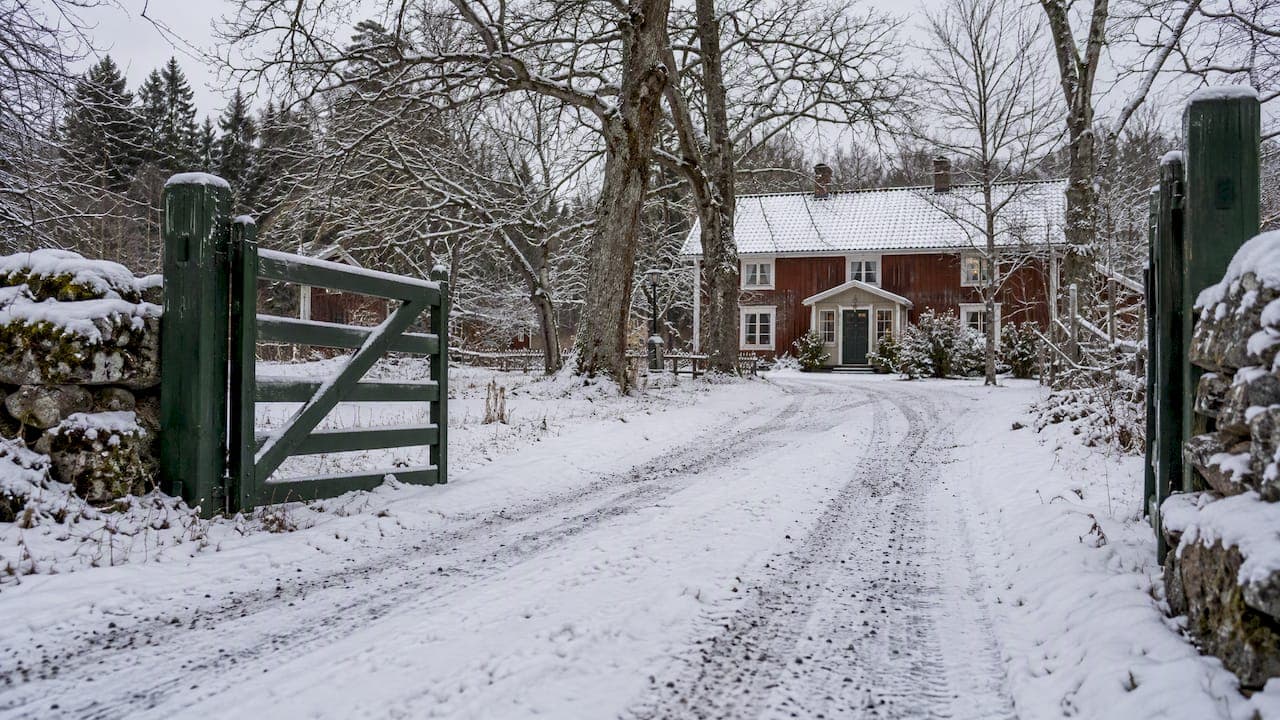
In Swedish, tryggt boende på landsbygden can mean several things. Searching for it often turns up sheltered housing for older people or protected housing for those fleeing violence. If you are planning a holiday, what you want is a countryside stay where you feel secure and unhurried: a house with clear access, honest information from the host, sensible safety around water, fire and forest, and a way to reach help if you need it. This guide explains how to judge that, and how we approach it at Villa Sakis, an 18th-century log farmhouse that you book as a whole.
TL;DR
- "Safe" for a rural holiday means practical certainty: a known access route, a host who answers operational questions, and a plan for signal, weather and emergencies.
- Ask about winter road maintenance, mobile coverage on your own network and the nearest help before you book, not after you arrive.
- Lakes, saunas and forests are the heart of a Swedish stay. They are safest when you treat them with a little routine: never swim alone, tell someone your plans, carry the basics.
- Renting a whole house gives you privacy and control over your own pace, which is much of what makes a countryside stay feel secure.
- Villa Sakis is a whole-house rental in a 1700s log farmhouse with a private sauna, lake access and direct access to forest and meadows.
Table of Contents
- What "safe rural accommodation" means (and what it does not)
- Getting there: roads, seasons and the last kilometre
- Mobile signal: ask about your network, not "the area"
- Why a whole house feels different
- Water: lakes, swimming and the cold
- Forest, meadow and the right of public access
- Exercise and recovery on a slow stay
- Emergencies: what to have in place
- Self-catering with care
- Perspective
- Planning your stay at Villa Sakis
- A short checklist before you book any rural stay
- FAQ
- Sources
What "safe rural accommodation" means (and what it does not)
Before anything else, it helps to separate the meanings, because the search results for this phrase are full of them.
Skyddat boende is temporary housing for people who need protection from violence or threats. It is regulated, and the National Board of Health and Welfare's 2025 regulations on sheltered housing stress systematic risk management and clear security planning for every resident. That is an important service, and it is a different thing from a holiday.
Trygghetsboende is a housing form for older adults, usually from around 70, with daytime staff, safety alarms and shared spaces. Again, a home, not a getaway.
What we write about here is the traveller's version: a rural holiday home where you can relax because the practical questions have already been answered. The countryside in Sweden is generally calm, and what matters is not fear but preparation. A quiet place only restores you if you are not quietly worrying about the road in, the phone signal or the lake.
The research on remote stays points the same way. Specific operational answers matter more than broad assurances that a place is "well equipped". So the rest of this guide is a list of specifics worth asking any host, us included.

Getting there: roads, seasons and the last kilometre
The last stretch of a countryside journey is often a gravel track or a minor road, and it behaves differently in November than in July.
Trafikverket explains that winter maintenance of state roads depends mainly on traffic volume. Roads are divided into five classes, and quieter roads have lower maintenance requirements. In practice, a lane to a farmhouse may be cleared later than the main road you drove along an hour earlier. This is normal rural Sweden, not a fault, but it should shape your plans if you travel between late autumn and early spring.
Before you set out, Trafikverket advises checking its traffic-information map, which shows incidents, roadworks, road conditions, ferries and frost damage. It also recommends leaving in good time and adapting your speed to conditions.
Questions worth putting to any host:
- Is the final approach paved, gravel or unploughed in winter, and who clears it?
- Does a normal car manage it year-round, or would you want winter tyres or higher clearance? (General remote-stay guidance suggests confirming seasonal restrictions and vehicle requirements in advance.)
- What is the address or coordinates to give a taxi, a delivery or, if ever needed, an ambulance?
- Where is the nearest shop that is open on a Sunday?
If you want to read about how a stay of this kind is shaped, our journal piece on what to expect from a Swedish countryside vacation covers the planning in more depth.
Mobile signal: ask about your network, not "the area"
Digital quiet is a reason many people come to the countryside. Being unreachable in an emergency is not. The two are compatible if you know where you stand.
The Swedish Post and Telecom Authority reports that in November 2025, basic mobile coverage reached 89.95% of Sweden's total area, and good-capacity coverage reached 81% of populated areas. The detail that matters for you: the survey combines all operators. An area counted as covered has coverage through at least one operator, and others may have none there.
So the useful question is "which network works best at the house, and does it reach the lake and the forest edge?" Ask the host, and check the operator's own coverage map for the address. It is also sensible to download offline maps before you travel, as remote-stay guidance advises.
A small habit helps: keep one phone on the stronger network and treat the rest of the weekend as optional. Many guests leave phones in a drawer after the first evening, and that is easier when you know you could reach help in two minutes if you chose to.
Why a whole house feels different
In a hotel or a shared holiday park, security comes from staff and neighbours. In a countryside farmhouse, it comes from something quieter: you are the only guests. There are no corridors, no strangers on the stairs, and no shared kitchen schedule.
Villa Sakis is let as a whole house to one party at a time, whether that is a family, a group of friends or a couple. That arrangement is one reason guests describe the stay as restful. You decide when to cook, when to light the sauna, when to go to bed. Children can move between house, meadow and garden without a reception desk to navigate.
The house itself is a log farmhouse established in the 1700s, with honest timber rooms. Old timber houses have their own rhythm: they creak, they smell of wood, and they hold warmth well when a fire or the heating is on. It is worth asking any host of an older building about heating, fire safety equipment and how the house is ventilated, and we are glad to answer these for our own.
Water: lakes, swimming and the cold
Sweden's lakes are one of the great pleasures of a countryside stay, and a swim at the end of a sauna is the classic Swedish ritual. A few habits make it safe rather than merely lovely:
- Never swim alone, especially in cold water or when you are tired.
- Walk in, do not jump: cold shock is real, and you do not know what lies under the surface of an unfamiliar shore.
- Keep children within arm's reach of the water and agree a rule about the jetty or shoreline before the first swim.
- Keep cold dips short and warm up gently afterwards.
- Leave alcohol for after the water, not before it.
- Know where you will get out: ladder, shallow shelf or jetty steps, in daylight, before you need them.
If you have a heart condition, high blood pressure or are pregnant, speak to your doctor before alternating between a hot sauna and cold water. This is a question for a medical professional, not a host.
Our guide to a true lakeside stay in Sweden lists what we think a host should be able to tell you about the shore, and the private sauna holiday guide explains how a sauna session works if you have never had your own.
Forest, meadow and the right of public access
The walking is half the reason to come. Sweden's right of public access (allemansrätten) lets you roam widely, with limits. Naturvårdsverket, the Swedish Environmental Protection Agency, explains that it excludes private protection zones near residences, and that staying overnight in a tent is, as a rule of thumb, for one or two nights in one place. The right depends on personal responsibility: leave no trace, do not disturb wildlife or people living nearby.
For safety, the same handbook recommends carrying a physical map and compass, a basic first-aid kit, and extra food and water. Check the forecast and tell someone your plans and expected return time.

That last point is the single most useful habit for a forest walk. At a farmhouse where you are the only guests, "someone" can be a note on the kitchen table: where you went, which route, and when you expect to be back. Our two longer guides go into detail: right to roam for farmhouse guests and forest hiking safety: ten essentials.
Exercise and recovery on a slow stay
Many of our guests want movement without a gym: a morning run on a quiet road, a long walk through pine forest, a swim, stretching on the meadow, then sauna and an early night. Training holidays and off-season retreats work well in the countryside because the day has a natural shape: move, eat, heat, rest.
A few practical points keep it safe:
- Build gradually. If you are coming from a desk, a long hilly run on day one is a poor idea.
- Run facing traffic on country roads, wear something bright in autumn and winter, and carry a phone with the 112 app.
- Respect daylight. Nordic winter afternoons are short, and so is the margin for error on a forest path.
- Hydrate around the sauna and rest between rounds.
- Sleep is part of the programme. The dark and quiet of a rural night do much of the work for you.
If you are recovering from burnout, the best plan is usually a light one: one walk, one swim or sauna, one proper meal, and a lot of nothing. Persistent exhaustion deserves the attention of your GP or occupational health service, and a holiday can support that care without replacing it. Our guide to a self-guided wellness retreat in Sweden offers three checks to make before you book.
Emergencies: what to have in place
Sweden's emergency number is 112. SOS Alarm's 112 app lets you see your position and coordinates and share them with others, and shows where the nearest defibrillator is on the map. In the countryside, where an address may not describe where you are standing in a forest, coordinates are valuable. Install the app before you travel and open it once at the house so you know how it looks.
A short arrival routine for the first evening:
- Note the house address and coordinates on paper, beside the phone.
- Find the first-aid kit, fire extinguisher and smoke alarms, and ask where the fuse board is.
- Check which network gives the best signal indoors and by the lake.
- Agree who in the group knows how to call 112 and what to say.
- Learn the sauna stove's routine, including how it is safely extinguished.
Travel insurance is worth having. Global Affairs Canada advises that cover including medical evacuation and helicopter rescue is strongly recommended for adventure tourism in remote areas, and it notes that the traveller carries the responsibility to be informed, physically prepared and equipped for quick weather changes. Most holidays in a farmhouse are far from adventure tourism, but the point holds for long forest walks and winter outings.
Self-catering with care
A kitchen is part of a secure stay: you control what you eat, and you can cook what suits your family. Practical details matter in the countryside, where the nearest large shop may be a drive away. Plan a first shop, bring the basics, and keep a few store-cupboard meals for the day the weather turns.
For local produce, timing and food handling matter as much as taste. Our notes on cooking Sweden's countryside produce safely cover REKO timing and guest-tested tips, and the self-catering packing list will save you a trip to town on arrival. If the stay is in summer, our summer guide describes how the season changes the days.
Perspective
We have always thought that safety on a countryside holiday is mostly a matter of honesty and good habits. A place can be wonderfully remote and still be easy to enjoy if the host tells you plainly how the road behaves in winter, which network works by the lake, and where the first-aid kit lives.
Villa Sakis is a log house from the 1700s, cared for by generations, and we have kept it as a house for people who want to slow down. You book the whole farmhouse, so the meadows, forest edge, lake and private sauna are yours for the stay. Nobody else is sharing the kitchen or the path to the water. For families, couples and friends, that privacy is what lets the nervous part of the mind settle.
Our advice is simple: ask us anything before you come, bring a paper map and a charged phone, tell someone where you are walking, and let the timber rooms do the rest.
Christian
Planning your stay at Villa Sakis
If the picture so far sounds like the kind of trip you want, Villa Sakis is a whole-house rental in a historic Swedish log farmhouse, with a private sauna, lake access, direct access to forest and meadows and a self-catering kitchen. It suits families wanting a peaceful getaway, friends on a nature retreat, couples, and wellness or training travellers who want daily movement and real rest.
We publish no fixed price on the site, so please look at the booking page for availability and ask us your practical questions before you book. You can also read more in our journal.
A short checklist before you book any rural stay
| Question | Why it matters |
|---|---|
| How is the last stretch of road kept in winter? | Quiet roads are cleared to a lower standard |
| Which mobile network works at the house and at the water? | Coverage figures combine all operators |
| Is the stay for the whole house or shared? | Privacy and control over your own routine |
| What are the water and sauna arrangements? | Safe routines depend on the setup |
| Where is the first-aid kit, extinguisher and address for emergency services? | You should not need to search in a hurry |
| Is travel insurance in place? | Covers evacuation and long walks |
FAQ
Is the Swedish countryside safe for a family holiday?
Generally, rural Sweden is a calm place to holiday, and the main risks are practical rather than social: roads in winter, cold water, forest paths and distance from help. Ask your host about each, and keep the 112 app on your phone. At a whole-house rental, you also have the place to yourselves.
Will I have mobile signal in a remote farmhouse?
It depends on your operator and the exact spot. National coverage figures combine all networks, so one operator may reach a place where another does not. Ask your host which network works best, check the operator's map for the address and download offline maps in advance.
Can I swim in a lake and use a sauna safely?
Yes, with sensible habits: do not swim alone, enter the water gradually, keep dips short and keep children close. If you have a heart condition, high blood pressure or are pregnant, ask your doctor first.
Is this the same as trygghetsboende or skyddat boende?
No. Those are housing forms with specific meanings: trygghetsboende for older adults and skyddat boende for people who need protection. A safe countryside stay is a holiday home chosen for calm, clear access and honest information.
Sources
- Nya föreskrifter och allmänna råd om skyddat boende, Socialstyrelsen
- Sheltered Housing (Trygghetsboende) in Sweden
- Mobiltäcknings- och bredbandskartläggningen 2025, PTS
- När kommer plogbilen till din väg?, Trafikverket
- Goda råd på vägen vid storhelger, Trafikverket
- Pre-Arrival Checklist for Staying at an Unusual or Remote Property
- Your outdoor access code for enjoying Sweden's nature, Naturvårdsverket
- Sweden travel advice, Global Affairs Canada
- 112-appen, vanliga frågor och svar, SOS Alarm