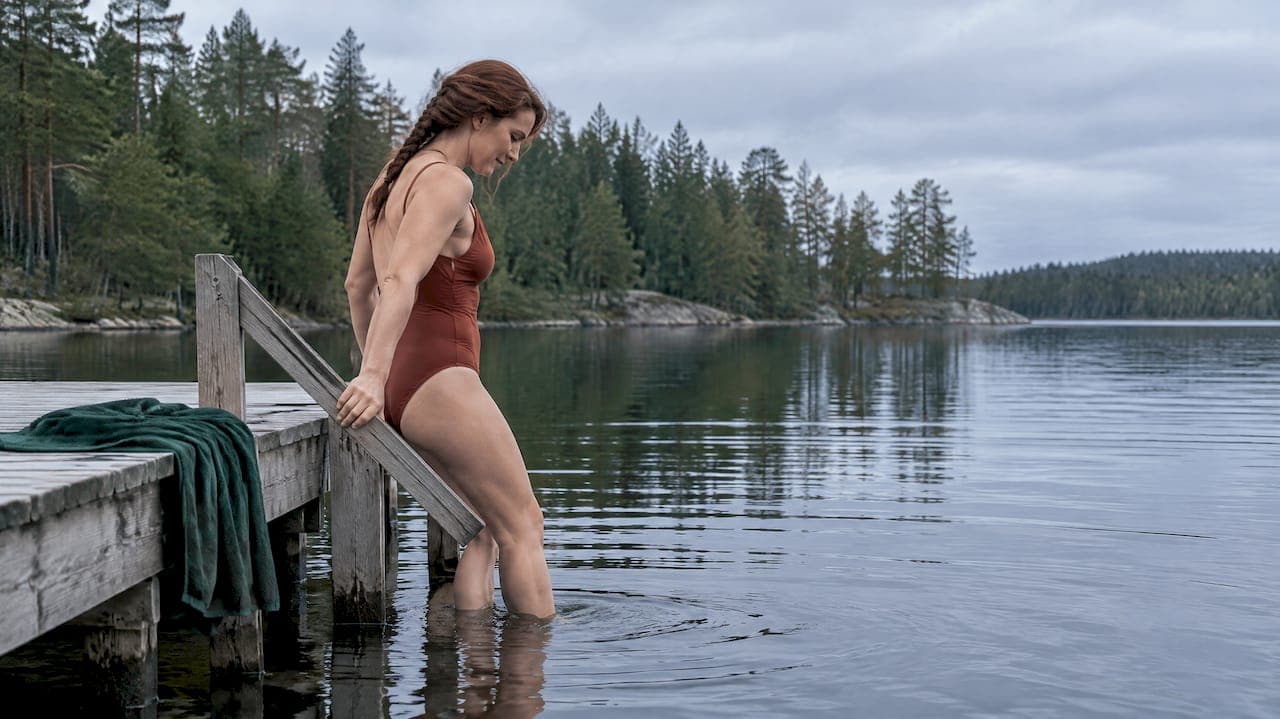
A morning dip in a lake, what Swedes call morgondopp i sjö, is simple in principle: you walk down to the water before the day has properly begun, step off a jetty, and come back up the path awake. Doing it well takes a little more care. You need to know the water is safe, that you are allowed to swim where you stand, that someone knows where you are, and that you have a way to get warm afterwards. This guide covers each of those, at the unhurried pace the ritual deserves.
TL;DR
- Check the bathing place on the national bathing-water service and read any signs on site before you get in. A recent result is not a guarantee.
- Under allemansrätten you may generally swim from a shore or jetty outside someone's home-protection zone, but leave a private jetty if its owner needs it.
- Do not swim alone. Agree the place and the duration with a buddy or a person on shore, and wear something bright.
- Keep the first dips short, and have a towel, dry layers and a warm drink ready before you go in.
- A farmhouse with its own lake access and sauna makes the routine easy to repeat each morning.
Table of Contents
- Why a morning dip is worth the effort
- Choosing the right lake and the right spot
- Check your own swimming, not just the lake
- What to bring for a morning swim
- Do not swim alone
- How the dip changes with the seasons
- Warming up afterwards
- Our perspective: a dip should be easy to repeat
- A farmhouse for a lakeside morning routine
- A simple morning plan
- Common mistakes to avoid
- FAQ
- Sources
Why a morning dip is worth the effort
Early in the day a Swedish lake is often at its stillest. The surface is flat, the air smells of pine and cold stone, and the only sound may be a bird further along the shore. People who make the dip a habit tend to describe it less as exercise and more as a quiet way of marking the start of the day, before phones and plans arrive.
It also suits the kind of holiday many guests come to us for: a slower, older, more restorative kind of trip. A short swim, a walk through the meadow, breakfast in the kitchen and a long day with nothing scheduled. If you are travelling to recover from a hectic year, to train gently, or simply to sleep better, the dip gives each morning a shape.
Choosing the right lake and the right spot
Sweden has a great many lakes, and not all of them are equally pleasant or equally safe at 7 a.m. Three things matter most: the water quality, the access, and the entry itself.
Water quality first
The national agency Havs- och vattenmyndigheten (HaV) runs a service called Badplatsen, where you can search for a bathing place and read the latest water-quality result and any advice. HaV explains that the latest result is not a guarantee, and that municipalities are responsible for sampling, monitoring and informing the public, as well as for advising against bathing when there is a health risk. Not every lake is an official bathing place, so if yours is not listed, rely on your own eyes and on local knowledge.
Signs count too. Lilla Krisinformation advises checking warning signs at the bathing place and looking the place up in the HaV service before you swim. We have written a longer piece on five live checks to tell if a Swedish lake is safe to swim, and another on why signs can beat websites when you are standing at the water's edge.
Reading the water by eye
Morning light makes it easy to see what the lake is doing. Two rules are worth carrying with you:
- Do not swim during an algal bloom. Lilla Krisinformation notes that swallowing toxic water can cause stomach pain, diarrhoea or vomiting, and it singles out water that looks like spinach soup.
- Uppsala municipality advises avoiding visibly blooming, cloudy or algae-coloured water, and waiting several days after a bloom disappears because toxins may remain. It also points out that you cannot tell from appearance alone whether a bloom is toxic, so its practical precaution is to stay out if you cannot see your feet when standing knee-deep.
The knee-deep test is a good habit to adopt. It takes five seconds and needs no equipment.
Where you are allowed to swim
Sweden's right of public access is generous but has limits. Naturvårdsverket's handbook says swimming is covered by allemansrätten when the shore, rock or jetty lies outside another person's home-protection zone, the hemfridszon. The same guidance tells you to leave a jetty if its owner needs it, and to check restrictions in bird-protection areas, nature reserves and national parks.
In practice that means you do not wander across someone's garden to reach the water, and you do not treat a private jetty as your own. If you want the full picture, our guide to the Swedish right to roam for farmhouse guests goes through it step by step.
In towns the rules can be stricter. Stockholm, for instance, states that swimming is generally prohibited in harbour areas and permitted only at marked locations, within 10 metres of the shoreline. If you are planning a city swim rather than a countryside one, our piece on swimming from a jetty in Stockholm covers the legal and safety side.
The entry
A jetty with a ladder is the easiest and safest way into a lake in the early morning, particularly when the stones are slippery with dew. A sandy, gently shelving shore also works. Avoid jumping or diving into water you do not know. In a lake you have not swum in before, wade or climb in, and look at what is under your feet first.

Check your own swimming, not just the lake
It is easy to assume that if you swim lengths in a pool you can manage a lake. Svenska Livräddningssällskapet (the Swedish Life Saving Society) is blunt about this: swimming ability is perishable, it should be tested if you do not swim regularly, and swimming 200 metres in an indoor pool is not the same as swimming 200 metres in open water.
The society's Nordic definition of being able to swim is to fall into water, submerge the head, resurface and swim 200 metres in deep water, including 50 metres on your back. If that sounds demanding, treat it as a guide to how far you should go: keep to the shallows, stay near the jetty, and do not stretch your first swims of the trip.
What to bring for a morning swim
The kit list is short. What matters is that everything is set out before you go down, because fumbling in the cold is when mistakes happen.
| Item | Why it helps |
|---|---|
| Large towel or robe | Dry quickly and cover shoulders before you start to shiver |
| Dry layers, including a hat and warm socks | Hands, feet and head cool fastest, and a hat keeps in a surprising amount of warmth |
| Shoes you can slip on | Grip on wet planks and a quick walk back up the path |
| Bright swim cap or tow float | Makes you visible to anyone watching from land or from a boat |
| Thermos of tea or something warm | Something to hold and sip while the body settles |
| Phone in a dry pocket on shore | For the person watching, not for you in the water |
In the shoulder seasons a wetsuit can extend the swimming year. Växjö's official guide says that short- or long-sleeved wetsuits make open-water exercise possible in its lakes from May to September. Many people prefer to swim without one for a short dip, but it is a sensible option if you want to stay in longer.
Do not swim alone
This is the one rule we would not bend. Växjö's guide advises against swimming alone. If no swimming partner is available, it suggests arranging a person on land whom you can signal, agreeing the route and duration beforehand, and wearing a brightly coloured cap or using a tow float.
In a group the arrangement is easy, but easy things get forgotten. Someone assumes someone else is watching, and nobody is. It helps to give people clear jobs before the trip begins; assigning simple roles for a cabin trip with friends works as well for who watches the shore at 7 a.m. as it does for who books the groceries.
A few habits that make the buddy system real:
- Decide the night before who goes in and who stays dry on the jetty, and swap the next day.
- Agree a duration out loud, and a signal for "come back now".
- The person on shore keeps a towel and a warm layer in hand, not in a bag.
- With children, an adult stays within arm's reach. Our two-minute lake safety briefing for parents is a good thing to read together before the first swim.
How the dip changes with the seasons
Summer, spring and autumn lakes are different animals, and the precautions follow.
Summer. The water is at its warmest, algal blooms are more likely, and the morning swim is mostly about checking clarity and signs. The dip can be as long as you enjoy.
Early autumn and late spring. Air and water can be at odds: a still, bright morning with a cold lake. Keep the dip shorter than you think necessary, and have your warm layers ready. Public water-temperature maps help. Temperatur.nu, for example, shows measurements submitted by private individuals, companies, municipalities and SMHI coastal stations, usually taken 20 to 50 centimetres below the surface. Treat these as a guide only, since a sensor in one bay says little about the lake where you are standing.
Cold months. Swimming in near-freezing water is a different activity, with its own preparation, and not something to try without experience, company and a warm place to go straight afterwards. If you have a heart condition, high blood pressure or any other medical concern, speak to your doctor before you start cold-water swimming.

Warming up afterwards
The dip is only half the ritual. Getting warm well is what makes it restorative rather than merely brisk.
- Dry off and dress at once. Do not stand around admiring the view in a wet swimsuit. Towel first, then hat and dry layers.
- Cover the extremities. Hands, feet and head cool fastest and are the last to warm.
- Move gently. A brisk walk back up to the house helps the body warm from within. Skip a hard workout straight away.
- Something warm to drink. Tea or coffee, and then breakfast.
- Expect a second wave of chill. Shivering can return a few minutes after you get out, as cooled blood from the arms and legs circulates. If it does, keep dressing, keep moving and sit somewhere warm. If you feel unwell, confused or cannot stop shivering, get warm indoors and seek medical advice.
And of course, a sauna, if you have one. A short, gentle sauna after the swim is the classic Swedish way to finish, and we say more about it in our private sauna holiday guide. Take it easy on the first rounds, drink water, and do not go from the hottest bench straight into cold water if you have any doubts about your heart or circulation.
Our perspective: a dip should be easy to repeat
We look after a log house that has stood since the 1700s, and over the years we have noticed that the mornings guests remember are rarely dramatic. They are the ones that follow a pattern: a quiet walk across the meadow, a swim from the jetty, a sauna, then coffee in a kitchen that smells of old timber. The ritual works because it is close and unforced.
That is why we think the best lake for a morning dip is the one that is easy to reach, easy to check, and comfortable to come back to. A long drive to a famous spot undoes much of the calm. A lake you can look at from the kitchen window, learn over several days, and read in different light is better. By the third morning you know where the water is clear, where the stones are slippery and how long you want to stay in.
We would also say, gently, that you do not need to be brave. A short dip, a shore companion and a warm towel are the whole of it. If the lake looks wrong, you go and have coffee instead, and nothing is lost.
— Christian
A farmhouse for a lakeside morning routine
If you would like to build a trip around this kind of morning, Villa Sakis is a whole 18th-century Swedish log farmhouse that you book for your own private use, with lake access, a private sauna, forest and meadow at the door and a self-catering kitchen. You can see the rooms and the setting on The House page, and check availability and book directly on our stay page. We are also listed on Airbnb. For a wider sense of what to plan, our lakeside stay checklist for Sweden lists what to ask any host before you commit.
A simple morning plan
Here is how a first morning at the water might look, with no rush built in.
- Evening before. Look up the nearest bathing place on the HaV service if it is listed, and read the latest result and advice. Set out towels, hat and a thermos by the door.
- On waking. Look at the lake from the shore. Can you see your feet at knee depth? Are there any signs, blooms or scum?
- At the jetty. Agree with your companion how long you will stay in and who is watching. Put on the bright cap if you have one.
- In the water. Enter slowly, breathe out steadily, and keep close to the jetty. Short is fine. A minute or two in cool water is a real swim.
- Out. Towel, hat, dry layers, shoes. Walk back briskly rather than at a run.
- After. Sauna if you have it, then something warm to drink and breakfast.
Repeat the next day, a little differently if you like, and keep to the same pattern. The habit is what makes a stay feel like a rest.
Common mistakes to avoid
- Trusting last week's result. Water quality can change. Use the latest result and your own eyes together.
- Using a neighbour's jetty. The right of public access has limits, and a private jetty or garden is not part of it.
- Staying in because it feels fine. The first minutes can feel manageable even when the body is cooling. Get out earlier than you think you must.
- Going in alone because it is only a quick dip. Most problems in the water are quick ones. Someone on shore changes the picture entirely.
- Swimming straight after a heavy night or on an empty stomach. Keep the morning gentle.
FAQ
Is it safe to swim in a lake first thing in the morning?
It can be, if you check the water and swim with someone watching. Look up the bathing place on HaV's service, read any signs on site, and stay out if the water is visibly blooming or you cannot see your feet at knee depth. Keep the first dip short, and do not swim alone.
Am I allowed to swim from any shore or jetty in Sweden?
Generally yes, under allemansrätten, as long as you stay outside another person's home-protection zone and do not cross private gardens or cultivated land. Leave a jetty if its owner needs it, and check for restrictions in nature reserves, national parks and bird-protection areas. In some towns, swimming is limited to marked places.
What should I wear for a morning lake swim?
In summer a swimsuit and a bright cap are enough for most people, with a robe or large towel waiting on shore. In the shoulder seasons, a short- or long-sleeved wetsuit can make longer swims comfortable. Whatever you choose, have dry layers, a hat and shoes ready for when you get out.
How do I warm up after a cold swim?
Dry off at once, put on dry layers with a hat and warm socks, and walk back gently. Have a warm drink, and expect the chill to return briefly after you come out. If shivering will not stop or you feel confused or unwell, get warm indoors and seek medical advice.
Sources
- Fakta om badvatten, Havs- och vattenmyndigheten
- Bada inte om vattnet är otjänligt, Lilla Krisinformation
- Algblomning, badklåda och bakterier i badvattnet, Uppsala kommun
- Din handbok i naturen, Naturvårdsverket
- Places where swimming is permitted, City of Stockholm
- Simskola, Svenska Livräddningssällskapet
- Swimming in the open water: Växjösjön and Trummen, Växjö
- Vattentemperaturer i Sverige, Temperatur.nu