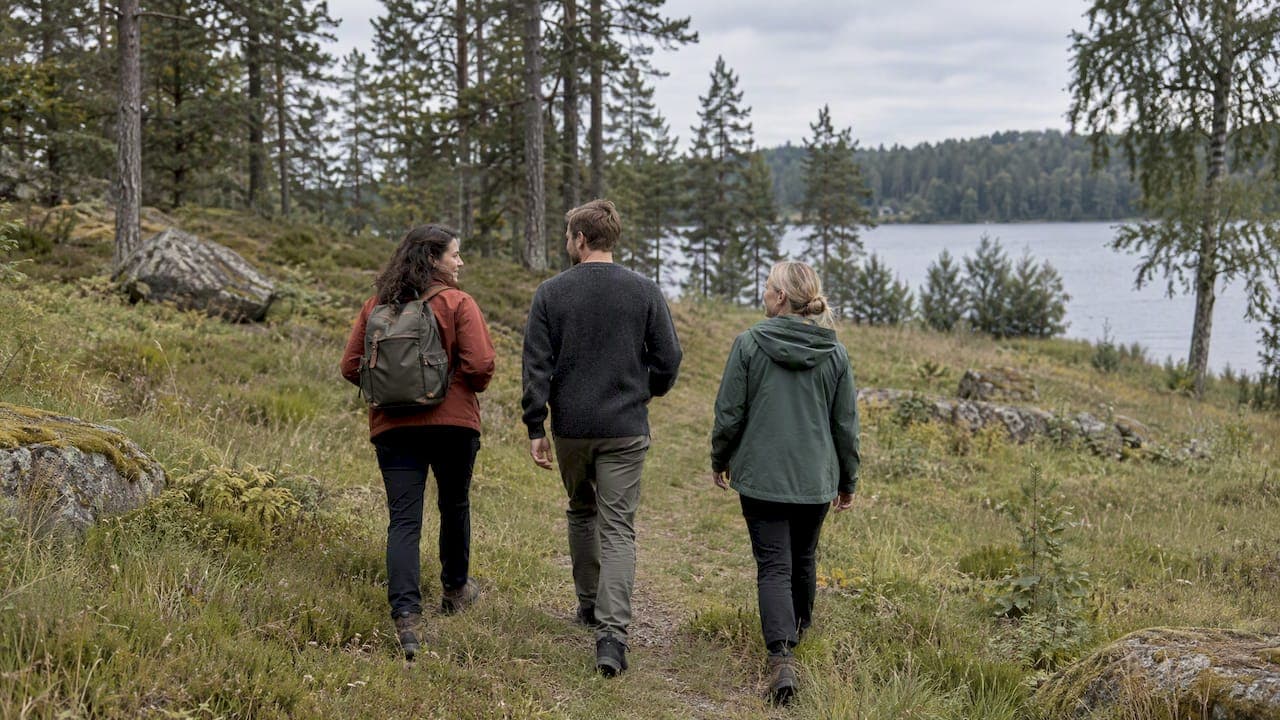
A good friends' trip to the Swedish countryside comes down to three decisions: one house that suits everyone, a loose plan with room for doing nothing, and a few shared habits about food, money and quiet. Get those right and the rest, the forest walks, the lake, the long dinners, tends to arrange itself.
We look after a historic log farmhouse in Bergslagen, and we have thought a good deal about what makes a group stay work. This guide gathers that thinking, along with the official rules for roaming, camping and fires in Sweden, so your group arrives prepared and unhurried.
TL;DR
- Rent one whole house rather than separate rooms: shared space such as a dining table and several places to sit matters more than a long list of extras.
- Plan one or two shared activities a day at most, and protect empty hours. Sweden's own tourism board suggests leaving room in the itinerary for doing nothing.
- Learn the basics of allemansrätten, the right of public access: you may roam and camp briefly, but you must respect the private zone around homes and check for fire bans.
- Agree on transport, shopping and cooking duties before you travel, not at the supermarket checkout.
- Choose the season by the kind of trip you want: long light evenings and swimming, or autumn colour, wood smoke and sauna.
Table of Contents
- Why the countryside suits a trip with friends
- Choosing the house and the area
- What friends can do together in the countryside
- Right of public access: what your group needs to know
- Getting there, eating and sharing the work
- Balancing activity and rest
- Choosing the season and what to pack
- Our perspective
- Stay with us in Bergslagen
- FAQ
- Sources
Why the countryside suits a trip with friends
City breaks with friends tend to be built around a schedule: tables booked, tickets bought, trains caught. The countryside works the other way round. There is little to book, so the group's attention goes to each other.
Sweden is well suited to this. Visit Sweden notes that the country has 267,570 islands, many of them uninhabited, and the same piece describes a culture that values personal space and silence. For a group of friends, that means you can be together without being on show. One person can read by the window while others walk to the lake, and nobody needs to explain.
The second reason is cooking. A shared kitchen turns a meal into an event: someone chops, someone lights the stove, someone lays the table. Conversation tends to be better with a task in hand.
The third is the simplest. Without a screen-lit city around you, evenings become long and unhurried, with cards, a sauna, a late walk. Friends who see each other in snatches during the year rarely get that.
Choosing the house and the area
The house is the trip. Everything else, the walks, the meals, the mood, depends on whether twelve rooms' worth of friendship fits comfortably under one roof.
Whole house or separate rooms
A whole-house rental gives your group a space of its own, with no other guests to share corridors or breakfast tables with. Practical guidance on renting for groups points to open floor plans, enough dining space and several sitting areas as what makes shared houses work. That matches our experience: a group is happiest when people can split into twos and threes without anyone feeling left out.
When you compare houses, look at:
- The dining table. Can everyone sit at it at once?
- Places to retreat. More than one room where a few people can sit, talk or read.
- The kitchen. Enough surface and equipment for two people to cook together.
- Sleeping arrangements. Whether the beds suit your mix of couples, singles and early risers.
- Nearby nature. A trail or lake you can reach on foot, so nobody has to drive to start the day.
Quiet or lively surroundings
The same group-rental guidance notes that properties in commercial or resort areas may be better suited to noise-intensive gatherings than homes in residential neighbourhoods. Turn that around and it becomes a useful test. If your idea of a good weekend is music and late nights, a resort area fits. If it is a long breakfast, a sauna and a forest walk, look for a house set among meadows and trees, where the loudest sound is wind in the pines.
It is worth being honest about this within the group before you book. A trip planned around two different ideas of fun often disappoints both camps.
A farmhouse in Bergslagen
Our own house is a Swedish log farmhouse with roots in the 1700s, set among meadows and pine forest in Bergslagen. It has honest timber rooms, a private sauna, access to a lake, a self-catering kitchen and the forest right outside the door. You book the whole house, which suits friends who want a trip to themselves. You can read more about renting a whole historic farmhouse or see what to expect from a Swedish countryside holiday.

What friends can do together in the countryside
The best countryside activities are the ones that need no organising. Here is how we think about them, from slowest to most active.
Slow, shared pleasures
- Sauna and a swim. Heat, then the lake, then a blanket on the steps. It is the most social thing you can do in silence. Our guide to a true lakeside stay in Sweden covers what to check before you go.
- Fika. A coffee break with something baked is as close to a national institution as Sweden has. Visit Småland's account of a shared cottage stay mentions hiking, cycling, swimming, fika and relaxing together, which is a fair outline of what a friends' week looks like.
- Cards and board games. The same account describes card games at the cottage in the evenings. Bring a deck.
- Cooking a big meal. See our notes on a holiday with a country kitchen.
Gentle movement
- Forest and meadow walks from the front door, with a thermos and no destination.
- Cycling on quiet country roads, a pace at which everyone can still talk.
- Morning exercise. For friends who like to train, a run or stretching session on a forest track before breakfast sets up the day. Our guide to a self-guided wellness retreat explains how to build this in.
- Foraging for berries and mushrooms, within the rules we describe below, and only for what you can identify with certainty.
One bigger shared challenge
Some groups like a single adventure to anchor the trip. A timber-raft journey on the Klarälven in Värmland, where guests build a raft from logs and rope and camp along the river, is presented by its organiser as suitable for groups of friends. Building and steering a raft calls for joint planning and cooperation, and it still leaves time to relax on the water.

If your group prefers boats to be simpler, there is a case for why pontoon boats suit large groups on a lake day: everyone fits, and nobody has to paddle.
Right of public access: what your group needs to know
Allemansrätten is the reason a Swedish countryside trip feels so open. It is not a law as such, but it is supported by the Swedish Constitution (Regeringsformen 2:15). For a group, the useful points are these, taken from the Swedish Environmental Protection Agency's guidance:
- Roaming. People may walk almost everywhere and stay briefly on suitable land away from homes, provided they avoid damage.
- The private zone. You may camp on someone else's land for a night or a few days if you show consideration, respect the homeowner's privacy (hemfridszon) and do not disturb or destroy nature. The more people in your group, the further from houses you need to be, so keep tents small in number and well away from anyone's garden.
- Fire. Use a fixed fireplace or a base of sand or gravel, extinguish the fire completely, and check for fire bans. The agency also warns against lighting fires directly on rock, which can crack, and notes that fire bans are common in summer. A small field stove may still be used during a ban, according to the same guidance.
- Swimming. Swimming is allowed outside the private zone. Staying on your own rented property's shore is the simplest course.
For the fuller picture, see our right to roam guide for farmhouse guests. Before any fire, look up the current fire-ban status for the county you are in; the local municipality or county administrative board publishes it.
Getting there, eating and sharing the work
The things that strain a group are rarely dramatic. They are who drives, who pays, and who is still cooking at ten.
Transport
Many rural houses are a drive from the nearest station. Decide early whether you will take the train to the closest town and share a hire car or taxi for the last stretch, or travel together in one or two cars. Public transport, walking and cycling are what regional planners in Sweden promote as sustainable travel, as in Trafikverket's infrastructure plan for Halland, which prioritises cycle infrastructure. For a holiday, that points to a sensible habit: arrive once, then leave the car parked and do the rest on foot or by bike.

Food
The first shop is where a holiday is won or lost. Our approach:
- Pick one person to draw up the list, based on a quick message to the group about allergies and dislikes.
- Buy staples for the whole stay in one go: coffee, bread, butter, eggs, potatoes, oil, spices.
- Give each evening an owner. One person or pair plans and cooks, everyone else clears up.
- Keep one simple dinner in reserve for the evening nobody feels like cooking.
A kitchen where several people can work at once makes this enjoyable rather than a chore.
Money and chores
Agree up front how to split the house, the food and the fuel. A shared payment app and a single running list in the group chat save awkward moments later. Chores such as firewood, sauna heating and rubbish are easier when they are rotated by name and written down on the fridge.
Balancing activity and rest
Groups tend to over-plan. Everyone wants to make the most of the weekend, so the schedule fills, and by Sunday the group is tired.
Visit Sweden's advice runs the other way: leave room in the itinerary for doing absolutely nothing, and let everyone recharge at their own pace. We think that is right, and it is especially true with friends, because different people need different amounts of company.
A rhythm that works for us:
- Morning: slow. Coffee, a walk, no agenda until late morning.
- Midday: one shared activity, such as a longer walk, a bike ride or a swim.
- Afternoon: free. Read, nap, bake, sit by the water.
- Evening: a shared meal, then the sauna, then cards or conversation.
This follows the pattern of hikes and bike rides balanced with relaxing at the cottage that Visit Småland describes. If one person wants to opt out of an activity, let them. The point is that the trip serves the group, not the other way round.
For more on this pace, see our guide to a slow holiday in Sweden.
Choosing the season and what to pack
There is no wrong season, only a different trip.
| Season | What it offers friends | Pack with this in mind |
|---|---|---|
| Late spring | Fresh green forest, quiet, cool mornings | Layers, waterproofs, sturdy boots |
| Summer | Long light evenings, lake swimming, outdoor dinners | Swimwear, sun hat, insect repellent, a light jumper for evenings |
| Autumn | Colour in the woods, mushrooms, sauna weather | Warm layers, rain jacket, head torch |
| Winter | Snow, stillness, deep sauna evenings | Thermal layers, wool socks, winter boots, a flask |
Our summer in the Swedish countryside guide goes into the warm months in more detail.
Whatever the season, a short packing list helps:
- Comfortable walking shoes and a pair of indoor slippers or thick socks for the timber floors
- A rain jacket, whatever the forecast
- A towel for the sauna and the lake, if the house does not provide enough for everyone
- A head torch for evening walks, since rural roads and paths are dark
- Cards, a book, a speaker if you like music
- Any food items that matter to you, such as a favourite coffee
Check with your host what is provided, and bring your own medication and any specific supplies.
Our perspective
We have watched many groups arrive at the farmhouse. Often they come a little frayed: busy jobs, group chats full of plans that never happened. By the second evening something shifts. Voices lower, people begin to cook together, and the sauna becomes the centre of the day.
That is why we believe in renting the whole house. An old log building, with honest timber rooms and its own sauna, gives a group somewhere to be together without performance. There is no lobby, no neighbouring table, and no checkout rush at ten. There are meadows to walk through, pine forest at the door and a lake close by.
Our advice to friends is simple: plan less than you think you need. Pick one thing to do each day, and let the rest be what it will. The house has been cared for by generations, and it is built for exactly this kind of slow, restorative time.
Christian
Stay with us in Bergslagen
If your group is looking for a private, historic setting with a sauna, a kitchen and the forest on the doorstep, Villa Sakis is a whole-house stay in the Swedish countryside. You can see the house and check availability on our booking page.
For couples in your group who are tempted to extend, we also write about a private romantic nature weekend.
FAQ
How many days is right for a friends' trip to the countryside?
A long weekend of three nights is enough to settle in and still go home wanting more. Five to seven nights suits groups who want to cook together properly and spend a few days doing very little. Longer stays also let people drift in and out of group activities without guilt.
Can we camp or light a fire near the house?
Under allemansrätten, short-stay camping is allowed on suitable land away from homes, but you must respect the private zone and avoid damage. For fires, use a fixed fireplace or sand or gravel, extinguish it fully and check for fire bans first. On rented land, always ask your host what is permitted.
How do we keep a group of friends from over-planning?
Pick one shared activity a day and leave the rest open. Visit Sweden itself recommends leaving room for doing nothing. Agree in advance that anyone can skip an activity without explanation.
Is the countryside good for friends who do not know the area?
Yes. Most of what makes a countryside trip enjoyable needs no local knowledge: a trail from the door, a lake, a sauna, a kitchen. Ask your host for a few walking routes and the nearest shop, and you have what you need.
Sources
- Why Sweden is a paradise for introverts, Visit Sweden
- How to Rent a Vacation House for a Group, Faroway
- Holiday in Småland, Visit Småland
- Timber raft on the river Klarälven, Vildmark.se
- Allemansrätten, en vägledning, Naturvårdsverket
- Allemansrätten paddling, Naturvårdsverket
- Regional infrastrukturplan Halland 2022-2033, Trafikverket