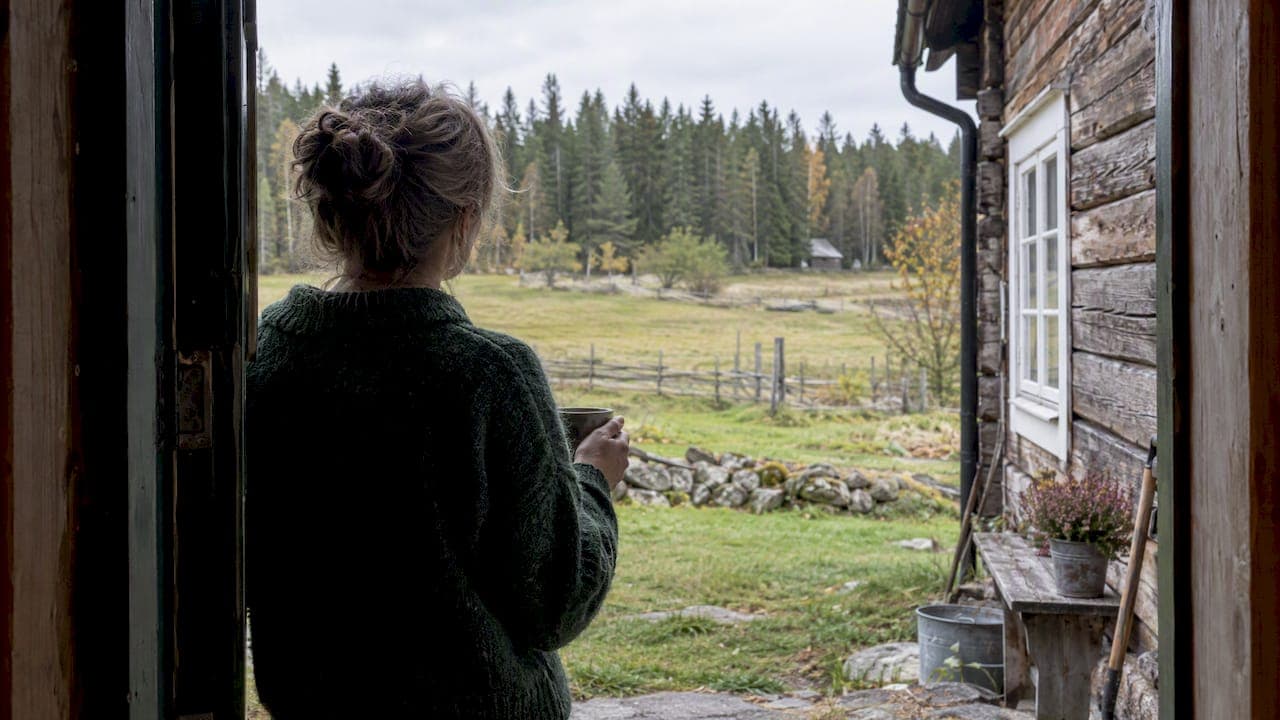
A slow holiday is a trip built around fewer things and more time: one place, a few unhurried days, and a daily rhythm you set yourself. In Sweden it fits naturally, because the country offers quiet landscapes, lakes, forest and a long habit of being outdoors. The practical advice is simple. Stay in one place for at least four nights, book somewhere with its own sauna and water nearby, and plan less than feels sensible.
TL;DR
- Choose one base and stay put. A slow holiday gets its value from repetition: the same path, the same lake, the same table.
- Allow two days to downshift before you expect real rest. Going straight from work to stillness often does not work.
- Plan one anchor per day at most, and leave the rest empty. Visit Sweden's slow travel guidance says the same: create space, not more activities.
- Heat and cold, a sauna followed by a lake, make a good daily ritual, and a whole house with its own sauna makes it easy.
- Know the rules of the countryside, especially allemansrätten, so you can walk freely and still be a good guest.
Table of Contents
- What a slow holiday actually is
- Why the first two days matter most
- Choosing the place: why a whole house changes the pace
- A daily rhythm that needs no schedule
- What to leave out
- When to go
- Making the time: Swedish holiday rights in brief
- Our perspective
- Respecting the land: allemansrätten
- Book a quiet week at Villa Sakis
- FAQ
- Sources
What a slow holiday actually is
The Swedish search term långsam semester describes something most of us recognise from the other kind of holiday. You return home needing a holiday from your holiday, because the days were full of transfers, queues, timetables and photographs.
A slow holiday reverses that. You choose a single place and let the days take their shape from the weather, the light and how you feel. You cook, walk, read, swim, sleep. You might drive somewhere once or twice, but nothing depends on it.
Visit Sweden's 2026 trend analysis describes the shift well. Travel is increasingly used for presence, recovery and direction rather than pace and performance, and the report suggests limiting both the number and length of activities and planning longer pauses for rest and reflection. It also points to the low and shoulder seasons as a natural fit, when calm itself is part of the experience.
That is not an exotic idea. It is an older, quieter way of travelling, and one that Swedish farmhouses were more or less built for.

Why the first two days matter most
Most people arrive tired and slightly wired. They have spent the last week finishing things, and the body has not yet been told that it can stop.
Hanna Malmberg Gavelin, a psychology researcher, makes the point in a forskning.se piece on recovering during the summer holiday: moving from high stress to real rest usually needs a transition, not a switch. Trying to shift instantly from intense work to deep rest often fails. A gradual downshift is what lasts.
In practice that means three things.
- Do not judge the first day. Feeling restless on arrival is ordinary. Unpack, light the stove or the sauna, walk to the water, go to bed early.
- Remove the temptation to fill time. If you have booked a day trip for day two, you have already told yourself that rest is optional.
- Stay long enough. A single night is a change of scenery. Four or five nights is a different kind of trip.
The Visit Sweden 72 Hour Cabin study is a useful reference here. Five people with stressful jobs spent 72 hours in glass cabins in Dalsland, and the results published by Visit Sweden, with stress researcher Walter Osika involved, reported a 70% decrease in stress levels and a drop in systolic blood pressure. It was a small group, not a clinical trial, so read it as an encouraging indication, not a promise. But the three-day timescale is telling: a long weekend is the minimum, and a full week is better.
Choosing the place: why a whole house changes the pace
Where you stay shapes how slowly you can go. A hotel puts you on someone else's timetable: breakfast hours, check-out, shared corridors. A whole house gives the day back to you.
When you look for a base for a slow holiday, we would suggest asking these questions.
| What to check | Why it matters for a slow stay |
|---|---|
| Is it the whole house, privately yours? | You set the hours. No shared spaces, no one else's noise. |
| Is there a kitchen you can really cook in? | Slow days revolve around meals made unhurriedly. |
| Is there a sauna on the property? | A daily heat ritual anchors the day without any planning. |
| Is there water within walking distance? | Swimming replaces the need for an activity. |
| Can you step straight into forest or meadow? | A walk should start at the door, not in a car park. |
| How long is the drive from the nearest town? | Close enough for supplies, far enough for quiet. |
At Villa Sakis we rent out the entire farmhouse, a log house that dates back to the 1700s, to one party at a time for private use. It has timber rooms, a private sauna, lake access, a self-catering kitchen, and meadows and pine forest directly outside. The house stands in Bergslagen, and you can read more about the house itself.
There is nothing complicated about what we offer, and that is deliberate. The house has been cared for by generations, and our aim is to keep it a place where little needs to be done and a great deal can be noticed.
A daily rhythm that needs no schedule
A slow holiday does not mean a day without structure. It means a structure you could follow without looking at your phone. Here is how one might look at a farmhouse in the countryside.
Morning: the long start
Coffee without a screen. A walk, even a short one, along the edge of a meadow or into the trees. Breakfast made from whatever you brought, eaten slowly. Some guests use the first hour for movement, a run or stretching, because the surroundings invite it. We have written separately about how a nature training retreat works for those who want to combine exercise with rest.
Midday: one thing, not five
Pick a single anchor. A longer walk. A paddle. A drive to a nearby village, a market, or a historic site. Bergslagen is the old mining and ironworking region of central Sweden, and it has much to see if you want it: Sala silver mine and Engelsberg ironworks are among the places regional guides recommend, and both are well worth a half day. After that, go home. Nothing is gained by squeezing in a second attraction.
Afternoon: nothing at all
This is the part people find hardest and benefit from most. Read. Nap. Sit on the step. Watch the weather change over the field. If a day feels empty, it is probably working.
Evening: heat, then cold
Light the sauna, sit until you are properly warm, then walk to the lake and get in. Repeat once or twice. Visit Sweden's 2026 trend release on Viking wellbeing describes wood-fired baths and forest immersion as a leading Swedish travel theme this year, built on the essentials of nature and the luxury of time. Alternating warmth and cold is also an old Swedish habit, and you do not need to treat it as a performance. A short dip is enough. If you have a heart condition, high blood pressure or are pregnant, speak to your doctor before alternating heat and cold water, and never swim alone in cold water.

Then cook, eat, and go to bed while it is still quiet. The aim is to let your sleep come to you.
What to leave out
Slow holidays are mostly decided by what you decline to do. A short list of things we would leave at home or leave undone:
- A packed itinerary. One anchor per day is the ceiling.
- Work email. If you cannot switch it off entirely, set one fixed check, ten minutes, and stick to it.
- Long drives between places. Choose one base and use it. Practical planning tips for northern, nature-heavy destinations from Iceland make a similar point about not over-scheduling transfers.
- Big shopping lists. Buy simple food and cook it simply.
- Expectations. Some days will be grey and some restless. That is part of the trip.
For a fuller account of what to pack and what the days feel like, our guide to the Swedish countryside vacation walks through the practicalities.
When to go
Each season gives a different kind of slowness.
- Late spring and early summer: long light, bird song, cool water that wakes you up. Our guide to summer in the Swedish countryside covers this season in more detail.
- Late summer and early autumn: warmer lake water, berries and mushrooms, softer evenings. This is an excellent window for a slow stay, and quieter than July.
- Winter: the sauna comes into its own, the silence is deeper, and the days are short enough to give you permission to rest. Visit Sweden's trend report specifically suggests that low and shoulder seasons suit offers built on stillness.
If you travel with a partner, a quiet weekend is also a good way to try the idea. We describe a private romantic nature weekend for exactly that.
Making the time: Swedish holiday rights in brief
Searching for semester in Sweden mostly returns pages on employment law, which is a reminder that time off is the first ingredient. Under the Swedish Annual Leave Act, employees are entitled to 25 days of holiday a year, though a new employee who starts after 31 August generally has a right to only a few days in the first period. Many collective agreements add days with age. Your own agreement and your employer are the place to check what applies to you.
If you do plan a slow holiday, it is worth thinking about how to spend those days. Ten days in one place, with nothing booked, will often do more than three weeks of moving between sights.
Our perspective
We have looked after this farmhouse long enough to see what happens to people in it. Most arrive on a Friday talking quickly. By the Sunday they are talking about the weather, the light on the field, and what to cook.
That is why we do not try to add things to a stay. A slow holiday is not improved by an activity programme. It is improved by good timber walls, a warm sauna, clean water, a kitchen that works, and nobody asking anything of you.
Our advice is practical. Stay longer than you think you need. Bring less than you think you need. Plan one thing a day, and be happy if you do none. The house is from the 1700s, and it has outlasted a great many hurried plans. It tends to set the pace on its own.
— Christian
Respecting the land: allemansrätten
Sweden's right of public access lets you walk, swim and pick berries almost anywhere in nature, and it is one of the reasons the country suits slow travel. It rests on responsibility, though. The Swedish Environmental Protection Agency explains that allemansrätten is not a law in itself but a freedom surrounded by laws that set limits. In practice that means showing consideration for animals, nature, landowners and other people, and not damaging trees or taking what is not yours. The agency's overview of allemansrätten is the best place to read the specifics before you go.
If you stay at a farmhouse, remember that the surrounding fields and forest belong to someone, and walk accordingly. Ask your host where it is fine to go, and where it is not.
Book a quiet week at Villa Sakis
If you are looking for a base for a slow holiday, our farmhouse in Bergslagen is built for it: the whole house to yourselves, a private sauna, lake access, timber rooms, and forest and meadow at the door. You can see availability and book directly on our booking page, or read first about what a whole-farmhouse stay involves. The house is also listed on Airbnb for those who prefer to book that way.
FAQ
How long should a slow holiday be?
Four to five nights is a sensible minimum, and a week is better. The first two days are largely spent downshifting, so a stay shorter than that tends to end just as the rest begins. If you can only manage a weekend, plan nothing at all for it.
Is a slow holiday the same as a digital detox?
They overlap but are not the same. A slow holiday is about pace and doing less. A digital detox is about screens. Many people find that one leads to the other once the days are quiet enough, but you can decide how strict to be.
What should I do each day on a slow holiday?
Pick one anchor activity at most: a walk, a swim, a visit to a nearby village. Keep mornings and afternoons open, and let the evening revolve around cooking and the sauna. If a day feels empty, it is working as intended.
Do I need to be fit or outdoorsy?
No. A slow holiday works for anyone who can walk to a lake and sit by it. If you do enjoy training, the surroundings suit running and strength work, and you can keep it as light or as hard as you like. See your doctor before starting new strenuous exercise or cold-water swimming if you have a health condition.
Sources
- Resetrend: Slow Travel, Visit Sweden
- 72 Hour Cabin results, Visit Sweden
- Så laddar du för återhämtning under semestern, forskning.se
- Viking wellbeing, Visit Sweden press release
- Bergslagens gruvor, Magazin24
- Hur många semesterdagar du har rätt till, Unionen
- Frågor och svar om allemansrätten, Naturvårdsverket
- Allemansrätten, Naturvårdsverket