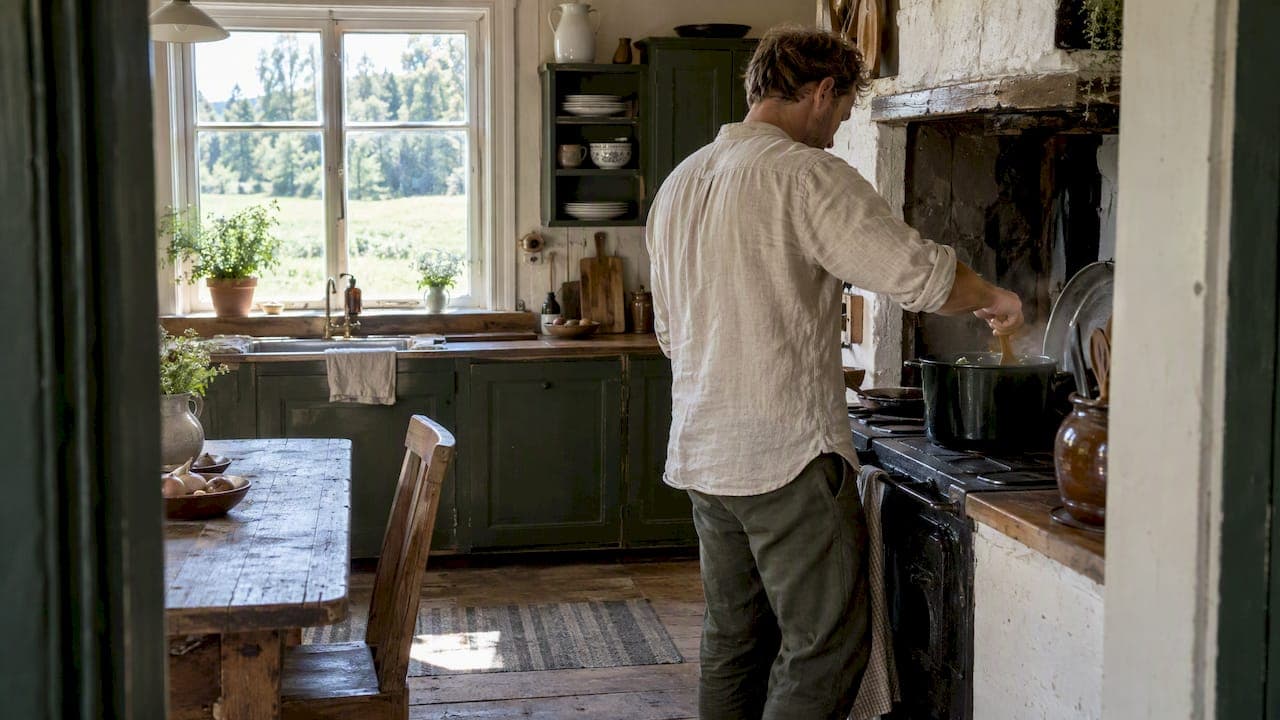
Search for lantligt kök and you will mostly find pictures: pine-panelled walls, a porcelain sink, a scrubbed wooden table. This article is about the other meaning of the phrase, the one you live inside for a week. A country-kitchen holiday in Sweden means renting a whole old house, shopping slowly, cooking without hurry and letting the kitchen become the centre of the day. Here is how to choose such a stay, what to bring, how to cook with what the countryside offers, and how to keep the rest of the days quiet and restorative.
TL;DR
- A country-kitchen holiday is self-catering by design: you rent the whole house, cook your own meals and eat at a timber table, not in a restaurant.
- Plan food around the season and the local supply, and pack the small things a rented kitchen rarely has.
- The kitchen is only half of it: forest, meadow, lake and sauna fill the hours between meals, within the rules of Allemansrätten.
- Families, couples and friends each need something different from the house, so decide who does what before you arrive.
- At Villa Sakis, an 18th-century log farmhouse in Bergslagen, you book the entire house privately, with its own sauna and lake access.
Table of Contents
- What a lantligt kök holiday actually is
- Why self-catering suits a slow stay
- Planning the kitchen side of your stay
- Food that belongs to the place
- Beyond the kitchen: filling the days
- Who is the stay for? Planning around different needs
- What to check before you book a rural Swedish stay
- A quieter week: sleep, movement and less screen
- Our perspective: why the old kitchen matters
- Stay in a Swedish farmhouse with a kitchen of your own
- FAQ
- Sources
What a lantligt kök holiday actually is
In Swedish interiors, lantligt kök describes a style: honest materials, wood, patina, simple furniture, nothing staged. On holiday the idea shifts from decoration to habit. The kitchen is where the morning begins with coffee, where berries from the forest edge are sorted, where the evening meal is cooked slowly while the light goes long over the meadow.
That is also why the format matters. A hotel gives you a buffet; a whole-house rental gives you a stove, a table and a day with no schedule. For many travellers this is the point. Research on Swedish rural cottages by the Stockholm University geographer Maja Lagerqvist describes how preserved materiality and history help visitors feel rooted and still, and the kitchen, with its worn wood and simple tools, is often where that feeling is strongest.
There is a Swedish word for the mood: mysig. BBC Travel describes it as a cosy, warm comfort built from wooden walls, candles, rugs and hot drinks, a counterweight to the cold outside. A good country kitchen is where that mood is made, one pot of something slow-cooked at a time.
Why self-catering suits a slow stay
Cooking for yourself changes the rhythm of a trip. There is no booking a table, no travelling to dinner, no hurry to be anywhere. A few reasons it works particularly well in the Swedish countryside:
- Distance. Farmhouses sit among meadows and pine forest, often well away from the nearest restaurant. The kitchen is the practical answer and the pleasant one.
- Freedom of timing. Breakfast can follow a morning swim; dinner can follow the sauna. Meals bend around the day instead of the other way round.
- Shared work. Chopping, stirring and washing up together is, for families and friends, one of the quiet pleasures of the week.
- Dietary ease. You control every ingredient, which helps with allergies, children and long-standing preferences.
The trade-off is honest: someone has to cook. Agree on that early, and the holiday stays a holiday.
Planning the kitchen side of your stay
Check what the house provides, then pack the rest
Before booking, ask the host what the kitchen holds: oven or hob type, pans, knives, a coffee maker, the number of plates. Rental kitchens are rarely as thoroughly equipped as your own. We have gathered the small items worth bringing in our self-catering packing list for a Swedish farmhouse stay. A sharp knife, a good peeler, your preferred coffee and a few spices are the usual rescues.
Shop in layers
Do one large shop on arrival for staples, then buy fresh and local through the week. Supermarkets in rural Sweden are fewer than in towns, and opening hours can be shorter on Sundays, so check the nearest one on the way in. Farm shops and local producers fill the gaps; our notes on cooking Swedish countryside produce safely cover REKO timing and how to handle fresh ingredients once you are home.
A sample first-night menu
Keep the first evening simple, because you will be tired from travelling:
- New potatoes boiled with dill, or whatever the season offers.
- Something from the nearest farm or fishmonger, pan-fried in butter.
- A green salad and good bread.
- Coffee and something sweet at the table, with the window open.
That is not a recipe so much as a pattern: few ingredients, good ones, no stress.
Food that belongs to the place
The countryside has its own cooking calendar. Summer brings new potatoes, herbs and greens; late summer and autumn bring berries and mushrooms from the forest. Swedish food culture is also tied to farming traditions still being practised. UNESCO inscribed Swedish fäbod summer farming on its Representative List in 2024, recognising a living tradition that includes herding, dairy production, land management and artisan food production. It is a reminder that what ends up on your table has a long rural story behind it.
If food and lodging are what you plan a trip around, it is worth reading how others combine lodging and gastronomy when they choose where to stay.
Picking berries and mushrooms
Allemansrätten lets visitors pick wild berries and mushrooms, but not in the private zone around homes, according to Naturvårdsverket's handbook. Take what you will actually cook, and leave the rest for wildlife and the next walker. Our guide to practical berry picking in Swedish forests explains the habit of taking only a third. Only pick mushrooms you can identify with certainty, and when in doubt, leave them where they grow.

Cooking over a fire
An evening fire is part of the picture for many guests, but Swedish rules are specific. Naturvårdsverket's 2025 guidance says that when lighting a fire you must make sure conditions are safe, use a flat non-flammable surface and supervise it at all times. Fire bans can apply in dry periods, so ask your host before you strike a match, and use only a fire place the property provides.
Beyond the kitchen: filling the days
A kitchen holiday works because the hours between meals are good ones. Cooking is a morning and evening activity; the middle of the day belongs to the landscape.
Forest, meadow and the right to roam
Allemansrätten gives everyone the freedom to explore nature, including privately owned land, but it asks for respect for wildlife, landowners and other visitors, and protected areas can add their own rules. In practice that means walking, running, picking berries and brief camping away from houses, while leaving no trace. Our guide to the Swedish right to roam for farmhouse guests turns it into everyday habits.
For guests who want to train on holiday, the countryside gives you trails for running and walking from the door. A kitchen helps there too: you can eat when your body wants to, rather than when a dining room opens.
Lake, sauna and recovery
A private sauna and lake access make the evening rhythm. Heat, a swim, then a meal cooked slowly: it is a simple loop, and a restorative one. Take care in cold water and cool air. If you feel numbness or pain from cold, 1177 advises warming the skin gently against warm skin and not massaging it or using hot water or a heated object. To avoid problems in the first place, wear several thin layers and avoid cotton against the body. If you have a heart condition, high blood pressure or are pregnant, ask your doctor before combining heat and cold water.

For more on choosing a property by the water, see our host checklist for a true lakeside stay.
Who is the stay for? Planning around different needs
| Traveller | What the kitchen does for you | What to settle before arriving |
|---|---|---|
| Families | Regular mealtimes, food children will eat, space to cook together | Bedding, high chair or child equipment, how much to bring from home |
| Couples | Slow dinners, no schedule, breakfast in bed if you like | Which meals to cook and which evenings to keep empty |
| Friends | Shared cooking, long evenings at one table | Who cooks when, how costs are split |
| Active travellers | Flexible meal times, easy fuelling around training | Training routes, storage for gear, sauna timing |
| Burnout recovery | A gentle routine without decisions | Groceries ordered or bought on day one, so there is no effort later |
For groups, clear roles stop the usual friction. A practical write-up on running a cabin trip with friends shows how to divide planning, money and cooking so the week feels easy.
What to check before you book a rural Swedish stay
A few questions save disappointment:
- Season. Summer offers long light, swimming and fresh produce; autumn brings berries, mushrooms and a deeper hush; winter makes the kitchen and the sauna the heart of the house. Ask what the house is like in the month you want.
- Whole house or rooms. A whole-house rental means nobody else uses the kitchen. Confirm that the property is let privately.
- Kitchen equipment. Ask for a list, or photographs of the kitchen.
- Distance to shops. Know the nearest supermarket and its hours.
- Access. Check how you reach the house, and whether you need a car. In most of rural Sweden you do.
- Water, sauna and fire. Ask how the sauna works, where the lake access is, and whether there are fire restrictions.
- Linen and towels. Find out what is included.
Our broader piece, what to expect from a Swedish countryside vacation, goes through these questions in more detail, and our guide to summer in the Swedish countryside adds seasonal notes.
A quieter week: sleep, movement and less screen
The kitchen helps here, quietly. Cooking is absorbing work with your hands, which is the opposite of scrolling. A few habits make the stay more restorative:
- Cook one meal a day from scratch. It anchors the day.
- Walk after dinner. Even twenty minutes in the long evening light settles the mind.
- Put the phone in a drawer in the kitchen, and leave it there during meals.
- Keep evenings dim. Candles and lamps instead of overhead light make the house feel as it was built to feel.
- Sauna, swim, sleep. In that order, if you can, then nothing the next morning until you are ready.
Nothing here is a prescription, only an invitation to let the days be as plain as the timber walls around you.
Our perspective: why the old kitchen matters
We care for a farmhouse that has stood since the 1700s, and we have learnt that the kitchen of an old house teaches guests how to slow down. The table is wide, the light comes low through the windows, and nothing in the room is in a hurry. People arrive expecting to be entertained and leave remembering a meal, a walk to the lake, and a conversation that went on longer than planned.
We do not think a country-kitchen holiday needs much. It needs a house with honest materials, good food bought without fuss, access to forest and water, and enough days to forget the clock. That is what generations of care have kept, and it is what we hope guests find.
— Christian
Stay in a Swedish farmhouse with a kitchen of your own
Villa Sakis is a historic 18th-century log farmhouse in Bergslagen, rented as a whole house for private use. It has timber rooms, a self-catering kitchen, a private sauna, lake access and direct access to forest and meadows. If this is the kind of week you are picturing, see The House or go straight to booking the whole farmhouse. For more on what the stay is like, read about renting a whole historic farmhouse for a private nature retreat or browse our journal.
FAQ
What does "lantligt kök" mean for a holiday?
It is a Swedish phrase for a country-style kitchen: wood, simple furniture, an unfussy and practical room. For a holiday it usually means staying in a rural house where you cook for yourself in such a kitchen, with local ingredients and no set mealtimes.
Is self-catering practical in the Swedish countryside?
Yes, if you plan. Do a large shop on the way in, buy fresh produce locally during the week, and bring the small items a rental kitchen may lack. Check the nearest supermarket's hours, since they can be shorter in rural areas and on Sundays.
Can I pick berries and mushrooms near the house?
Under Allemansrätten you may pick wild berries and mushrooms, but not within the private zone around homes. Take only what you will use, and eat only mushrooms you can identify with certainty.
Can I light a fire outdoors during my stay?
Only where it is safe and allowed. The official guidance asks you to use a flat, non-flammable surface and to supervise the fire at all times. Fire bans can apply in dry weather, so ask your host first and use the fire place the property provides.
Sources
- Lagerqvist, Fennia study on Swedish rural cottages
- UNESCO: Summer farming at fäbod and seter
- BBC Travel: The Nordic woman with the right to roam
- Naturvårdsverket: Din handbok i naturen
- Naturvårdsverket: The right of public access, 2025
- Naturvårdsverket: Your outdoor access code, 2025
- 1177: Köldskador