
A short, nature-based stay lasting about three days is enough to clear the initial withdrawal period and begin resetting your attention and sleep patterns; a stay of five to seven days supports lasting behaviour change by allowing the nervous system time to settle fully. The most practical next step for UK travellers is to book a private whole-house stay somewhere genuinely quiet, with forest, water, and minimal Wi-Fi pressure. Villa Sakis, a historic Swedish log farmhouse in Bergslagen, is the recommended option: private, self-catering, and surrounded by pine forest and lake.
Table of Contents
- What is a digital detox retreat, and does the evidence support it?
- How long should your detox trip be?
- How do you choose the right detox getaway?
- How to prepare and pack for a travel digital detox
- Sample daily routines and activity ideas for your detox stay
- Villa Sakis: what it offers for a travel digital detox
- Key takeaways
- Why the travel-first approach works better than willpower alone
- Villa Sakis: a private farmhouse for a nature-based digital detox
- Further reading and sources
What is a digital detox retreat, and does the evidence support it?
A digital detox retreat is a voluntary, temporary reduction or complete cessation of device use, taken in a setting designed to make that easier. Healthline defines it as a deliberate break intended to lower stress, improve sleep, and restore mental clarity. The travel version adds a crucial ingredient: physical distance from your usual environment, which removes the contextual cues that trigger habitual phone-checking.
The evidence for measurable benefits is real, though not without nuance.
Benefits with research support:
- Reduced cortisol levels and lower perceived stress after sustained breaks from devices
- Improved sleep quality, particularly when screens are absent in the hours before bed
- Restored focus and attention, especially after multi-day nature immersion
- Stronger social connection when face-to-face time replaces passive scrolling
- Reduced anxiety, with sauna and cold-water exposure adding a physiological dimension to the mental benefits
The caveat worth stating plainly: outcomes vary by individual, and the research is clearest when the detox is paired with meaningful offline alternatives rather than simple abstinence. Sitting in a cabin staring at the wall is not the same as walking through a pine forest, cooking over a wood fire, or watching a lake at dusk. Sensory-rich nature-based activities are what ground the nervous system and make the break feel restorative rather than punitive.
How long should your detox trip be?
Duration is the decision most people get wrong. They either book a single night (too short for the withdrawal to pass) or assume they need a full week when three days would serve them well.
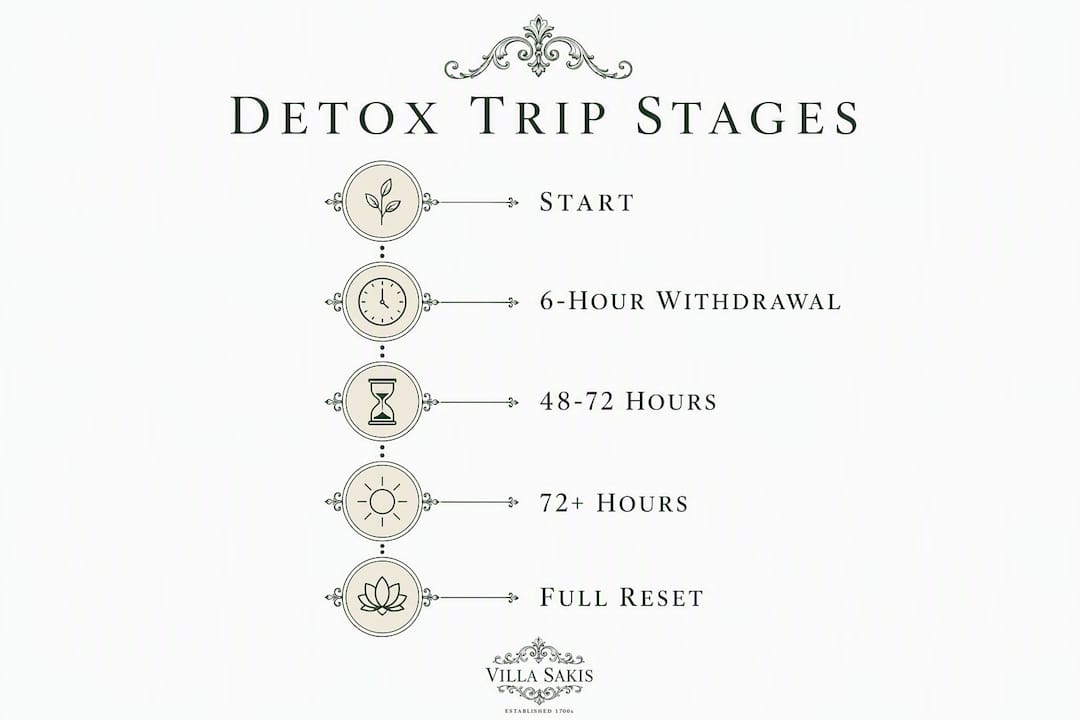
Practitioners report an initial withdrawal window of roughly six hours during which restlessness and the urge to check devices peaks. After that, attention and calm tend to increase noticeably. A 48-hour stay barely clears that window. A 72-hour stay gives you a full day of genuine quiet on the other side of it.
Common formats and what each delivers:
| Goal | Minimum length | Best format |
|---|---|---|
| Stress relief and sleep reset | 48–72 hours | Off-grid cabin or private farmhouse |
| Attention and focus restoration | 3–5 days | Self-guided whole-house stay with nature access |
| Sustained behaviour change | 5–7 days | Structured retreat or extended private stay |
| Gradual reduction (work constraints) | 7-day progressive plan | At-home or part-travel challenge |
Off-grid cabins offer simplicity and low cost but often lack the comfort that makes a longer stay sustainable. Guided group retreats add structure and facilitation, which suits people who want accountability, though they sacrifice privacy and tend to cost more. A private whole-house stay, such as a self-catering farmhouse, sits between the two: you set your own rhythm, bring your own group, and have full control over device rules without a facilitator dictating the schedule. For those who genuinely cannot disconnect for a full weekend, structured 7-day progressive programmes offer a gentler on-ramp.
How do you choose the right detox getaway?
The setting matters more than the branding. A property that calls itself a "wellness retreat" but has strong Wi-Fi in every room and no outdoor space is not a detox destination. Use these criteria to shortlist quickly.
Primary decision criteria:
- Setting: Forest, lake, or open countryside with minimal light and noise pollution
- Device rules: Are they explicit, self-directed, or vague? Vague is a red flag.
- Facilitation level: Do you want a programme, or do you prefer to set your own pace?
- Group size: Private stays suit families and friend groups; guided retreats suit solo travellers seeking community
- Travel time from the UK: Sweden is 2–3 hours by air from most UK airports; Scandinavia generally offers the density of nature that makes the trip worthwhile
- Cost: See the wellness retreat cost guide for a realistic breakdown by format
Questions to ask before booking:
- What is the connectivity policy, and is it enforced or advisory?
- How do guests handle emergencies if devices are stored away?
- Are there dietary or accessibility accommodations?
- What outdoor activities are available on-site or within walking distance?
- Is there a minimum stay, and what does the self-catering setup include?
Pro Tip: Approach the planning with curiosity rather than guilt. Research suggests that observing your usage patterns without self-judgement, then replacing habits with planned offline activities, produces more lasting change than a punitive cold-turkey approach.
Pricing varies considerably. Off-grid cabin rentals in Scandinavia typically start lower but may lack amenities. Guided group retreats carry a premium for facilitation. A private farmhouse stay sits in the mid-range and offers the best value for groups of four or more, since the cost is shared across the whole property.

Red flags to avoid: vague or contradictory device policies, properties with no outdoor access, retreat marketing that frames disconnection as punishment, and hosts with no clear emergency contact plan.
How to prepare and pack for a travel digital detox
Preparation is where most detox trips succeed or fail. The week before departure is the time to reduce friction, not the morning of.
Pre-trip device setup:
- Set an out-of-office reply on email and messaging apps
- Notify close contacts and one emergency contact of your plans and location
- Remove social media app icons from your home screen or log out entirely
- Turn off all non-essential notifications
- Download offline maps, playlists, and any reading material you want access to
- Decide where devices will be stored during the stay (a locked drawer or car boot works better than a bedside table)
For UK travellers heading to Sweden, the logistics are straightforward. Direct flights from London, Manchester, and Edinburgh reach Stockholm in roughly 2–3 hours. From Stockholm, Bergslagen is a comfortable two-hour drive through open countryside. Hiring a car gives you flexibility and removes the need for connectivity en route.
Packing for a nature-based stay:
- Layered clothing for variable Scandinavian weather, including waterproofs
- Sturdy walking boots and a warm layer for evening outdoor time
- Books, a journal, sketch pad, or analogue games
- A camera without a SIM card if you want to photograph the landscape
- Any medication, with a written note of emergency contacts and medical details
- A physical map of the local area
Store devices in a designated spot on arrival. Physical removal of temptation, rather than relying on willpower alone, is one of the most consistently recommended practical strategies for making a detox stay.
Sample daily routines and activity ideas for your detox stay
The first six to eight hours are the hardest. Plan them in detail so you are not relying on willpower when the urge to check your phone peaks.
A restorative day (slow pace)
- 7:00 Wake without an alarm; sit outside with coffee or tea
- 8:30 Slow breakfast, cooked from scratch
- 10:00 Forest walk, 60–90 minutes, no destination required
- 12:30 Lunch and rest; read or journal
- 14:30 Lake swim or sauna session
- 16:30 Afternoon creative time: sketching, writing, or simply sitting by the water
- 19:00 Wood-fire cooking or a shared meal with your group
- 21:00 Evening reflection, stargazing, or a second sauna round
A structured activity day (more movement)
- 7:00 Morning cold-water dip or lake swim
- 8:30 Breakfast and intention-setting for the day
- 10:00 Longer hike through forest trails, 2–3 hours
- 13:00 Lunch and a rest period
- 15:00 Foraging, photography, or a craft activity
- 17:30 Sauna and recovery
- 19:30 Group dinner and conversation
- 21:30 Reading or journalling before sleep
Activity ideas to replace screen time:
- Forest walks and trail running
- Lake swimming and cold-water therapy
- Wood-fire cooking and foraging
- Private sauna sessions
- Journalling and letter writing
- Analogue board games and card games
- Stargazing and seasonal nature observation
- Sketching or watercolour painting
Pro Tip: Plan your re-entry before you leave home. Decide in advance that you will check urgent communications first and delay social media and non-essential apps for at least several hours after returning. A deliberate re-entry strategy is what separates a trip that changes habits from one that simply pauses them.
Villa Sakis: what it offers for a travel digital detox
Villa Sakis is an 18th-century Swedish log farmhouse in Bergslagen, available as a private whole-house rental for families, friend groups, couples, and wellness travellers. The property is booked exclusively, meaning no shared spaces, no other guests, and no ambient social pressure to be connected.
The setting does much of the work. The farmhouse sits within meadows and pine forest, with direct access to a lake and surrounding woodland trails. There is no ambient noise to compete with the quiet. The grounds and surrounding area provide the kind of low-stimulation, sensory-rich environment that nature immersion research consistently associates with restorative outcomes.
Features that matter for a device-light stay:
- Private whole-house booking: no shared facilities, no strangers
- Authentic timber rooms with a calm, unhurried atmosphere
- Private sauna on-site
- Direct lake access for swimming and cold-water exposure
- Forest and meadow access from the property
- Self-catering kitchen for slow, intentional cooking
- No structured programme: you set the pace and the rules
For UK guests, the travel is manageable. Fly into Stockholm (approximately 2–3 hours from most UK airports), then drive roughly two hours to Bergslagen. The Swedish countryside travel guide covers what to expect on arrival and how to plan the journey.
A stay of several nights is recommended to clear the initial withdrawal period and give yourself at least one full day of settled quiet. A longer stay allows for a deeper reset and time to establish new daily rhythms before returning home.
Key takeaways
A nature-based stay lasting a few days can clear the initial withdrawal period and deliver measurable improvements in attention and sleep; longer stays support lasting behaviour change.
| Point | Details |
|---|---|
| Minimum effective duration | 72 hours (three days) clears the withdrawal window; five to seven days supports sustained behaviour change. |
| Choose setting over branding | Prioritise forest, lake access, and explicit device rules over wellness marketing language. |
| Prepare before you leave | Set out-of-office replies, store devices physically, and plan offline activities in advance. |
| Re-entry strategy matters | Delay social media for several hours after returning to preserve the gains from your stay. |
| Villa Sakis recommendation | A private whole-house booking at Villa Sakis in Bergslagen offers forest, lake, sauna, and genuine quiet for UK travellers. |
Why the travel-first approach works better than willpower alone
There is a version of digital detox that asks you to put your phone in a drawer at home and resist it for a weekend. It rarely works, because the environment stays the same. The contextual cues, the habits, the ambient expectation of availability — none of it changes. You are fighting your own nervous system on its home ground.
What changes when you travel is the environment itself. A pine forest does not remind you to check your messages. A lake at six in the morning does not trigger the same neurological pull as a notification badge. The physical distance is not incidental to the detox; it is the mechanism.
What I find most persuasive about the evidence is not the cortisol data or the sleep studies, though both are real. It is the simpler observation that recalibration, not abandonment, is the sustainable aim. A week at Villa Sakis does not cure screen dependency. What it does is give you a clear before-and-after reference point: a felt sense of what attention feels like when it is not fractured every four minutes. That reference point is what makes the guardrails you build afterwards feel worth keeping.
The private whole-house format matters here too. Guided retreats are valuable for some travellers, but the group dynamic and the programme can become their own kind of performance. A private farmhouse stay, where you set the pace and the rules, is closer to how life actually works. You practise the rhythms you want to take home, not the ones a facilitator designs for a group of strangers.
Villa Sakis: a private farmhouse for a nature-based digital detox

For UK travellers who want a genuinely quiet, device-light break, Villa Sakis offers something specific: a private 18th-century Swedish log farmhouse in Bergslagen, booked exclusively for your group, with forest, lake, and sauna on the doorstep. There is no shared space, no programme to follow, and no ambient pressure to stay connected.
The self-catering setup means you cook at your own pace, eat when you choose, and spend your days as the forest and the weather suggest. Guests can request device-light house rules for their stay, and the property's natural setting makes those rules easy to keep. For safety, guests are encouraged to share their location and an emergency contact number with someone at home before arrival, and the nearest town is within easy reach by car.
A stay of at least three nights (72 hours) is recommended to clear the initial withdrawal window; a full week gives you time to settle, slow down, and return home with something that lasts. Check availability and book directly at Villa Sakis.
Further reading and sources
| Source | Why it is useful |
|---|---|
| Healthline: What Is a Digital Detox? | Clear definition and evidence summary for health benefits; good starting point for the research. |
| PeakLevs: Digital Detox Weekend Guide | Practical step-by-step guide covering the withdrawal window, re-entry strategy, and environmental tips. |
| PositivePsychology.com: How to Digitally Detox | Behavioural framing of detox as recalibration; useful for sustainable habit-building after the trip. |
| FudgeMyLife: Meaningful Offline Weekends | Practical activity ideas and the rationale for replacing passive consumption with active presence. |
| Mindful by Sodexo: 7-Day Digital Detox Challenge | Structured progressive programme for travellers who cannot do a full cold-turkey disconnect. |
| This Is The Antidote: Restorative Offline Weekend | Evidence and examples for nature-based sensory activities that support nervous system restoration. |
| Nevermore Lane: A Weekend Offline | Gentle how-to guide with preparation checklists and a stepwise timeline from planning to switch-off. |
| Villa Sakis: The House | Full property details, photographs, and amenities for guests planning a stay. |
| Villa Sakis: Grounds and Area | Details of the lake, forest, and surrounding landscape available to guests. |