
A private whole-house wellness retreat in the UK typically costs varying amounts per person per night depending on the booking length, rising when facilitators, catering, and extras are included. Total group outlays for a weekend or week-long stay with a group of 10 vary considerably depending on venue and services included. The single most important budgeting rule: keep your venue and accommodation spend within a significant portion of the total budget, and always reserve a contingency before committing to anything else.
Quick ballpark summary:
- Weekend, short, and week-long retreats with groups of around 10 guests vary widely in total cost, influenced by venue share and contingency reserves.
- Weekend retreats are generally recommended as an entry point for first-timers.
Table of Contents
- What drives the cost of a private whole-house wellness retreat?
- How should you split a retreat budget?
- What do worked budgets look like for different retreat lengths?
- How do you price and plan a retreat that covers its costs?
- How can you reduce the cost of a private wellness retreat?
- What extra costs should UK travellers expect when booking?
- Planning a weekend retreat at Villa Sakis: a worked example
- Key takeaways
- Why whole-house retreats are worth the price
- Villa Sakis: a restorative setting for your private retreat
- Useful sources
What drives the cost of a private whole-house wellness retreat?
Several factors move the price considerably, and understanding them helps you decide where to spend and where to hold back.
- Venue and season: The property itself is the largest single line item. Shoulder months such as April, May, or October can secure premium venues at lower rates than peak summer weeks.
- Group size: A larger group spreads the fixed whole-house fee across more people, reducing the per-person nightly cost meaningfully.
- Catering style: Full board with a private chef costs far more than a self-catering arrangement using a well-equipped kitchen.
- Facilitator expertise: A specialist yoga teacher or somatic therapist commands higher day rates than a generalist fitness instructor.
- Included therapies: Group classes are cost-efficient; private massage or one-to-one coaching sessions add quickly to the total.
- Transfers and excursions: Airport or station transfers, guided hikes, and off-site activities are often priced separately.
- Cleaning, linen, and laundry: Many whole-house rentals charge a fixed cleaning fee regardless of stay length.
- Taxes and permits: VAT applies to facilitator services in the UK; some local councils levy tourist levies on commercial bookings.
Pro Tip: Switching from private en-suite rooms to shared sleeping is the single most flexible saving available. Private accommodation is the biggest price driver in any retreat budget, and sharing a room rarely diminishes the core wellness experience.
How should you split a retreat budget?
The industry-standard percentage split gives you a reliable framework for checking whether a quoted price is sensible or whether one category is eating the whole budget.
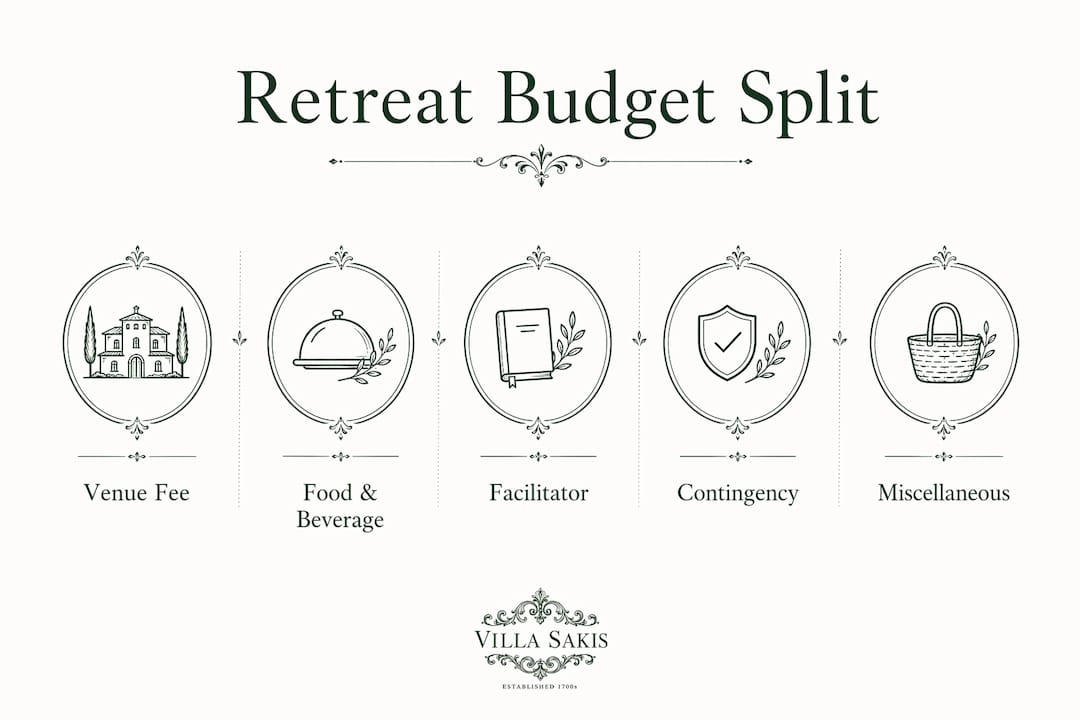
| Budget category | Recommended share |
|---|---|
| Venue and accommodation | 40–50% |
| Food and beverage | 15–20% |
| Facilitators | 10–15% |
| Marketing and admin | 5–10% |
| Contingency | 10% |
Step-by-step worked calculation (total budget: £5,000):
- Venue: 45% = £2,250
- Food and beverage: 17% = £850
- Facilitators: 12% = £600
- Marketing and admin: 6% = £300
- Contingency: 10% = £500 (held in reserve, not pre-spent)
The contingency must be accounted for as an essential part of the budget because unexpected logistical changes, last-minute service adjustments, and supplier price fluctuations are routine in retreat planning.
Before booking, ask your venue host to confirm: the whole-house nightly rate, the cleaning fee, the damage deposit, and whether VAT is included in the quoted price. These four figures are the easiest to verify upfront and together they determine whether your venue share stays within the 40–50% target.
What do worked budgets look like for different retreat lengths?
The table below uses a group of 10 as the base case. Assumptions: whole-house hire, one shared breakfast daily, two communal dinners, one group yoga or movement session per day, a fixed cleaning fee, and a 10% contingency. Private therapies and transfers are listed separately as discretionary add-ons.
| Retreat type | Nights | Venue total | Per-person nightly | F&B per person/day | Facilitator (total) | Contingency |
|---|---|---|---|---|---|---|
| Weekend | 2 | £1,200 | £60 | £30–£50 | £300–£500 | £120 |
| Short retreat | 3–4 | £1,800 | £60 | £30–£50 | £450 | £180–£240 |
| Week-long | 6–7 | £3,600 | £60 | £30–£50 | £900 | £360–£420 |
These figures include a 10% contingency, calculated from the total base cost for each retreat length as recommended.
These figures represent the base package. Advertised rates often exclude private spa sessions, one-to-one coaching, transfers, and gratuities, which can add 30–50% to the headline price. A retreat quoted at £300 per person may realistically cost £400–£450 once those extras are counted.
- Hidden add-ons to anticipate: private massage (£60–£120 per session), airport transfer (£80–£200 return per person), equipment hire, travel insurance
- Use the true daily rate formula: (total cost including add-ons + travel) ÷ number of nights
How do you price and plan a retreat that covers its costs?
Defining your target audience, desired outcome, and pricing model before choosing a venue is the step most organisers skip, and it is the one most likely to cause underpricing.
Break-even formula:
(Total fixed costs + variable cost per guest × number of guests + 10% contingency) ÷ number of paid spaces = minimum price per guest
Fixed costs include the whole-house venue fee, cleaning, insurance, and any non-refundable deposits. Variable costs cover meals per head, facilitator fees per session, and consumables. In the UK, VAT applies to facilitator services if the provider is VAT-registered, so confirm this before building your price.
Planning checklist:
- Set your group size and minimum viable number (the lowest headcount at which the retreat breaks even)
- Confirm the whole-house rate, cleaning fee, and deposit terms with the venue
- Cost facilitators at their day rate, including travel expenses
- Build the catering budget per head per day
- Add transfers, equipment hire, and any one-off costs
- Apply the 10% contingency to the subtotal
- Divide by the number of paid spaces to find your floor price
- Add your desired margin (typically 15–25% above break-even for a commercially run retreat)
A detailed cost checklist and break-even modelling before venue selection prevents the most common planning loss: committing to a property whose fixed cost cannot be recovered at a price guests will pay.
How can you reduce the cost of a private wellness retreat?
Retreat pricing spans a wide spectrum, and there is genuine room to reduce outlay without sacrificing the restorative core of the experience.
- Book shoulder season: April, May, or October typically offer lower whole-house rates than July and August.
- Choose shared sleeping: Sharing rooms rather than booking private en-suites is the single largest saving available.
- Self-cater or part-cater: A self-catering kitchen reduces food costs to supermarket prices; even one self-prepared breakfast per day makes a difference.
- Limit private sessions: One group class per day delivers most of the wellness benefit at a fraction of the cost of daily one-to-one sessions.
- Travel by rail or share driving: Splitting fuel costs or booking advance rail tickets is consistently cheaper than individual transfers.
- Negotiate group rates: Venues and facilitators often offer reduced rates for confirmed group bookings, particularly mid-week or in quieter months.
Pro Tip: Ask every venue for a fully itemised quote before committing. A line-by-line breakdown shows exactly where the budget is going and gives you a clear basis for negotiation. Hosts who cannot or will not provide one are a caution sign.
What extra costs should UK travellers expect when booking?
Several one-off fees are predictable but frequently overlooked in initial budgets.
- Cleaning fee: Usually a fixed charge per stay, not per night. For a whole-house booking it can range from £100 to £400 depending on property size.
- Security or damage deposit: Typically £200–£1,000, held and returned after checkout. This is not a cost, but it affects cash flow.
- Local council or tourist levies: Some UK local authorities charge a small per-night levy on commercial short-term lets; check with the host.
- VAT on services: Facilitators and therapists who are VAT-registered must charge 20% on top of their fee.
- Transport and transfers: Rail, car hire, or private transfer to a rural property can add £40–£150 per person return.
- Equipment hire: Yoga mats, bolsters, or specialist fitness equipment hired locally adds to the total.
- Travel insurance: Cancellation cover for a group booking is worth including, particularly for longer retreats.
Watch the fine print on all-inclusive rates. Many whole-house retreat packages describe themselves as all-inclusive but exclude private therapy sessions, off-site excursions, gratuities for staff, and specialist dietary catering. Always ask the host for a written list of what is and is not covered before you pay a deposit.
Planning a weekend retreat at Villa Sakis: a worked example
Villa Sakis is a whole-house Swedish log farmhouse from the 1700s, set among pine forests and meadows in Bergslagen, with a private sauna, lake access, and a self-catering kitchen. The following worked example uses illustrative figures for a 10-person weekend (2 nights).

| Cost item | Assumed cost | Per person (10 guests) |
|---|---|---|
| Whole-house venue fee (2 nights) | £1,200 | £120 |
| Cleaning fee | £180 | £18 |
| Catering (self-catered, 2 breakfasts + 1 shared dinner) | £400 | £40 |
| Facilitator (yoga, 2 morning sessions) | £400 | £40 |
| Contingency (10%) | £220 | £22 |
| Total | £2,400 | £240 |
This breakdown explicitly includes a 10% contingency on the total, as recommended by industry guidance.
Assumptions: whole-house hire, self-catering kitchen used for breakfasts, one communal dinner with shared ingredients, one yoga facilitator travelling with the group, no private therapies included.
Discretionary add-ons that change the total:
- Private sauna session hire (if priced separately): £20–£40 per person
- One massage per guest from an external therapist: £70–£120 per person
- Rail travel from Stockholm or a nearby city: variable
For a personalised, itemised estimate based on your group size and dates, check availability at Villa Sakis directly.
Key takeaways
A private whole-house wellness retreat costs £150–£450 per person per night in the UK, with venue and accommodation accounting for 40–50% of the total budget and a 10% contingency built in from the start.
| Point | Details |
|---|---|
| Realistic cost range | Expect £150–£450 per person per night for a private whole-house retreat, depending on length and inclusions. |
| Venue budget rule | Keep venue and accommodation within a reasonable share of the total budget to leave room for facilitators and food. |
| Contingency is structural | Reserve 10% of the total budget as contingency before allocating anything else. |
| Start with a weekend | A 2–3 night retreat is the lower-risk entry point for testing preferences and managing upfront spend. |
| Villa Sakis as a base | Villa Sakis offers a whole-house historic farmhouse with private sauna and lake access, with a worked weekend example aligned with typical retreat costs. |
Why whole-house retreats are worth the price
The conventional wisdom is that private whole-house retreats are a luxury reserved for large budgets. That framing misses something. When a small group books an entire property, the per-person cost of the venue often compares favourably with a mid-range hotel retreat once you account for what you are actually getting: uninterrupted access to the space, the freedom to set your own schedule, and the kind of quiet that a shared retreat centre simply cannot offer.
What organisers and guests consistently underestimate is the value of flexibility. A whole-house booking means you can bring your own facilitator, self-cater to your dietary needs, and move between the sauna, the forest, and the kitchen at whatever pace the group needs. That operational freedom is not a premium feature. It is the point. A property like Villa Sakis, with its private lake access and forest grounds, offers the kind of natural immersion that structured retreat centres charge considerably more to approximate.
The honest caveat is that whole-house retreats require more planning than a packaged programme. The break-even formula and budget split in this guide exist precisely to make that planning tractable, not intimidating.
Villa Sakis: a restorative setting for your private retreat
For groups seeking a private wellness retreat that does not require a large resort budget, Villa Sakis offers something quieter and more considered. The 18th-century Swedish log farmhouse sits within meadows and pine forest in Bergslagen, with a private sauna, direct lake access, and a fully equipped self-catering kitchen — everything a small group needs to build a restorative few days without relying on a managed programme.
The whole-house model means your group has the property entirely to yourselves: no shared dining rooms, no timetables set by strangers, no noise from other guests. You bring the facilitator you trust, you cook what suits the group, and you move at the pace the retreat actually needs. Pricing is transparent, and the team can provide an itemised breakdown for your specific dates and group size. Check availability and request a quote to begin planning your stay.
Useful sources
- Wellness retreat planning checklist — SquadTrip: industry budget percentage split and contingency guidance; useful as a planning template for organisers.
- How much does a wellness retreat actually cost? — RetreatVault: pricing tiers, hidden add-on analysis, and the true daily rate concept; essential reading before booking.
- Wellness retreat planning: how to plan a retreat that actually makes money — Olivier Consultancy: commercial foundations guidance for hosts and organisers.
- Retreat planning checklist — Olivier Consultancy: downloadable checklist covering fixed and variable costs, break-even modelling, and profit margin targets.
- How much does a wellness retreat cost? — Anahata Holistic Healing: practical guidance on retreat length, first-timer advice, and cost-per-night comparisons.