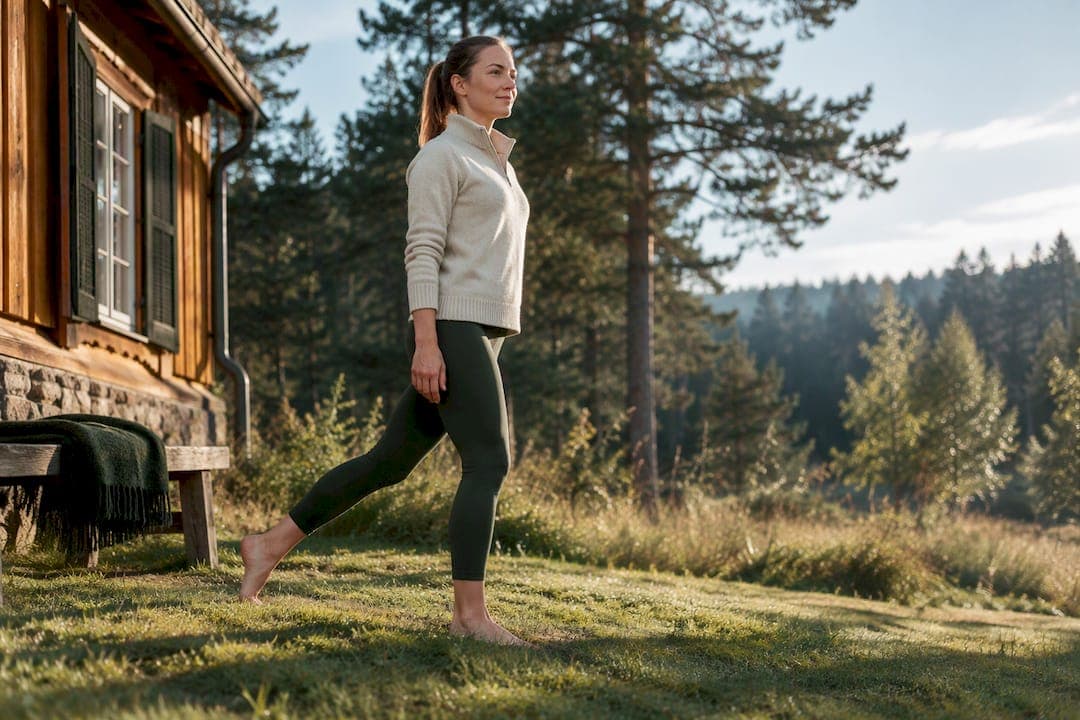
Training on holiday is optional, not obligatory, and success looks smaller than most people imagine. A brisk morning walk, a ten-minute bodyweight circuit, or an afternoon swim all count. FYSS-style guidance points to a recommended amount of moderate weekly movement, but that figure spreads easily across a week of ordinary holiday activity. What follows are compact templates and routines, tested against how a slow, outdoor-first stay like Villa Sakis actually unfolds.
TL;DR:
- Short, low-effort activities like walking, swimming, or cycling for 20 to 40 minutes daily meet weekly guidelines without scheduling long sessions.
- Bodyweight, backpack, or resistance band exercises can be done anywhere, with routines as brief as ten minutes, focusing on proper form and sufficient effort.
- Most outdoor or natural stays naturally support movement through activities like hiking, swimming, or exploring, reducing the need for structured workouts.
- Visible training gear and anchoring movement to regular habits significantly increase the likelihood of maintaining activity during holiday schedule disruptions.
- Rest and gradual progression are essential; avoid strenuous sessions in extreme heat, after illness, or if experiencing symptoms like chest pain or dizziness.
Table of Contents
- A flexible weekly template: what 'enough' looks like on holiday
- Three short bodyweight strength routines you can do anywhere
- Cardio and active holiday ideas by setting
- What to pack and how to improvise
- Motivation hacks and a low-pressure schedule that actually sticks
- Safety and progression: how to restart sensibly
- How nature-based stays support low-pressure activity
- An editorial view on holiday fitness that works
- A quiet place where movement happens without trying
- Sources
- FAQ
A flexible weekly template: what 'enough' looks like on holiday
Forget the idea that a proper holiday workout needs an hour and a gym. The FYSS guidelines recommend 150 to 300 minutes of moderate aerobic activity weekly, or 75 to 150 minutes vigorous, plus muscle-strengthening work twice a week. The World Health Organization mirrors this almost exactly, and both frameworks are explicit that the minutes need not arrive in one tidy block. A stroll to buy bread, a swim before lunch, and a stretch before bed all count toward the same total.
Two templates cover most holiday situations:
- Maintenance week: 20 to 40 minutes of daily low-effort movement (walking, swimming, cycling) plus one 10 to 20 minute strength session.
- Active week: the same daily movement baseline, plus two or three short structured sessions and one longer outing, such as a hike, a longer bike ride, or a swim across the bay.
A low-threshold weekly plan built around daily walks and two brief strength sessions preserves fitness without eating into rest days, which matters more on holiday than any single session does. If mornings are unpredictable, do the walk after dinner instead. If the strength session gets skipped one day, fold it into the next. The template bends around the holiday, never the other way round.
Three short bodyweight strength routines you can do anywhere
Three exercises, done properly, beat ten done badly. A simple holiday strength session built from familiar movements, repeated for two to four rounds, is genuinely effective when time or motivation is thin on the ground.
- Beginner circuit (12 to 15 minutes): bodyweight squats, incline push-ups against a bench or wall, glute bridges, and a 20 second plank. Two to three rounds, resting as needed between exercises.
- Intermediate circuit (15 to 20 minutes): walking lunges, standard push-ups, step-ups onto a bench or rock, and a side plank each side. Three to four rounds, slower on the lowering phase of each rep.
- Compact ten-minute circuit: squats, push-ups, and a plank, cycled through as many times as fits in the window, resting only when form starts to slip.
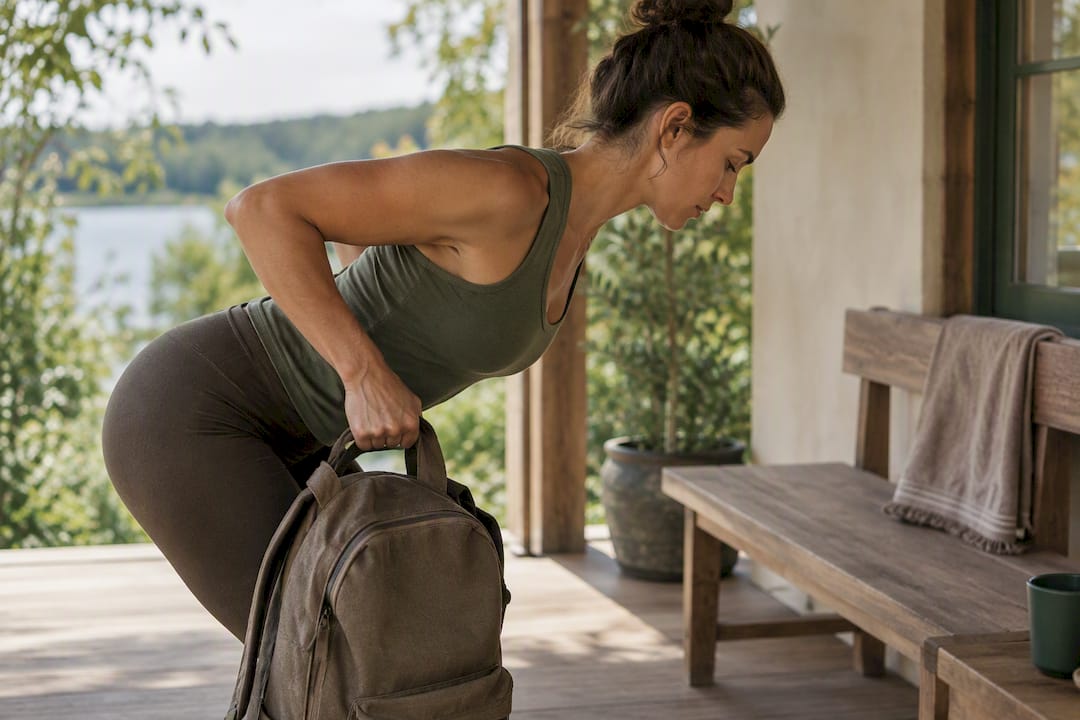
You can preserve strength on holiday using bodyweight, a loaded backpack, or a resistance band, and a stable bench or low wall substitutes for a step-up box. Aim to finish each round feeling like you had one or two reps left in reserve, not zero. Watch your form on planks (hips level, no sagging), step-ups (full foot on the surface, controlled step down), and bench dips (shoulders staying low, not shrugging toward the ears).
Pro Tip: Keep a backpack loaded with a few books or bottles by the door. It turns lunges and rows into a proper strength stimulus without a single piece of gym kit.
For more variations using nothing but a bench, a band, or your own bodyweight, this guide to strength training without a gym is worth a look before you pack.
Cardio and active holiday ideas by setting
The best travel workout ideas are usually not workouts at all. They are the things you were already going to do, done with slightly more intention.
- Beach: swimming laps parallel to shore, walking on soft sand (harder on the legs than pavement), stand-up paddleboarding, or a casual game of beach volleyball.
- Cabin or forest: a purposeful hike rather than a stroll, carrying firewood or water as functional loaded carries, or a longer walk with a hill section.
- City: sightseeing entirely on foot, hiring a bike for the day with Galway Bike Tour Routes, or taking the stairs at a viewpoint or old town tower instead of the lift.
- Hotel room: a short bodyweight circuit, stretching on a towel laid over the floor, or simply pacing during a phone call instead of sitting through it.
Some days need none of this. If you have hiked eight kilometres, swum in a lake, and carried bags up three flights of stairs, that day's aerobic quota is already met and a formal session would just be excess. A gentle beginner-friendly cycling route through unfamiliar countryside covers ground at a pace that still counts as moderate activity, and it rarely feels like exercise at all.
What to pack and how to improvise
A single loop resistance band, a lightweight travel mat, comfortable walking shoes, and a refillable water bottle cover most situations without adding real weight to a suitcase. Everything beyond that can be improvised.
- A rolled towel works as a mat for stretching or planks on a hard floor.
- A backpack loaded with clothes or bottles becomes a weight for squats, lunges, or rows.
- A sturdy bench, low wall, or large rock substitutes for a step-up box or dip station.
- Pack a small mesh bag for damp kit so a wet swimsuit or sweaty shirt does not sit against clean clothes.
Quick-dry fabrics matter more than people expect on a week away. A single technical t-shirt washed in the sink at night and hung to dry saves you from packing five, and it means the kit that matters is always ready the next morning.
Motivation hacks and a low-pressure schedule that actually sticks
Activation energy, not willpower, decides whether holiday movement happens. If the resistance band is buried at the bottom of a case, it stays there. If it is sitting on top, visible the moment the case opens, it gets used. Behavioural research on habit friction backs this up consistently: small, visible cues beat ambitious plans drawn up in the abstract.
Two anchors do most of the work: a short mobility routine on waking, and a walk after the evening meal. Both attach to something you were doing anyway, which is exactly why they survive an unpredictable schedule. Keep one reserved backup session in your back pocket, a ten-minute circuit you can do in a hotel room at 9 p.m. if the day disappears.
- Anchor movement to existing habits (morning coffee, post-dinner walk) rather than a fixed clock time.
- Make it social: a family walk or a game on the beach counts as much as a solo session.
- Track tiny wins loosely; a mental note of "moved today" builds momentum better than a missed target does.
Pro Tip: Pack your training kit somewhere you will see it first, right on top of the case, not tucked beneath the holiday clothes. It is the single easiest way to lower the barrier to doing something.
For readers who want the opposite emphasis (deliberate rest, not more movement), a piece on genuinely restorative holidays is a useful counterweight to this section.
Safety and progression: how to restart sensibly
Returning from a period of inactivity calls for restraint, not enthusiasm. FYSS guidance is specific here: progress duration and frequency before intensity, rather than jumping straight into a maximal session after weeks of sitting at a desk. A holiday is not the moment to test a new personal best.
Stop and seek medical attention immediately if you experience any of the following during activity:
- Chest pain or unusual pressure in the chest.
- Fainting, severe dizziness, or disorientation.
- Breathlessness that feels out of proportion to the effort.
Heat changes the maths, too. Hot climates demand more water, shorter sessions, and a shift toward early morning or evening timing. Anyone recovering from illness, travelling with jet lag, or supporting older relatives on the trip should treat the first two or three days as an extended warm-up period, not a training block.
How nature-based stays support low-pressure activity
A historic countryside stay without a gym on site offers a different approach. Trails through surrounding forests, nearby water access, and open meadows remove the biggest obstacle to holiday movement: deciding where to go and how far. A morning walk can start the moment you step outside the door, no drive or map needed.
Available wellness amenities like a sauna can aid recovery, making it easier to enjoy the next day's activities. Guests tend to fall into simple rhythms without anyone programming them: a stretch on the grass before breakfast, a swim before the day gets going, a longer family walk once the light softens in the evening. The mobility and gentle movement content built around stays like this reflects what the house naturally invites rather than what it prescribes. Nothing here counts as a fitness programme. It is simply an environment where the easiest option and the healthy option happen to be the same one.
An editorial view on holiday fitness that works
Most advice on training while travelling still smuggles in a performance mindset dressed up as flexibility, promising a "quick" 45 minute HIIT session as though that counts as low-pressure. It does not. The FYSS and WHO figures were never written as a holiday challenge; they are population-level health targets, met by most active adults through ordinary daily movement long before any structured session gets added.
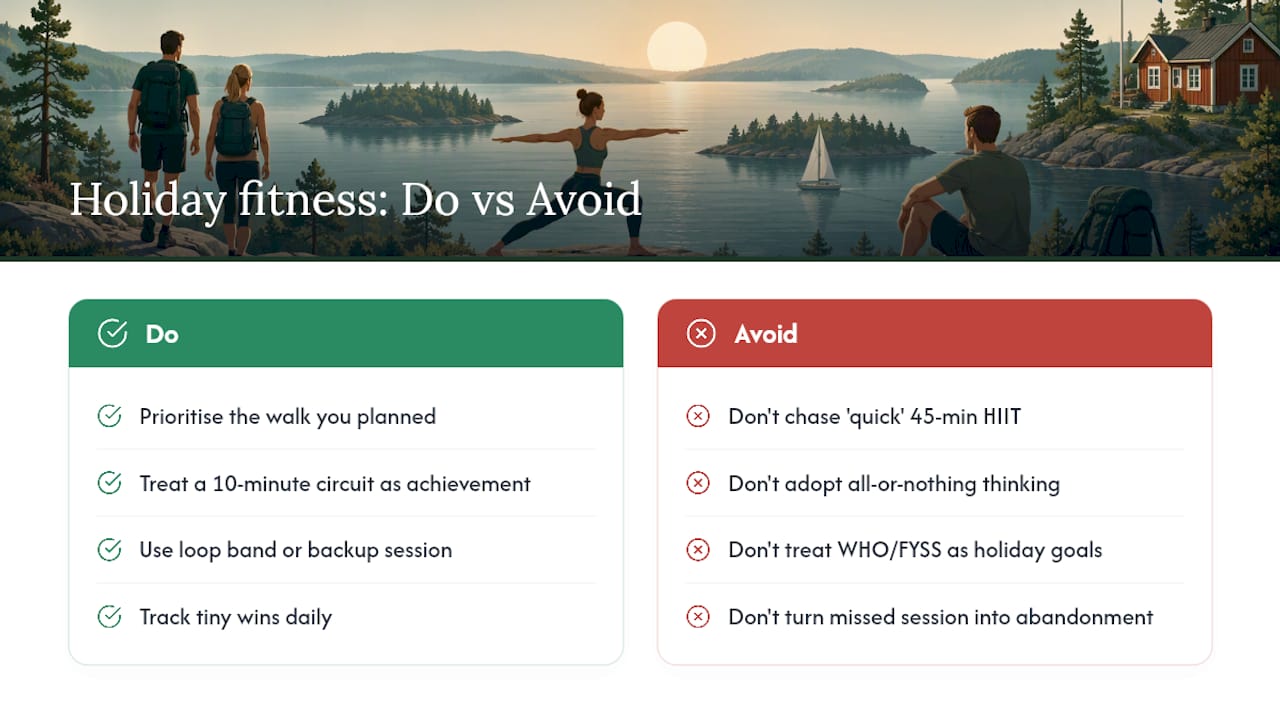
What the research on detraining actually supports is reassuring: short breaks rarely cause the losses people fear, and the evidence on this is genuinely mixed rather than alarming. The bigger risk on holiday is not muscle loss. It is the all-or-nothing thinking that turns a missed gym session into an abandoned week.
Prioritise the walk you were going to take anyway over a session you will resent. Treat the ten-minute circuit as a genuine achievement, not a consolation prize. Everything else, the loop band, the reserved backup session, the tracked tiny wins, exists to protect that one habit from a schedule that will not cooperate.
— Christian
A quiet place where movement happens without trying
This type of stay offers an alternative to a structured fitness retreat for anyone who would rather let activity happen naturally than schedule it. There is no programme to follow and no equipment to find, but access to natural surroundings and wellness amenities supports a relaxed approach to activity and recovery.

Open natural spaces can suit a range of activities, from casual sports to relaxation. Groups often settle into shared outdoor activities naturally. Wellness travellers aiming to rebuild habits gently may find that a low-pressure setting encourages more movement than a formal plan would.
To see what a stay actually involves, visit The House for details on the rooms, sauna, and grounds, or head to Villa Sakis to check dates and start a booking.
Sources
- FYSS allmänna rekommendationer om fysisk aktivitet och stillasittande för vuxna (18–64 år)
- 5 tips om styrketräning under semestern | Styrkelabbet
- Träning på semestern? Tänk rörelse, ej prestation. | Nordic Wellness
- WHO physical activity recommendations for adults (18–64 years)
FAQ
What is the 12-3-30 method, and does it apply on holiday?
The 12-3-30 method is a treadmill routine: a 12% incline, 3 miles per hour, for a sustained period. It translates well to holiday walking as an uphill trail or hill section at a brisk, sustained pace, though outdoors you will not control incline as precisely.
When should you absolutely not train?
Skip a session if you have chest pain, fainting, severe dizziness, or breathlessness out of proportion to the effort, and seek medical attention instead. Recent illness, extreme heat, or significant jet lag also call for rest or a much gentler pace than usual, following the FYSS guidance on gradual progression.
What is the 3-3-3 method for exercise?
Definitions vary depending on where you encounter this term, and no single version is standard across fitness guidance. Rather than chase a specific formula, the more reliable approach on holiday is the simple circuits and daily movement targets covered above.
Is 30 minutes of strength training a week enough?
For most adults, yes, particularly alongside daily walking or swimming. FYSS and WHO both recommend muscle-strengthening activity on two or more days weekly, and two 15-minute bodyweight circuits comfortably meet that bar.
Do I need any equipment to train on holiday?
No. A bodyweight circuit, a loaded backpack, or a resistance band covers almost every situation, and stays like Villa Sakis add trails, lake access, and open ground that make structured equipment largely unnecessary.