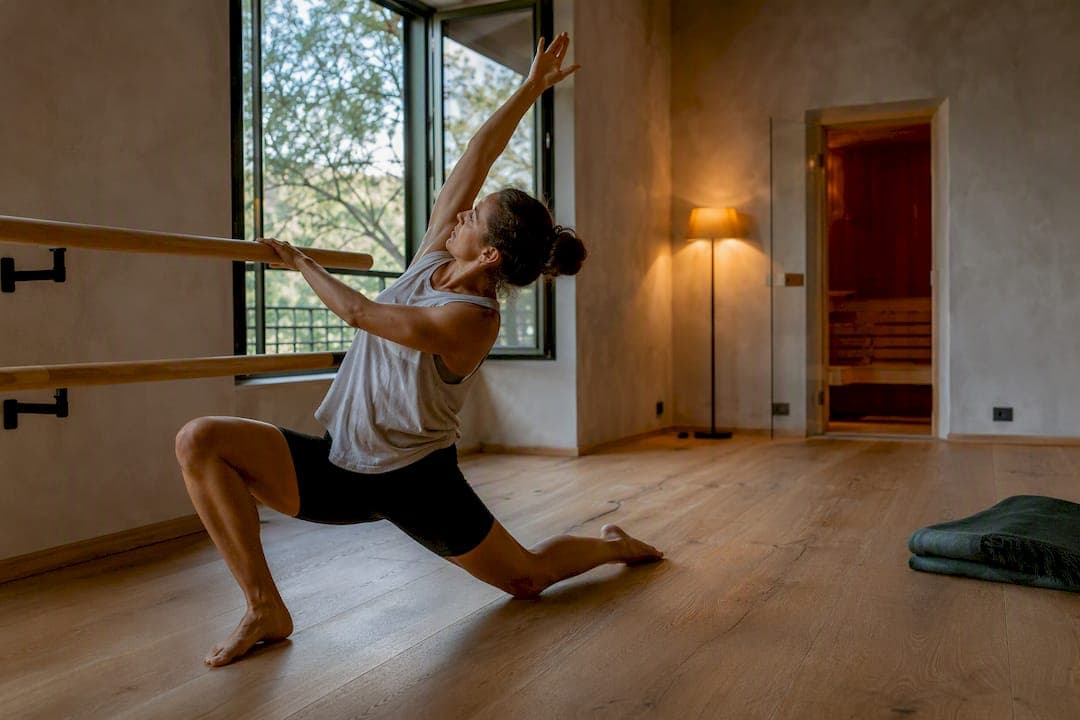
A stretch and mobility trip is a bookable stay pairing guided sessions of movement work with recovery-focused facilities and quiet outdoor space. The two things that decide whether an offer delivers on that promise are programme balance (structured coaching against free time) and the facilities on hand, particularly a sauna, bathing access, and level ground for outdoor practice. Villa Sakis, a private 18th-century Swedish log farmhouse, suits groups wanting exactly this combination without sharing space with strangers.
TL;DR:
- Private whole-house rentals like Villa Sakis offer exclusive access to practice spaces, sauna, and outdoor areas, ideal for personalized mobility retreats.
- Programs are most effective when balanced between mobility, restorative work, and free time, with sessions lasting 45 to 60 minutes and small group sizes of four to eight guests.
- Facilities such as hot tubs, saunas, and flat outdoor ground significantly enhance recovery and safety, especially when scheduled after stretching or breathwork sessions.
- Preparation should include checking space dimensions, props availability, and meal arrangements, with packing non-restrictive clothing and essential self-myofascial tools.
- Guest reviews emphasize the importance of program sustainability, instructor attentiveness, and private facilities, which influence whether participants maintain mobility routines at home.
Table of Contents
- What to look for in a stretch and mobility retreat booking
- What a good stretch and mobility day actually looks like
- Why sauna, bathing, and flat ground matter more than they seem to
- Preparing for a mobility retreat: what to do and what to pack
- What past guests say about the mobility programmes they book
- Comparing intensity levels and group sizes across mobility retreats
- Massage, physiotherapy, and other treatments worth asking about
- Choosing between shared retreat rooms and a private whole-house stay
- What Villa Sakis guests report about mobility-focused stays
- Booking a mobility-focused stay at Villa Sakis
- Sources
What to look for in a stretch and mobility retreat booking
Not every property calling itself a wellness retreat has thought through what mobility work actually needs. The difference between a genuinely useful stay and a disappointing one usually comes down to two things: how the programme is structured, and whether the physical space supports it.
Programme balance matters more than programme intensity. More travellers booking training trips now expect a balance between guided sessions and restorative practices such as breathwork and deep stretching, rather than back to back high-output classes. A retreat that schedules every waking hour tends to produce sore, fatigued guests by day three. Small group or private coaching also changes the outcome considerably. An instructor working with four people can correct a hip alignment or adjust a stretch depth in real time; one working with twenty cannot.
Facilities either support this work or quietly undermine it. Before booking, weigh up:
- Practice space size and floor surface — enough room to lie flat with arms extended, and a surface that will not bruise knees or slip underfoot.
- Props on hand — bolsters, blocks, straps, and a few resistance bands save you from checking a bag full of equipment.
- Climate control — a room that overheats by mid-morning or chills by evening breaks concentration fast.
- Sauna or hot tub access — a genuine asset for post-session recovery, covered in more detail below.
- Flat, accessible outdoor ground — grass or packed earth without roots or loose stone, for classes held outside.
Before you book, ask the host directly: How many guests share the practice space at once? Is coaching private, small-group, or open class? What happens on a rain day? Is the sauna or bathing space exclusive to your party or shared with other guests?
A private-house booking answers most of these automatically. When you rent the whole property, as with Villa Sakis, the studio, sauna, and grounds belong only to your group for the length of the stay, with no scheduling around strangers.
What a good stretch and mobility day actually looks like
A well-built mobility programme is not a string of identical workouts. It moves through distinct types of session, each doing a different job on the body.
Mobility flow sessions move joints through their full range using slow, controlled sequences. Dynamic warm-ups wake up muscles before more demanding movement. Restorative long-hold stretch work, often held for one to three minutes per position, targets tissue that needs time rather than force to release. Breathwork slows the nervous system down, usually bookending the day. Good programmes mix short mobility sessions with free windows and restorative blocks rather than filling every hour with structured output, a pattern confirmed in how Swedish training trips are typically designed.
A representative day might run like this:
- Morning mobility session (45 to 60 minutes) — joint-focused flow and dynamic warm-up, ideally outdoors if the ground allows.
- Free time or self-practice (two to three hours) — a walk, a swim, or simply rest.
- Afternoon restorative session (30 to 45 minutes) — long-hold stretching, often with props.
- Evening breathwork (15 to 20 minutes) — a wind-down before dinner.
Class sizes of four to eight guests tend to work best for a private-house setting, keeping instruction personal without feeling crowded. Sessions of 45 to 60 minutes suit most fitness levels better than longer marathons. When checking instructor credentials, ask what training body certified them and how long they have taught mobility or stretch specifically, rather than general fitness. The best programmes deliberately leave gaps: not every hour scheduled, because habit-forming stays need room to rest as much as they need structure.
Why sauna, bathing, and flat ground matter more than they seem to
Heat and cold do real work on tired muscles, and the facilities around a mobility programme often matter as much as the sessions themselves. Retreat packages built around recovery and mobility commonly pair movement classes with sauna, hot tub, or nearby bathing spots, using heat to loosen tissue before a session and temperature contrast to calm it afterwards. This is one reason Swedish retreat culture leans so heavily on bastutält (sauna tents) and badtunnor (hot tubs) as standard recovery extras rather than optional luxuries.
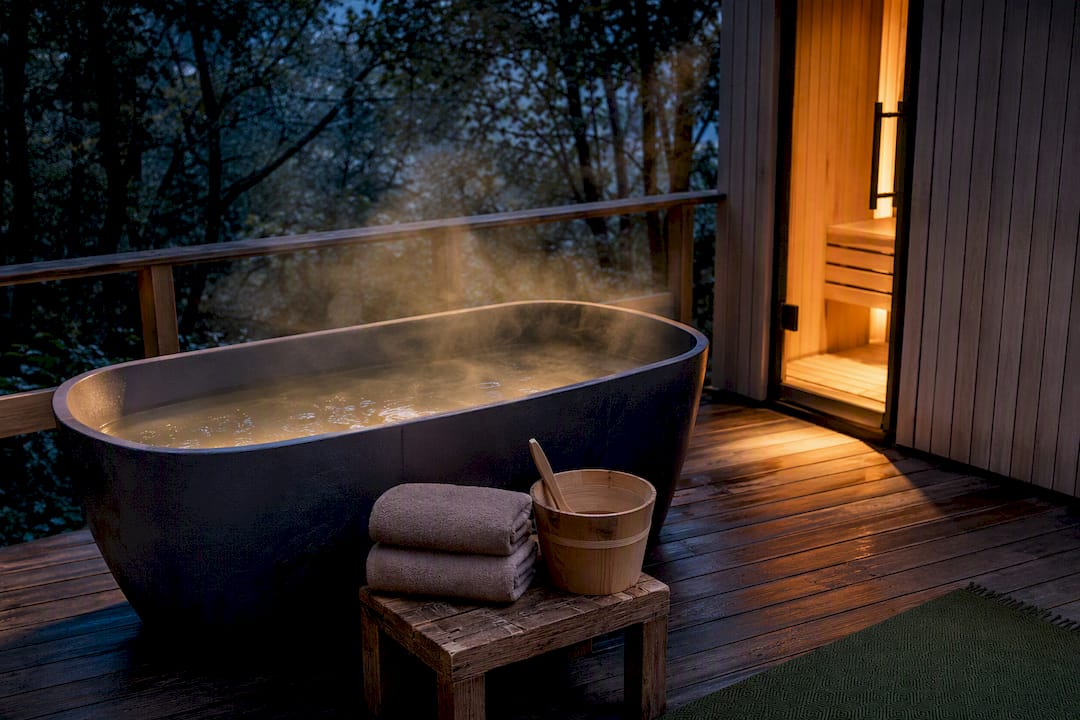
Outdoor practice space carries its own quiet requirements. Even, grassed areas or flat rock surfaces are strongly preferred for outdoor mobility work, since uneven ground turns a floor-based stretch sequence into a hazard rather than a benefit. A private deck beside water, or a studio positioned near a lake, gives a session somewhere calm to land afterwards.
Strong facility pairings tend to repeat across well-designed stays:
- A practice studio positioned near open water, for a swim straight after a session.
- A private sauna adjoining a stretch deck, so heat and movement sit steps apart.
- Level lawn or meadow ground close to the accommodation, avoiding a walk to reach practice space.
Pro Tip: Book your sauna or hot tub session for the end of the day, after the restorative stretch block rather than before the morning mobility flow. Heat loosens tissue that has already been worked, which supports recovery more than it prepares cold muscle for movement.
Preparing for a mobility retreat: what to do and what to pack
Good preparation starts before you arrive, not once you walk through the door.
Before the stay, contact the host directly to understand the key benefits of vacation rentals for your stretch and mobility group. Declare any injuries or joint issues so sessions can be adapted rather than avoided. Ask about the practice space's dimensions and what props are available, so you know what to bring yourself. Confirm meal arrangements too, since a self-catering property means you plan your own recovery meals rather than relying on a set kitchen schedule.
A short packing list saves a lot of frustration once you arrive:
- Non-restrictive clothing that allows full range of motion, layered for temperature shifts.
- A travel mat, if the studio does not supply enough for your group.
- A resistance band, light enough to pack flat.
- A massage ball or mini roller for self-myofascial release between sessions.
- Grip socks, useful on timber floors or during barefoot outdoor work.
- A reusable water bottle, given how much hydration matters around sauna use.
Travelling with props is straightforward if you keep them soft-sided: a rolled resistance band and a small ball fit into hand luggage without trouble. If you have an existing injury or a chronic joint condition, a brief check-in with your GP or physiotherapist before travel is worth the ten minutes it takes.
What past guests say about the mobility programmes they book
Guests who book a stretch and mobility stay tend to talk about the same two things afterwards: whether the pace felt sustainable, and whether they kept doing anything once they got home. Reviews of well-run mobility retreats consistently mention feeling looser and calmer by the end of the stay, rather than exhausted, which points back to the programme balance discussed earlier.
A retreat that emphasises enjoyment over intensity tends to produce guests who actually keep up their new stretch or breathwork habit once the suitcase is unpacked. That outcome matters more than how demanding a programme looked on paper. A low-pressure, welcoming environment makes the difference between a routine that survives the flight home and one that fades within a week.
What separates the reviews worth trusting from generic praise is specificity: guests who mention a particular instructor's cueing, a facility they used daily, or a session type that shifted something physically. Vague five-star praise with no detail tells you very little about whether the programme itself was any good. When reading testimonials for any retreat you are considering, look for mentions of group size, instructor attentiveness, and whether the facilities (sauna, bathing, outdoor space) were exclusive to the group or shared. Those details tell you far more than a star rating ever will.
Comparing intensity levels and group sizes across mobility retreats
Stretch and mobility retreats sit on a spectrum, and knowing where a given offer falls saves you from booking the wrong intensity for your body and your goals.
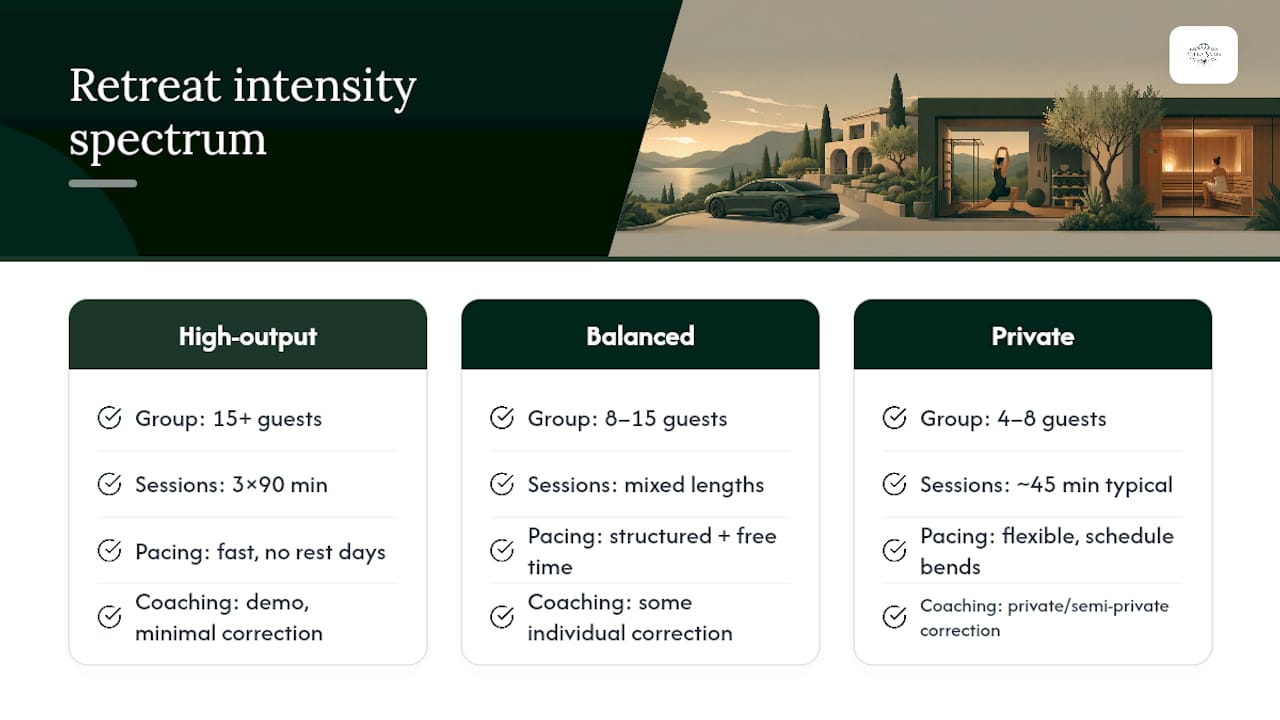
At one end sit high-output training camps that use mobility work as a supplement to hard conditioning sessions, typically running larger groups of fifteen or more with a fast-paced schedule. In the middle sit balanced wellness retreats, usually eight to fifteen guests, mixing structured mobility classes with substantial free time and recovery facilities. At the calmer end sit small private-house stays, often four to eight people, where sessions are private or semi-private and the schedule bends around the group rather than the other way round.
Group size changes the coaching you actually receive. A class of twenty means an instructor demonstrating a movement once and moving on; a class of six or fewer means real-time correction of your specific range of motion. If you are recovering from an injury, managing a chronic mobility limitation, or simply prefer not to perform stretches in front of strangers, the smaller end of that spectrum matters far more than any amenity list.
Intensity should be judged by session length and recovery windows, not just how demanding a single class feels. A retreat running three 90-minute high-intensity sessions daily with no rest days suits a very different traveller than one running one 45-minute session with hours of free time. Match the intensity to what you actually want from the week: skill-building and correction, or simply rest with some structured movement folded in.
Massage, physiotherapy, and other treatments worth asking about
Mobility sessions do the structural work, but complementary treatments often finish the job a class alone cannot. Massage is the most common addition to a mobility-focused stay, loosening tissue that stretching alone cannot always reach, particularly around the shoulders and lower back after days of new movement patterns.
Physiotherapy input, where available, adds real value for guests managing an existing injury or an old pattern of tightness. A physiotherapist can adapt a mobility flow to protect a vulnerable joint in a way a general instructor may not be trained to do. Not every retreat offers this on-site, so it is worth asking directly whether treatments are built into the stay or arranged separately through a local practitioner.
Some properties also offer simpler complementary elements: guided breathwork sessions separate from the main mobility programme, or quiet space set aside for personal stretching outside class hours. None of these substitute for a well-run mobility programme, but they extend its benefit considerably. When comparing retreats, ask plainly what is included in the price and what would need booking as an extra, since "wellness treatments available" can mean anything from a full in-house therapist to a phone number for a local clinic twenty minutes away.
Choosing between shared retreat rooms and a private whole-house stay
Accommodation for stretch and mobility retreats generally falls into two categories, and the difference shapes the entire experience far more than most people expect.
Shared retreat centres book guests into individual rooms or shared dormitories within one larger building, alongside other guests attending the same programme. This suits solo travellers wanting to meet others with similar goals, and it usually comes with a fixed group schedule set by the organiser.
A private whole-house rental, by contrast, means one group books the entire property, studio, sauna, kitchen, and grounds included, with no other guests present. This suits families, groups of friends, couples, or small training groups who want the schedule to bend around them rather than the reverse. Room options within this model tend to include several bedrooms of varying size, a shared self-catering kitchen, and communal living space, letting the group configure sleeping arrangements as they wish. Practising mobility work inside a genuine log-house also brings a different atmosphere entirely: honest timber, natural light, and a quiet that a purpose-built studio rarely manages to recreate.
The trade-off is straightforward. Shared centres often cost less per person and build in a ready-made social group. Private houses cost more collectively but deliver full control over pace, privacy, and facility access, which matters enormously if your group includes an injury, a preference for quiet, or simply a wish not to share a sauna with strangers.
What Villa Sakis guests report about mobility-focused stays
Guests staying at Villa Sakis for restorative and movement-focused trips consistently describe the same shift: arriving tense and leaving with a slower, steadier rhythm they try to hold onto at home. That pattern lines up with the Villa Sakis journal's own guidance on resting and truly restoring during a countryside stay, which argues that recovery needs unstructured time as much as it needs a class schedule.
The private-house format changes the retreat dynamic in a specific way. There is no shared studio timetable to negotiate, no stranger's sauna booking to work around, and the self-catering kitchen means meals fit your group's own rhythm rather than a fixed dining hour. That flexibility, paired with direct access to forest, meadow, and lake, gives mobility work a setting that a hotel conference room simply cannot match.
— Christian
Booking a mobility-focused stay at Villa Sakis
If the checklist above sounds like what you are after, whole-house privacy, real recovery facilities, and room to set your own pace, Villa Sakis is built for exactly this kind of stay. Booking the entire farmhouse means your group can decide how the days run, from session times to meal hours.
The property brings together the practical checklist covered throughout this guide: an authentic 18th-century log farmhouse with honest timber rooms, a private sauna for post-session recovery, direct access to lake, forest, and open meadow for outdoor practice, and a self-catering kitchen so your group eats on its own schedule. Because the whole house is yours for the stay, there is no shared studio to book around and no other guests to negotiate sauna time with.
Before enquiring, it helps to ask about a few specifics: whether an instructor can be arranged for your dates, the practice space's exact dimensions, and how sauna or hot tub access works for your group size. A quick look through the journal will also give you a fuller sense of what a stay here typically involves.
What you get with a private booking:
- Exclusive use of the studio, sauna, and grounds for your group alone.
- Flexible scheduling around your own mobility programme rather than a fixed house timetable.
- Self-catering meals timed to suit recovery, not a set dining hour.
- Direct access to forest, meadow, and lake for outdoor sessions.
Check dates and enquire directly through Villa Sakis to start planning your stay.
Sources
- Träningsresa som förnyar både kropp och själ - Aktiv kvinna
- Forest Camp Wellness Retreat för vila, natur & self-care - Elles Utemat