Du kan bygga verklig styrka utan ett gym. Det kräver inte heller dyra redskap eller en timme om dagen. Vad det kräver är ett program med progressiv belastning, tillräcklig intensitet och regelbundenhet. Expert commentary gathered by NPR in 2026 confirms that bodyweight exercises, when progressed systematically, are a viable route to building both strength and general muscle. Start here, today, with this full-body session:
Today's starter session:
- Bodyweight squat — 3 sets of 12 reps
- Push-up (or knee push-up) — 3 sets of 8–10 reps
- Glute bridge — 3 sets of 15 reps
- Plank hold — 3 sets of 20–30 seconds
- Superman hold — 2 sets of 10 reps
Four things that will determine your results:
- Progressive overload. Increase repetitions, reduce tempo, or progress to a harder variation once a set feels manageable; this principle is central to training gains.
- Frequency. Multiple sessions per week is the sweet spot for many people. Consistency over weeks matters far more than any single heroic session.
- Form before load. A clean squat with full range of motion builds more strength than a rushed, shallow one. Slow down and feel the muscle working.
- Recovery. Sleep and rest days are not optional extras. They are when adaptation actually happens. The NHS recommends adults aim for at least 150 minutes of moderate activity per week, paired with adequate rest.
Key takeaways
Progressive bodyweight training, done consistently two to four times per week with deliberate progressions, builds genuine strength without a gym or expensive equipment.
| Point | Details |
|---|---|
| Start with the basics | Use the full-body starter session: squat, push-up, glute bridge, plank, 3 sets each. |
| Prioritise progression | Add reps first, then sets, then tempo, then a harder variation — in that order. |
| Train 2–4 times per week | Beginners do well on 3 full-body sessions; advanced trainees can split to 4–5 days. |
| Keep kit simple | Resistance bands and a yoga mat (under £30 total) open most progressions you will need. |
| Recovery is the programme | Sleep, deload weeks and outdoor active rest determine how well training adapts. |
| Villa Sakis for restoration | A private stay at Villa Sakis pairs forest trails, sauna and lake access with your training routine. |
Table of Contents
- What does a weekly programme without gym equipment look like?
- How do you perform the key exercises safely and effectively?
- How should you structure sets, reps and progression over time?
- What kit and household substitutes actually help?
- How do you warm up and avoid injury?
- How does outdoor recovery support your training progress?
- Why this programme shape is worth trusting
- A restorative training break at Villa Sakis
- Sources
What does a weekly programme without gym equipment look like?
Three templates follow below, each designed to run for 4–12 weeks. Choose the one that matches your current level, then move up when the sessions feel consistently manageable.
Beginner: 3 sessions per week (full body)
A simple 3×/week plan with clear progressions is one of the most effective ways for beginners to start building strength at home. Each session takes roughly 20 to 30 minutes.
Progression note: Each week, aim to add 1–2 reps per set, or hold the plank 5 seconds longer. After four weeks, introduce a harder variation (e.g. move from knee push-up to full push-up).
Intermediate: 3–4 sessions per week (push/pull/legs split)
| Day | Focus | Sample exercises | Duration |
|---|---|---|---|
| Monday | Push | Pike push-up, tricep dip, decline push-up | 30 min |
| Tuesday | Pull + core | Australian row (under a table), Superman, hollow hold | 30 min |
| Thursday | Legs | Bulgarian split squat, glute bridge, step-up, calf raise | 20 to 30 minutes |
| Saturday | Full body | Circuit: squat, push-up, row, plank — 4 rounds | 30 min |
Progression note: Increase sets from 3 to 4 after week three. Introduce tempo work (3 seconds down, 1 second pause, 1 second up) before moving to harder variations.
Advanced: 4–5 sessions per week (upper/lower + conditioning)
Progression note: Prioritise quality over volume. Add a fifth day only when four sessions feel fully recoverable. Outdoor interval formats such as Tabata (20 seconds on, 10 seconds off, 8 rounds) work particularly well for the conditioning day.
Express versions (20–30 minutes): For any template, reduce to 2 exercises per movement pattern and cut rest periods to 45 seconds. The session becomes shorter but remains effective when intensity stays high.
How do you perform the key exercises safely and effectively?
The five movement patterns below form the foundation of any no-equipment programme. Master these before chasing harder variations.
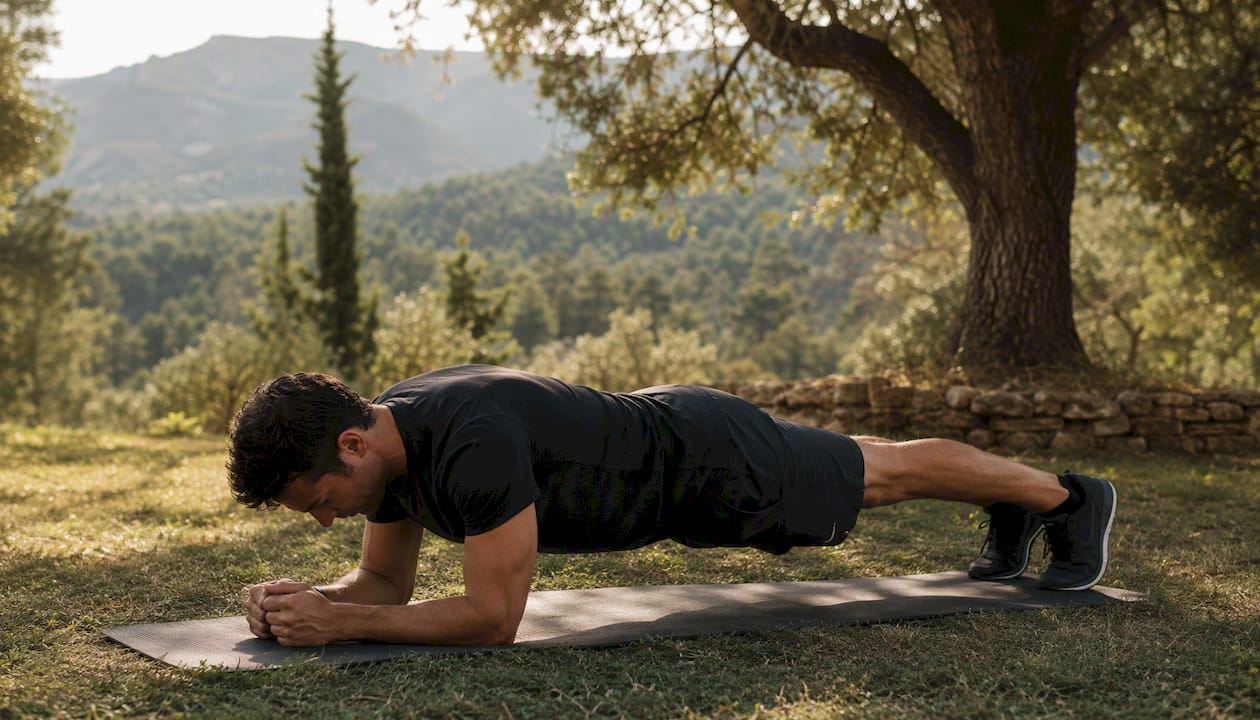
Push: push-up
Execution: Hands slightly wider than shoulder-width, body in a straight line from heels to crown. Lower your chest to within a centimetre of the floor, then press back up without flaring your elbows past 45 degrees.
- Regressions: Wall push-up → incline push-up (hands on a step) → knee push-up
- Progressions: Close-grip push-up → decline push-up → archer push-up → one-arm push-up
- Common faults: Sagging hips, chin jutting forward, elbows flaring wide
Pull: Australian row (inverted row)
Execution: Lie under a sturdy table, grip the edge with hands shoulder-width apart, body straight. Pull your chest to the table, hold briefly, lower with control. Practical regressions and progressions for this pattern make it accessible at every level.
- Regressions: Bent-knee row → towel row in a doorframe
- Progressions: Straight-leg row → feet-elevated row → single-arm row
- Common faults: Hips dropping, pulling with the wrists rather than the back
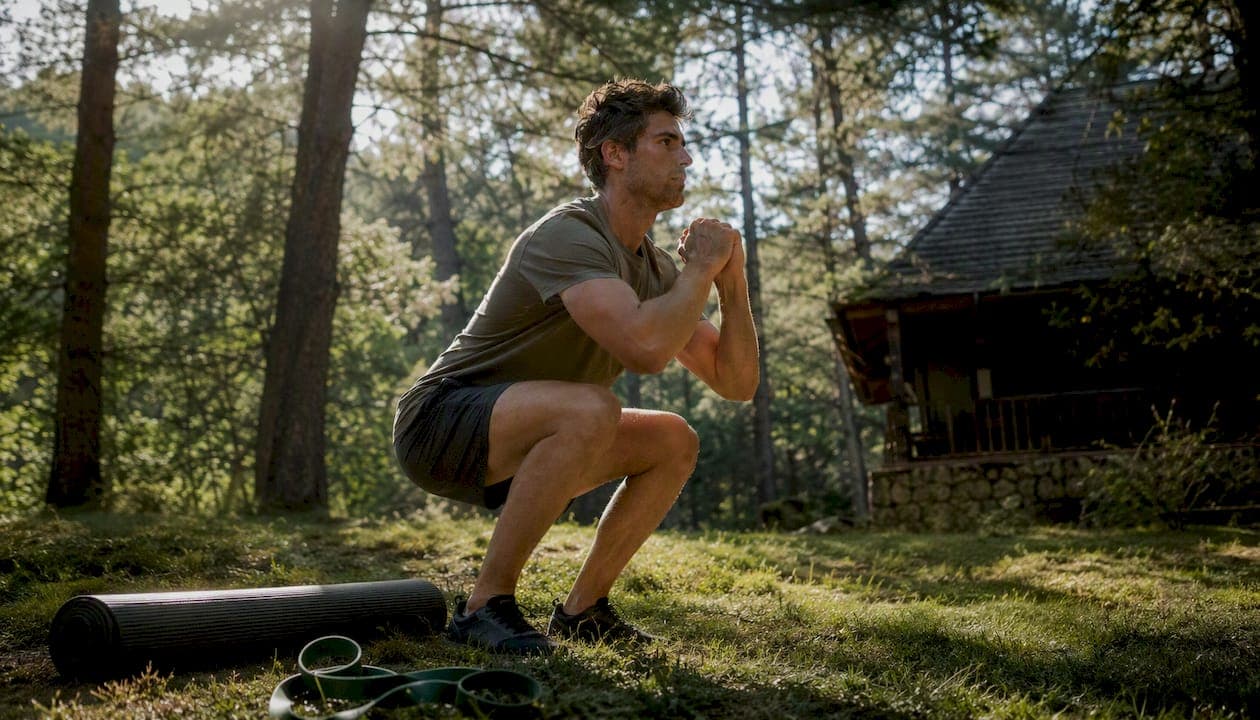
Squat: bodyweight squat
Execution: Feet hip-to-shoulder-width apart, toes turned out slightly. Sit back and down, keeping your chest tall and knees tracking over your toes. Aim for thighs parallel to the floor or below.
- Regressions: Box squat (sit to a chair) → assisted squat (hold a door frame)
- Progressions: Pause squat → Bulgarian split squat → pistol squat progression
- Common faults: Heels rising, knees caving inward, forward lean collapsing the chest
Hinge: glute bridge and hip thrust
Execution: Lie on your back, knees bent, feet flat. Drive through your heels to lift your hips until your body forms a straight line from knees to shoulders. Squeeze your glutes at the top and lower slowly.
- Regressions: Partial range bridge → single-leg bridge with bent knee
- Progressions: Single-leg bridge → elevated hip thrust (shoulders on a sofa edge) → weighted hip thrust with a backpack
- Common faults: Overextending the lower back at the top, feet too close or too far from the hips
Core: plank variations
Execution: Forearms on the floor, elbows under shoulders, body in a straight line. Breathe steadily and brace your abdomen as though bracing for a gentle punch.
- Regressions: Knee plank → incline plank (hands on a step)
- Progressions: Extended plank → plank with shoulder tap → RKC plank → hollow body hold
- Common faults: Hips rising or sagging, holding the breath, neck craning upward
Pro Tip: To increase time under tension without any equipment, slow every repetition down. A 3-second lowering phase on a push-up or squat recruits more muscle fibres and produces a training stimulus comparable to adding external load. This is one of the most underused tools in bodyweight training.
How should you structure sets, reps and progression over time?
Frequency, volume and intensity are the three levers you control. Progressive overload through harder variants, slower tempo or reduced rest is the central mechanism for gains without external weights.
Recommended frequency
Multiple sessions per week suit most beginners and intermediate trainees. More frequent sessions may benefit advanced trainees who recover fully between sessions. Training the same muscle group twice per week tends to produce better results than once per week for most people.
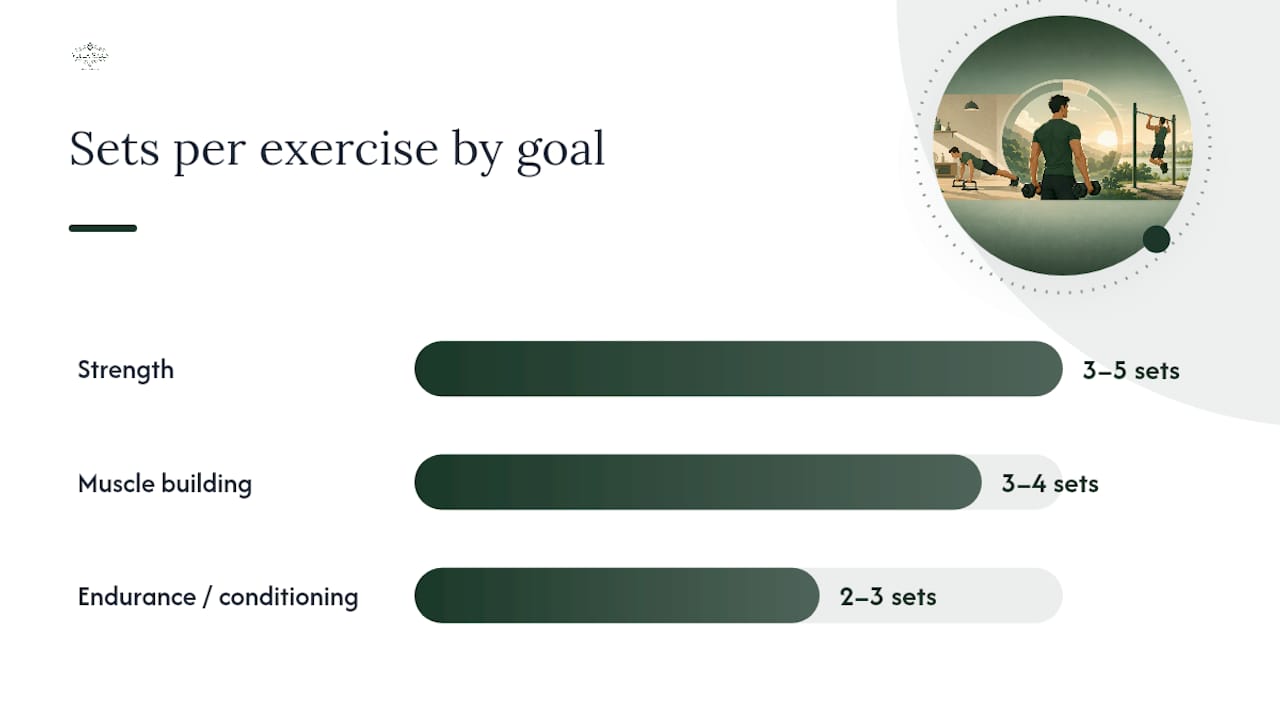
Sets, reps and goals
| Goal | Sets per exercise | Rep range | Rest between sets |
|---|---|---|---|
| Strength | 3–5 | 3–6 (hard variations) | 2–3 minutes |
| Muscle building | 3–4 | 8–15 | a minute or so |
| Endurance / conditioning | 2–3 | higher repetitions or timed sets | less than a minute |
Work close to muscular failure on the last set of each exercise. If you can complete all reps with two or more in reserve, the variation is too easy.
Progression checklist
When a session feels consistently manageable, apply changes in this order:
- Add reps (reach the top of the rep range)
- Add a set (move from 3 to 4 sets)
- Slow the tempo (add a 3-second lowering phase)
- Reduce rest periods
- Move to a harder variation
Timeline: what to expect
- Weeks 1–4: Noticeable improvements in coordination, technique and endurance. Strength gains begin, driven largely by neural adaptation.
- Weeks 5–8: Visible changes in muscle tone. Harder variations become accessible. Energy levels during sessions improve.
- Weeks 9–12: Meaningful strength gains across all movement patterns. Most beginners can progress from basic to intermediate variations within this window.
Track progress by logging reps and sets in a notebook, taking a monthly photo, or timing how long a circuit takes. Numbers on paper are more reliable than memory.
What kit and household substitutes actually help?
Bodyweight training is highly accessible, and most people can run a full programme with nothing at all. A few low-cost items, however, open up movement patterns that are genuinely difficult to replicate otherwise.
Worth buying (under a moderate budget)
- Resistance bands (loop and long). Add resistance to squats, bridges and rows; also useful for pull-up assistance. A set costs £10–£20 and fits in a pocket for travel.
- Yoga mat. Protects joints during floor work and defines your training space. Particularly useful for core and hinge exercises on hard floors.
- Suspension straps (TRX-style). Attach to a door or tree branch and unlock rows, face pulls and single-leg exercises that are otherwise hard to load. A basic set costs around £20–£30.
- A sturdy step or low box. Enables step-ups, elevated push-ups and decline variations. A bottom stair works equally well.
If you are setting up a more permanent home training space and want to think about layout and environment, home gym setup guidance covers practical considerations worth reading.
Household substitutes
- Sturdy chair: dips, step-ups, incline or decline push-ups
- Backpack filled with books: adds load to squats, hip thrusts and push-ups (place on your back)
- Park bench or low wall: elevated push-ups, step-ups, Bulgarian split squats
- Towel on a smooth floor: slider lunges, hamstring curls (lie on your back, feet on towel, curl heels toward hips)
Safety note: Test any improvised surface for stability before loading it. A chair that wobbles under your bodyweight during a dip is a genuine injury risk.
When to invest in kit
Consider buying equipment when you have been training consistently for six to eight weeks and find yourself limited by variation rather than effort. If every exercise in your programme feels too easy at high reps and slow tempo, a resistance band or suspension strap will open new progressions that bodyweight alone cannot easily provide.
How do you warm up and avoid injury?
A short warm-up is not optional. Cold muscles and joints are less pliable, and skipping preparation is one of the most common reasons people pick up minor strains during home sessions.
Five-minute warm-up protocol
- Joint circles (30 seconds each): ankles, knees, hips, shoulders, wrists
- Leg swings (10 per side): forward/back and side to side
- World's greatest stretch (5 per side): a deep lunge with a thoracic rotation
- Inchworm (5 reps): walk hands out to a plank, walk feet in, repeat
- Bodyweight squat (10 slow reps): use as a final movement check before the session begins
Recovery rules that actually matter
Sleep is the most powerful recovery tool available. Sufficient nightly sleep is essential for consistent training adaptation. Nutrition does not need to be complicated: adequate protein intake as recommended by general sports nutrition guidelines and sufficient total calories support muscle repair.
Schedule a deload every four to six weeks: reduce volume by roughly half for one week, keep the movement patterns, and let the body consolidate its gains. Many people skip this and plateau unnecessarily.
Red flags: when to stop and seek help
- Sharp, localised joint pain during a movement (not to be confused with muscle burn)
- Swelling around a joint after training
- Persistent weakness on one side that does not resolve after a rest day
- Pain that worsens with each session rather than improving
If any of these appear, pause training and consult a physiotherapist or GP before continuing.
Pro Tip: Delayed onset muscle soreness (DOMS) typically peaks 24–48 hours after a session. A gentle 20-minute walk the following morning is one of the most effective ways to reduce it. Light movement increases blood flow to the affected muscles without adding training stress.
How does outdoor recovery support your training progress?
There is a quiet logic to training outdoors and recovering in nature. Research cited by Actic points to improved mood, lower stress hormones and better concentration as benefits of exercising outside compared with indoor training. These are not trivial effects: mood and stress levels directly influence sleep quality, and sleep is where strength adaptation happens.
At Villa Sakis, the approach to recovery is woven into the environment itself. The property sits within Swedish pine forest and meadow, with lake access and forest trails that make active recovery feel less like a protocol and more like a natural part of the day. A restorative stay at Villa Sakis is designed around exactly this rhythm.
Recovery practices that complement training
- Sauna sessions. Post-training sauna use supports muscle relaxation and sleep quality. The Villa Sakis private sauna is well suited to this. For a detailed look at how sauna fits into an athlete's recovery week, the sauna for athletes guide on the Villa Sakis journal is worth reading.
- Forest walks. A 30–45 minute walk through woodland at a conversational pace counts as active recovery. It keeps blood moving without adding training load.
- Cold water immersion. Where safe and accessible (a lake, a cold shower), brief cold exposure after training may reduce perceived soreness. Always enter cold water gradually and never alone.
- Sleep hygiene in a quiet environment. Darkness, low noise and cool temperatures improve sleep depth. Rural settings naturally provide all three.
Outdoor active recovery sessions
On rest days, consider a light bodyweight circuit in a garden or park: 10 minutes of mobility work followed by two easy rounds of squat, push-up and plank at 50% effort. This keeps movement patterns fresh without accumulating fatigue. Sweden's right to roam means that forest trails and open land are freely accessible, making outdoor sessions easy to plan wherever you are staying.
Home training offers genuine convenience and can improve consistency for many people, though it trades the social energy of a gym for solitude. Pairing that solitude with a restorative natural setting, even for a week, tends to reset both motivation and sleep in ways that a busy urban environment rarely allows.
Why this programme shape is worth trusting
The progressions in this guide are built around one principle that holds across every level of training: the body adapts to what it is consistently asked to do, and only to that. Harder variations, slower tempos and reduced rest periods are not tricks. They are the same stimulus that external weights provide, expressed differently.
The emphasis on outdoor recovery is not decorative. The Villa Sakis environment, with its forest trails, private sauna and lake, exists precisely because restorative surroundings accelerate the recovery that makes training sustainable over months rather than weeks. That is not a marketing claim. It is a pattern visible in how guests arrive and how they leave.
This plan is not designed for competitive powerlifters seeking maximal absolute loads. For that goal, a barbell and a coach are genuinely necessary. For everyone else, including people returning from a break, travelling, working from home, or simply preferring to train outside, this framework is sufficient to build real, lasting strength.
A restorative training break at Villa Sakis

Villa Sakis offers something that no home programme can replicate on its own: a complete change of environment. The 18th-century log farmhouse in Bergslagen sits within private forest and meadow, with a lake a short walk away, a wood-fired sauna on site, and enough open space to run a full bodyweight session outdoors each morning.
A sample day might look like this: an early morning bodyweight circuit in the meadow, a quiet breakfast, a long forest walk in the afternoon, and an evening sauna followed by cold lake water and early sleep. The grounds and outdoor spaces at Villa Sakis are well suited to exactly this kind of rhythm.
For anyone who has been training consistently and wants a week that deepens recovery rather than interrupting it, Villa Sakis is a natural fit. The whole house is available for private hire, which means no shared spaces and no compromises on rest. Check availability and plan your stay at Villasakis.
Sources
- Styrketräning hemma utan vikter — komplett guide
- Träning med egen kroppsvikt: fördelar och nackdelar
- Träna hemma | 19 bästa övningarna + gratis träningsschema
- Utomhusträning med Actic - Actic
- Styrketräning hemma – tips på övningar! | SATS
- Building strength withouth weights - NPR
- Är hemmaträning framtiden för fitness? - Myprotein