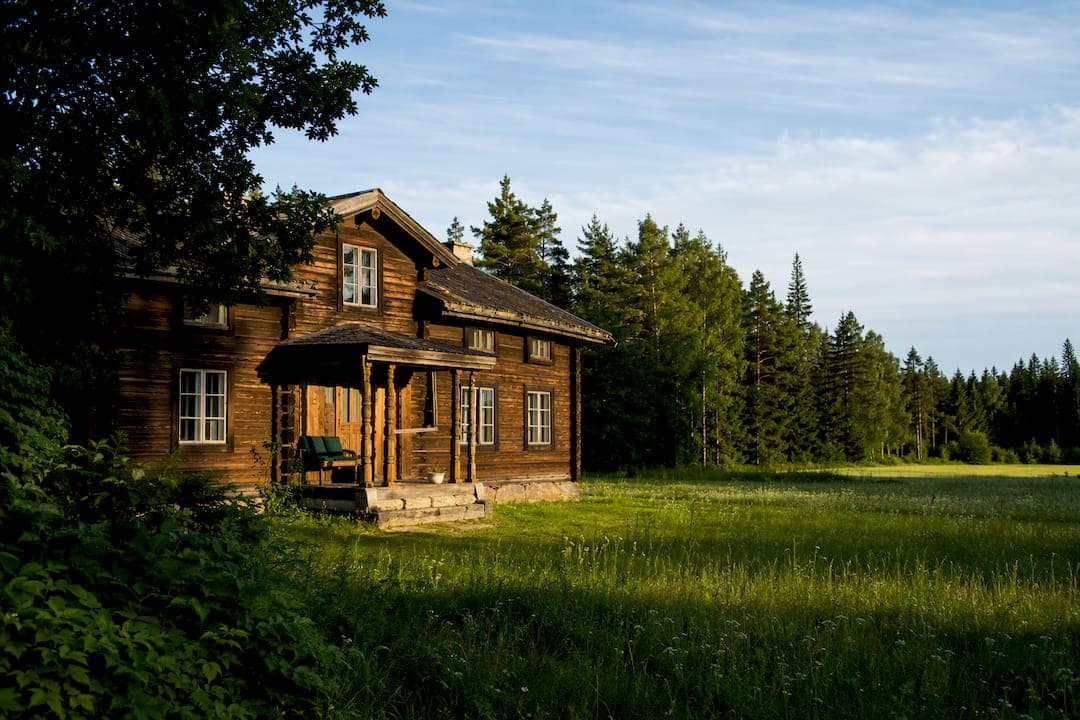
Book an entire farmhouse, not a room within one, and confirm four things before you pay a deposit: exclusive whole-house access, a kitchen sized for your group, enough bathrooms to avoid a morning queue, and a written deposit and cancellation agreement. An 18th-century Swedish log farmhouse with a private sauna and self-catering kitchen illustrates the standard worth measuring against. Most listings typically require a deposit that is refundable after inspection. The checklist below turns that standard into a five-minute test for any property you're considering.
TL;DR:
- Confirm that the entire farmhouse is rented exclusively to your group, not just a part or an annexe, to avoid disputes and ensure privacy.
- Ensure the property has sufficient bathrooms and kitchen appliances matching your group's size to prevent morning queues and food prep delays.
- Verify parking capacity and access road conditions, especially in rain or snow, to avoid logistical issues during arrival and departure.
- Obtain written agreement on deposit amount, refund conditions, and cancellation policies to prevent disagreements and facilitate smooth refunds.
- Plan arrival logistics such as shared shopping lists, roles, and early meals in advance to minimize chaos and promote harmony on the first day.
Table of Contents
- What does "gruppresa till landet" actually mean for a group?
- Quick checklist: the non-negotiables to confirm before booking
- Choose the right farmhouse layout and facilities for your group
- Booking, payments and paperwork: what to agree in writing
- Pre-arrival logistics: shopping, transport and first-day planning
- On-stay house rules, safety and handling accidents
- Sample weekly menu and time-saving meal plans for self-catered groups
- What activities suit a group staying in the countryside?
- When is the best time to plan a countryside group trip?
- How do group accommodation options compare by size?
- What local customs should group travellers keep in mind?
- Christian's perspective: hosting lessons from Villa Sakis
- If you want a ready-made option: booking Villa Sakis for your group
- Sources
What does "gruppresa till landet" actually mean for a group?
A gruppresa till landet, a countryside group trip, works best when it means one private house for the entire group rather than a shared building with other guests. That distinction sits at the heart of every good or bad group holiday story you've heard. The phrase gets used loosely online, sometimes to describe organised coach tours through rural regions, but the version that actually delivers rest and reconnection for friends, families, or a wellness group is simpler: a whole farmhouse, rented outright, self-catered, with nobody else's name on the lease that week.
That distinction matters because shared-access listings are where most disputes start. A host might describe a "farmhouse for groups" while actually letting out one wing and keeping a private annexe for themselves or other guests. Before you get attached to photographs, confirm the booking is for exclusive use of the entire property, not a slice of it. Ask the question plainly in your enquiry message: "Will our group be the only people staying at the property during our dates?" A host who hesitates or answers vaguely has told you something useful.
Quick checklist: the non-negotiables to confirm before booking
Run through this before you message a second listing or commit to a first one.
- Ask directly whether your group gets exclusive use, or whether an owner's annexe or other guests share the grounds.
- Count kitchen appliances against your group size: one small oven and two hob rings will not feed twelve people twice a day.
- Match bathroom numbers to your family units, not just to headcount.
- Check parking capacity and whether the access road suits multiple cars, especially after rain or snow.
- Request a full price breakdown: base rate, per-person charges above a set number, cleaning fee, and deposit.
- Read the host's cancellation history and rating rather than trusting the headline star score alone.
Groups routinely underestimate how much kitchen equipment, bathroom count, and parking capacity matter compared with cosmetic extras like a hot tub or a games room. A farmhouse with one bathroom and a gorgeous view will wear thin by day three with ten guests sharing it.
Choose the right farmhouse layout and facilities for your group
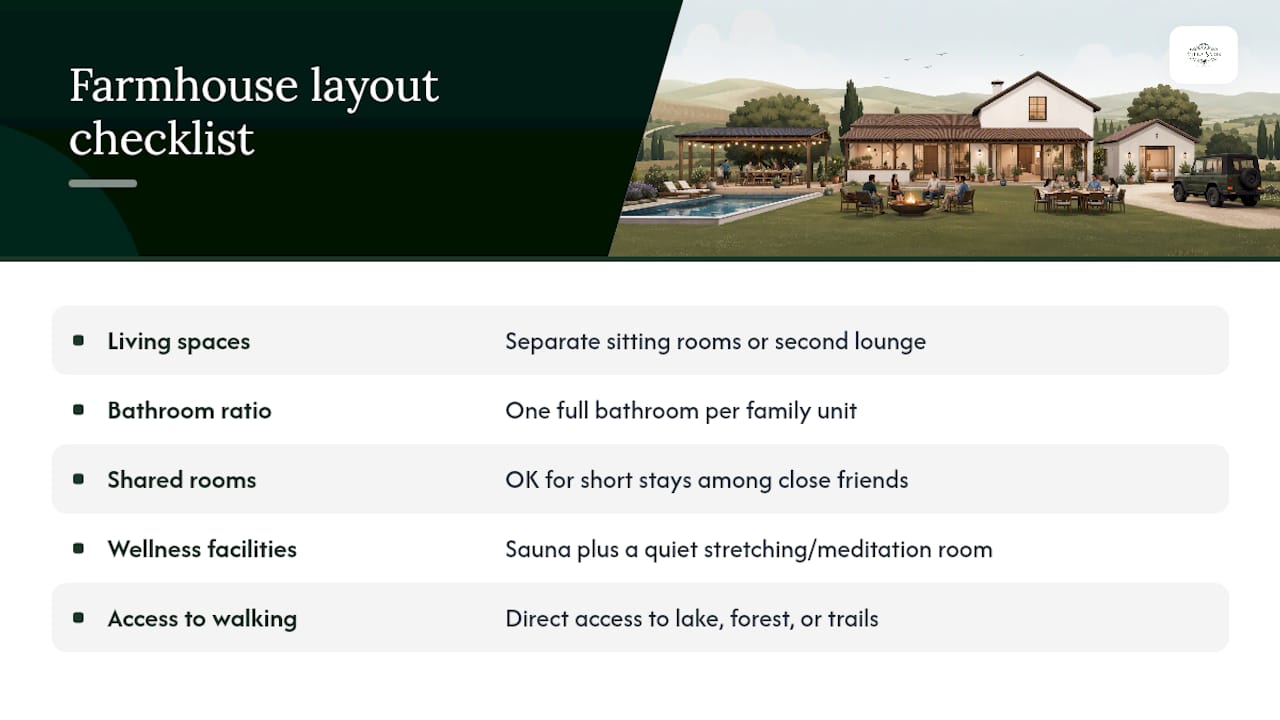
Layout decides whether a week together feels restorative or fraying. Separate living spaces, even a second small lounge, let early risers and night owls coexist without one group resenting the other. This matters more with mixed-age groups: grandparents and toddlers keep different hours to twenty-somethings, and a single shared sitting room forces everyone onto the same schedule.
As a rule of thumb, aim for one full bathroom per family unit rather than per bedroom. Four bedrooms and one bathroom sounds spacious in a listing photo and feels like a bottleneck by 8am. Shared rooms and smaller bedrooms are perfectly fine for short stays among close friends who don't mind the closeness, but stretch that arrangement across a week with in-laws and the cracks show.
For wellness groups specifically, prioritise facilities that support quiet rather than activity: a sauna, at least one room set aside for stretching or meditation, and direct access to a lake, forest, or walking route. A property with direct access to countryside walking terrain removes the need to drive anywhere for the thing you came for, which is often just space to breathe.
Booking, payments and paperwork: what to agree in writing
Verbal reassurance from a host is worth little once you're two hundred miles from home with a leaking pipe. Get the terms down before you transfer a deposit.
- Request written confirmation showing the total cost, deposit amount, and the exact conditions under which the deposit is refunded.
- Ask how the deposit refund process works in practice: is it returned automatically after inspection, or does the host need to be chased?
- Check the host's cancellation history on the platform you're using, not just their current star rating, before committing.
- Ask about insurance cover for the property and clarify who is liable for accidental damage during your stay.
- Photograph the property together with the host (or a delegated key-holder) on arrival, and keep a signed inventory list.
Pro Tip: Ask for the inventory list and refund policy in writing before you pay anything, even a holding deposit. A five-minute email exchange now saves a week of arguing over a security deposit later.
Large group listings commonly structure pricing as a base fee for a set number of guests, an extra per-person charge above that number, and a deposit refunded after inspection. That structure is worth expecting rather than being surprised by. Private owners often sit outside the consumer protection frameworks that cover commercial letting agencies, so treat every verbal promise as provisional until it's written down. If cancellation risk worries you, favour hosts with a long, stable booking history over one with a shiny rating but few completed stays. On pricing quirks, Swedish tax guidance for private cottage letting allows a 40,000 SEK standard allowance plus a 20% deduction on income above that, which occasionally explains why two similar farmhouses are priced quite differently. This is background, not legal advice.
Pre-arrival logistics: shopping, transport and first-day planning
The first evening sets the tone for the whole trip, and it's usually chaos unless someone has thought about it in advance.
- Set up a shared shopping pot before you travel, so nobody arrives having fronted the whole first supermarket run.
- Draft a simple arrival-day shopping list: coffee, milk, bread, and whatever your group eats for breakfast, so the kitchen isn't empty on night one.
- Confirm how many cars are coming and check the access road can handle them, particularly for a rural farmhouse reached by a gravel track.
- Decide in advance whether to pre-order groceries for delivery, or pay for a one-off catered meal on the first night to remove pressure from tired drivers.
- Assign roles before you leave home: one key-holder, one shopping lead, one small kitchen team for the first meal.
Creating a shared shopping pot and a simple rota from the outset heads off the low-level friction that builds when nobody has agreed who's paying for what. It sounds like a small thing. It's rarely the small things that ruin a group holiday, but this one comes close.
On-stay house rules, safety and handling accidents
Agree the basics before anyone arrives, not after the first disagreement. A noise curfew, a smoking policy, and a clear line on pets save awkward conversations mid-stay.
- Set a rough noise curfew that suits the mix of ages in your group.
- Agree the house's position on smoking and pets before booking, not on arrival.
- If there's a sauna, set a sensible occupancy limit and make sure children are supervised near heat and water at all times.
- Photograph any pre-existing damage on arrival and report new incidents to the host immediately, in writing.
- Keep the host's phone number and the address of the nearest clinic somewhere every adult in the group can find quickly.
Setting a handful of simple ground rules before arrival is the single cheapest way to keep a mixed group of ten or twelve people on good terms for a week. It costs nothing and takes one email.
Sample weekly menu and time-saving meal plans for self-catered groups
Self-catering for a large group can become a second job unless you structure it loosely in advance. A simple pattern works better than an ambitious one nobody sticks to.
- Breakfasts: shared and self-serve, laid out once each morning rather than cooked to order.
- Lunches: light and easy, often leftovers, bread, and something from the fridge that doesn't need a pan.
- Dinners: communal and rotated, with two or three families sharing cooking duty on different nights.
- One evening off: order in or hire a local caterer, particularly midweek when everyone's energy dips.
Batch-cooking a large pot of something on day one, a stew or a curry, gives you two dinners for the effort of one and frees the second evening for something else entirely. Split the shopping list between families rather than one person carrying the whole load, and consider a full weekly meal template if you'd rather not improvise from scratch.
What activities suit a group staying in the countryside?
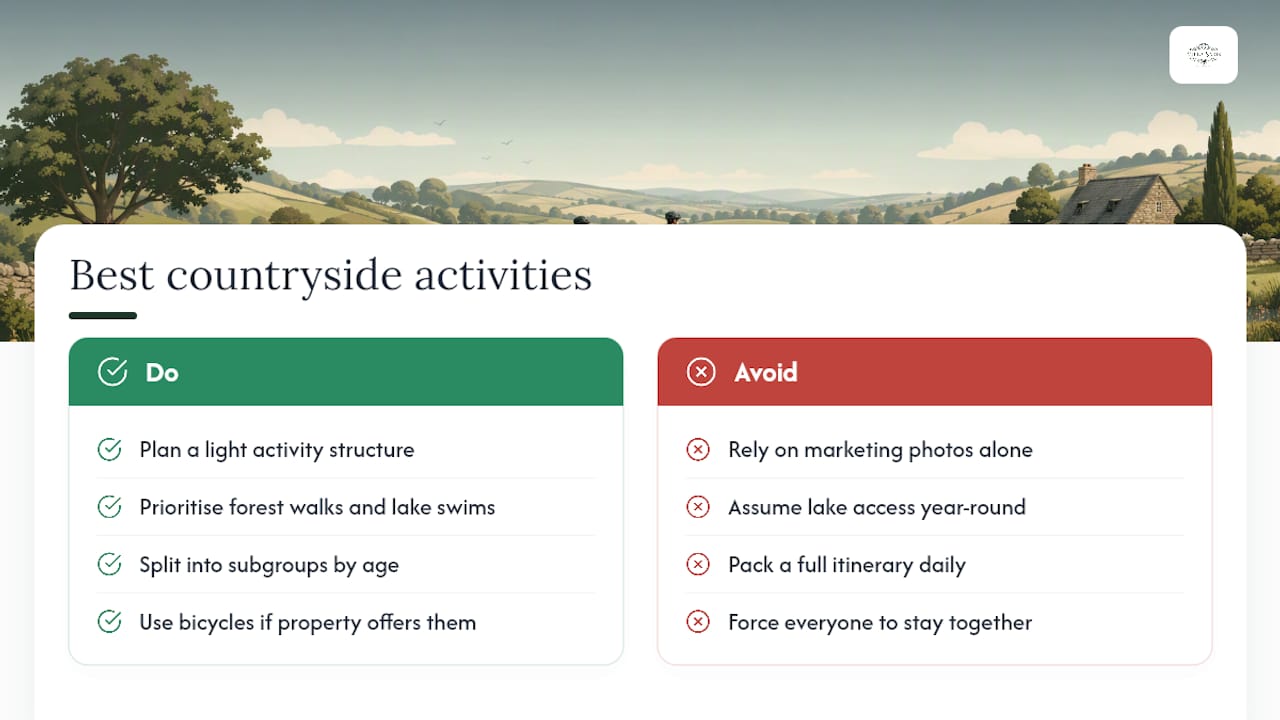
Rural retreats reward groups who plan a light structure rather than a packed itinerary. Forest walks, lake swimming where access allows, and simply sitting outside with a book cover most of what wellness travellers actually want from the week. Bicycles, if the property offers them, turn a farmhouse into a base for exploring nearby villages without everyone needing a car.
Groups with a wider age range tend to do best splitting into smaller units for part of each day: grandparents and younger children on a shorter walk, more energetic guests on a longer forest route, everyone reconvening for the evening meal. A sauna session in the late afternoon works as a natural gathering point that doesn't demand energy from anyone still recovering from travel.
Larger group properties sometimes list on-site activities and seasonal access rules worth checking rather than assuming: some farmhouses restrict lake access in certain months, or set minimum-stay requirements around peak weekends. Read the listing detail rather than the marketing photos. A property boasting "forest access" might mean a five-minute walk down a marked path, or it might mean a gate at the edge of the garden and nothing beyond it. Ask, if it isn't clear.
When is the best time to plan a countryside group trip?
Summer, roughly June through August, gives you the longest daylight and the most reliable warm-weather activities: lake swimming, outdoor dining, evening walks that don't require a torch until quite late. It's also when demand and prices for larger farmhouses peak, so groups planning a summer trip should book several months ahead.
Late spring and early autumn offer a quieter, cheaper alternative with cooler but often clear days, better suited to groups who want walking and stillness over swimming. Winter changes the character of a countryside stay entirely: shorter days, snow-dependent access roads, and an emphasis on indoor warmth, sauna use, and slower mornings. It's a genuinely restorative option for a smaller wellness-focused group, provided you've confirmed the access road is manageable in poor weather, something worth asking about directly rather than assuming from a summer photograph.
Whichever season you choose, book earlier than feels necessary. Good multi-bedroom farmhouses with genuine whole-house exclusivity get reserved well ahead of the date, particularly around midsummer and school holidays.
How do group accommodation options compare by size?
Group size should drive the decision more than aesthetics. A farmhouse suited to six guests rarely scales cleanly to sixteen, and the strain shows up first in the kitchen and bathrooms.
| Group size | Best-suited option | Main consideration |
|---|---|---|
| 2 guests | Smaller farmhouse or cottage, one shared kitchen | Fewer bathroom pressure points, simpler logistics |
| — | Mid-sized farmhouse with separate living areas | Needs multiple bathrooms and a genuinely equipped kitchen |
| — | Large group house or a cluster of linked buildings | Parking, water pressure, and hob capacity become real constraints |
Smaller cottages can feel cosy for a couple but strained the moment a third family unit is added, since most were designed around a single kitchen and one bathroom. At the upper end, above roughly fifteen guests, some groups find it easier to book two adjoining properties rather than one enormous house, purely because plumbing and cooking infrastructure in older rural buildings wasn't designed for that scale. Whatever the size, structural essentials outweigh minor amenities: a hot tub is nice, a second bathroom is necessary.
What local customs should group travellers keep in mind?
Rural hospitality in Sweden runs on a few unspoken habits worth knowing before you arrive. Shoes come off at the door in most homes, farmhouses included, and hosts generally appreciate guests who ask before rearranging furniture or moving items between rooms. Quiet hours matter more in the countryside than in a city apartment: neighbouring properties, even at a distance, can hear a group of twelve on a still evening far more clearly than you'd expect.
Sweden's allemansrätten, the right of public access to the countryside, lets you walk, forage berries, and swim across most uncultivated land even where you're not staying, provided you're respectful of private gardens and don't disturb livestock or crops. It's a genuine freedom worth using, and one that surprises many first-time visitors from countries with more restrictive access laws. Understanding how that right of access works helps a group make the most of the surrounding land without accidentally overstepping a boundary.
Recycling and waste separation are taken seriously in most rural areas too. Farmhouses typically provide separate bins for food waste, packaging, and glass, and hosts notice when a group ignores the system entirely.
Christian's perspective: hosting lessons from Villa Sakis
The single most common thing guests forget isn't a toothbrush. It's asking how many people the kitchen was actually built to feed. A farmhouse kitchen from the 1700s was designed around a much smaller household, and groups who assume "self-catering" means "identical to home" are usually the ones messaging hosts on day two asking where the second hob is.
Preparing for a group means walking through arrival hour by hour before it happens: is the sauna briefing given on check-in or left for guests to work out themselves? Is the shopping list sent in advance, or discovered too late? The deposit conversation matters too. It should happen once, in writing, before arrival, not negotiated retroactively over a scuffed floorboard. Hosts who set out house rules and timing clearly before a booking tend to have calmer, happier groups than those who leave it to chance.
— Christian
If you want a ready-made option: booking Villa Sakis for your group
This property meets the checklist rather than asking you to take it on faith: the entire 18th-century log farmhouse is booked exclusively by one group at a time, with a private sauna and a self-catering kitchen built for shared meals rather than solo cooking. There's no shared annexe, no other guests in the grounds, and no ambiguity about whose week it is. For a group weighing whether to keep searching listings or settle on one property that already answers the whole-house, kitchen, and privacy questions, that clarity is worth something.
Compare your own checklist, exclusivity, bathroom count, kitchen capacity, deposit terms, against the full house layout and facilities, and get in touch through Villa Sakis to check availability for your dates. If you want more on planning the practical side of a countryside stay, the guide to what a Swedish countryside trip involves is a useful next read before you book.
Sources
- Fritiden
- Semesterboende med plats för alla — vad ska du tänka på?
- Att hyra stuga, lägenhet och hus på Airbnb
- Checklista: Hyra ut din stuga — Stugsson