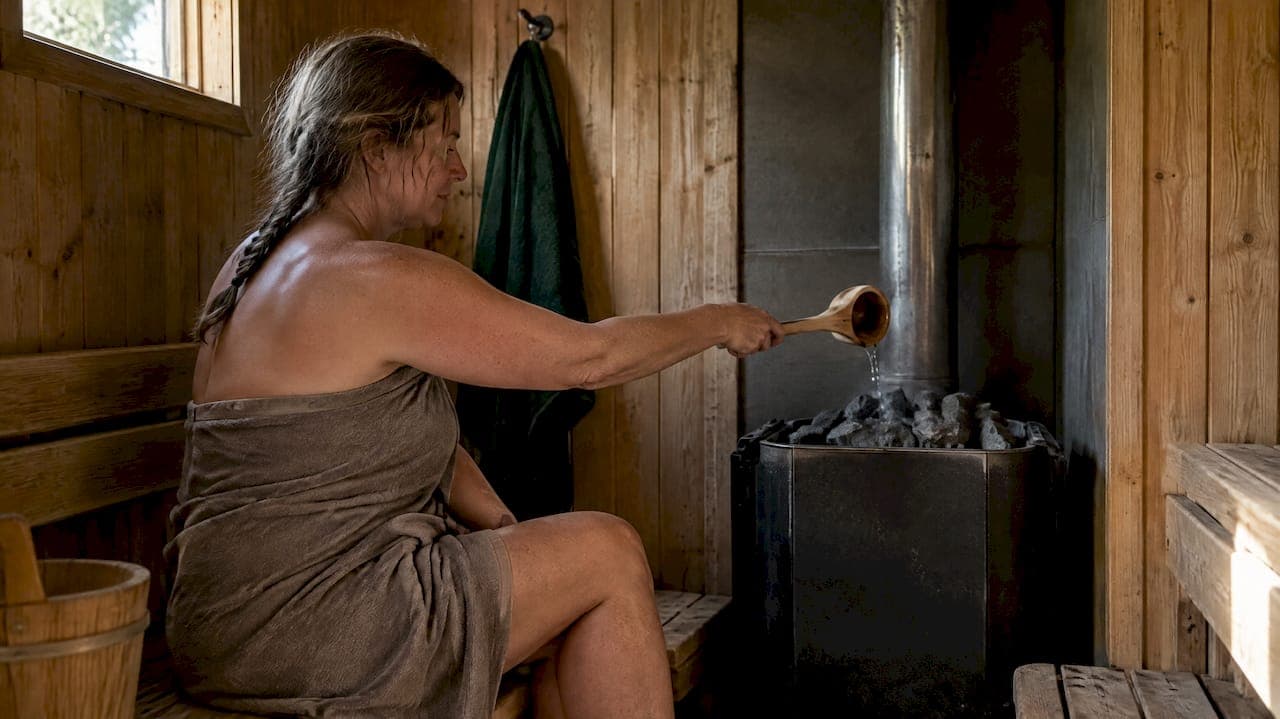
A Swedish bastu ritual is a slow cycle of heat, cooling and rest, repeated three or four times, with no hurry and very little ceremony. You sit in the warmth for roughly 8 to 15 minutes, cool off with a dip or fresh air, rest, and go back in. The rest of this guide covers the details: what each round feels like, the etiquette, the lake, and where it all comes from.
TL;DR
- The core ritual is heat, cooling and rest, repeated three to four times, with 8 to 15 minutes in the heat per round.
- Shower first, sit on a towel and ask before pouring water on the stones.
- Swedish bastu is quieter and more domestic than the theatrical German aufguss, and often sits beside a lake.
- If you have a heart condition or have had surgery, speak to your doctor or care team before using a sauna.
- A private sauna lets you set the pace yourself, which suits a first ritual best.
Table of Contents
- What a Swedish sauna ritual actually is
- The ritual in five movements
- Löyly: why the steam matters more than the thermometer
- Aufguss, birch whisks and other rituals you may meet
- Etiquette: small courtesies that make the ritual work
- The lake: the other half of the ritual
- Where the tradition comes from
- Safety: who should be careful
- A private ritual in a log house
- Our perspective
- FAQ
- Sources
What a Swedish sauna ritual actually is
Most visitors imagine a rulebook. In practice the ritual is a rhythm. Heat, then cool air or water, then rest, and then again. According to a Swedish lakeside sauna guide, taking a sauna means repeating that cycle, usually three to four rounds, and a wood-fired sauna typically runs at 70 to 90 °C.

Sweden's own heritage inventory, Levande kulturarv, notes that bathing in a bastu has long roots in several parts of the country and happens today both at home and in public settings. That mix explains the tone: it is an ordinary, unhurried part of life more than a performance.
The Swedish version also leans quiet. One European sauna guide describes the Swedish approach as softer and more domestic than the Finnish tradition it shares roots with, often woven into leisure time at summer houses and nature-immersed places. That is the version we know best.
The ritual in five movements
1. Prepare: shower, hydrate, slow down
Shower before you go in. Take a towel to sit on. Arrive without a phone, a watch or a plan. Drink water beforehand, and keep a glass nearby for afterwards. If you want to think about sleep, finish your last round well before bedtime; our note on finishing the sauna 60 to 120 minutes before bed explains the reasoning.
2. The first round: warm up
Sit on a lower bench the first time. The first round is for letting the body understand where it is. Eight minutes is plenty. Leave when you want to, not when a clock says so. The recommended range of 8 to 15 minutes per round is a ceiling, not a target.
3. Cool down
Step outside and let the air meet your skin. Or go to the water. A traditional Swedish pattern is to alternate sauna sessions with a swim or cold bathing in a nearby lake, river or sea, and many saunas are built by the water for exactly this reason. If you are new to it, enter slowly and keep dips short. We have written separately about a 15 to 20 minute sauna with 30 to 60 seconds of cold as a recovery routine.

4. Rest
This is the part people skip, and it is the point. Sit wrapped in a towel or blanket. Breathe. Watch the light on the water or the trees. Resting for several minutes between rounds is what makes the next round pleasant.
5. Repeat, then finish gently
Go back in for round two and three, perhaps a fourth. End with a cool rinse or a quiet sit, then more water. Do not rush into a hot drink or a full dinner; give your body a little while to settle.
Löyly: why the steam matters more than the thermometer
Löyly is the Finnish word, widely used in Sweden too, for the steam that rises when water meets hot stones. The same lakeside guide says the steam, not the thermometer, makes a sauna feel hot. A sauna at 80 °C with dry air feels gentle; add a ladle of water and the heat rolls over you.
So pour in small amounts. One ladle, wait, breathe. And ask first. Contemporary etiquette in Sweden includes checking whether others are comfortable before pouring more water on the stones. In a private sauna, you decide together, which is one of its quiet pleasures.
Aufguss, birch whisks and other rituals you may meet
The search results for this topic are full of aufguss, so it is worth placing it. Aufguss means "infusion" in German. It is a multisensory ritual in which a sauna master drops fragrance-infused ice onto hot rocks and directs the steam with a towel. It is theatrical, scheduled and led. Dr Martha Newson, a psychologist, has suggested that communal rituals like this can act as "third spaces" where social norms are suspended, helping people feel supported and part of something.
Swedish home bastu rarely looks like that. Nobody swings a towel. The ritual is the pace itself.
The birch whisk, or vihta, is a Finnish tradition, and first-timers are not expected to use one. If you are curious, try it once, gently, with someone who has done it before. If not, nothing is missing.
Etiquette: small courtesies that make the ritual work
The rules are few and they are mostly common sense:
- Shower before you enter, and sit on a towel.
- Make room on the benches for others.
- Ask before adding water to the stones.
- Chat if you like, but respect anyone who wants a quiet moment.
- At many lake saunas, use the outdoor footbath on the way in or out.
Nudity is normal in Swedish single-sex or private family settings and is not meant to be provocative. One Stockholm guide describes it as a kind of honesty rather than titillation. In mixed company, a towel or swimwear is always acceptable; follow the signs and the people around you. For practical manners around showering, towels and asking first, the same logic applies wherever hot water is shared.
We have gathered our own house guidance in sauna etiquette at Villa Sakis, and if you are travelling with children, sauna with children covers temperature, timing and supervision.
The lake: the other half of the ritual
In Sweden the sauna and the water belong together. A short, calm entry into a lake after the heat is the traditional cooling step, and an evening version of this is one of the simplest rituals there is. Our guide to an evening sauna by a lake walks through timing and light, and cold bathing in Swedish lakes explains how to read local signs before you get in.
A few sensible habits: never swim alone after dark, get in by steps or a jetty where you can, keep the first dips short, and get out when your body says so. Cold water is a shock to the system, and you are not being tested.
Where the tradition comes from
The story is longer than most people expect. Swedish sauna tradition has roots in early-modern public baths and was later shaped by ties to Finland, where sauna bathing continued without a break. Late-nineteenth-century hygiene ideas and twentieth-century public-health campaigns then revived and transformed it. The same research notes that almost 10,000 public and community saunas were built in Sweden between 1920 and 1950.
Going further back, historian Charlotta Forss describes early-modern Swedish bathhouses as places where people met to talk and enjoy themselves, and where visits were understood to affect health. The sociable, restorative side of bastu is not a modern invention.
Safety: who should be careful
Sauna and cold water are not for everyone, and the caution belongs at the point of action. Swedish healthcare guidance from 1177 advises patients who have had certain heart operations to avoid saunas for four to six weeks, and to begin with lower temperatures and short sessions once a medical professional approves. If you have a heart condition, low or high blood pressure, are pregnant, or take regular medication, ask your doctor or nurse before you start, and before alternating with cold water.
Everyone else: drink water, avoid alcohol before and during, leave if you feel dizzy, and never sleep in the heat.
A private ritual in a log house
Shared saunas have their charm, but a first ritual is often best taken alone or with people you know. That is the idea behind a private sauna holiday in Sweden: you control the heat, the water, the silence and the length of each round.
At Villa Sakis, an 18th-century Swedish log farmhouse in Bergslagen, you book the whole house for your own use. It comes with a private sauna, lake access and direct paths into forest and meadow, so the ritual can begin and end at your own door. You can see the rooms on the house page and check availability on the booking page.
If you are planning a colder-season stay, our notes on a cosy private sauna weekend cover hygiene and session length, and the Swedish countryside vacation guide covers the rest of the planning.
Our perspective
We have looked after this farmhouse for a long time, and we have watched guests arrive with a list of things to get right. Temperature, minutes, breathing, cold plunges. By the second evening the list has usually gone.
What we believe is simple. The ritual works because it is slow. The timber walls, the smell of the stones, the walk down to the water, the quiet afterwards: they are not extras, they are the practice. We would rather a guest took two gentle rounds and watched the light go than chased four rounds and a record.
So our advice is to keep it plain. Shower, sit, breathe, cool, rest. Ask the people you are with what they want. Leave the phone in the house. Let the evening be longer than the sauna.
— Christian
FAQ
How long should you stay in a Swedish sauna?
A typical round is 8 to 15 minutes in the heat, followed by cooling and rest, repeated three or four times. Beginners should start at the short end and leave whenever they feel uncomfortable. Resting between rounds matters as much as the heat.
What is the difference between aufguss and a Swedish bastu ritual?
Aufguss is a guided German-style session in which a leader pours infused water or ice on the stones and fans the steam with a towel. A Swedish bastu ritual is usually self-led, quiet and domestic, often by a lake. Both use steam from hot stones, but the mood differs greatly.
Do you have to be naked in a Swedish sauna?
No. Nudity is common in private and single-sex settings, but a towel or swimwear is always acceptable, especially in mixed company. Follow local signs and the habits of the people around you, and always sit on a towel.
Do you need a birch whisk?
No. The birch whisk is a Finnish tradition, and first-timers are not expected to use one. If you are curious, try it gently once you are comfortable with the heat.
Is it safe to go from sauna into cold water?
For many healthy adults, short dips are a long-standing Swedish habit, but it is a real shock to the body. If you have heart or blood pressure problems, or are pregnant, ask your doctor first. Enter slowly, keep it brief and never swim alone.
Sources
- How to sauna like a Swede, the Nordic sauna ritual
- Bada bastu, Levande kulturarv
- Scandinavian sauna traditions, Europe Sauna Guide
- Swedish sauna etiquette, Europe Sauna Guide
- The ultimate guide to Swedish sauna etiquette, The Local
- Europe's new steamy wellness trend, BBC Travel
- What is Aufguss?, Wallpaper*
- Stockholm sauna culture guide
- Sweating for the Future, Karlstad University
- The Body in the Bathhouse, Cambridge University Press
- 1177 patient information on heart surgery