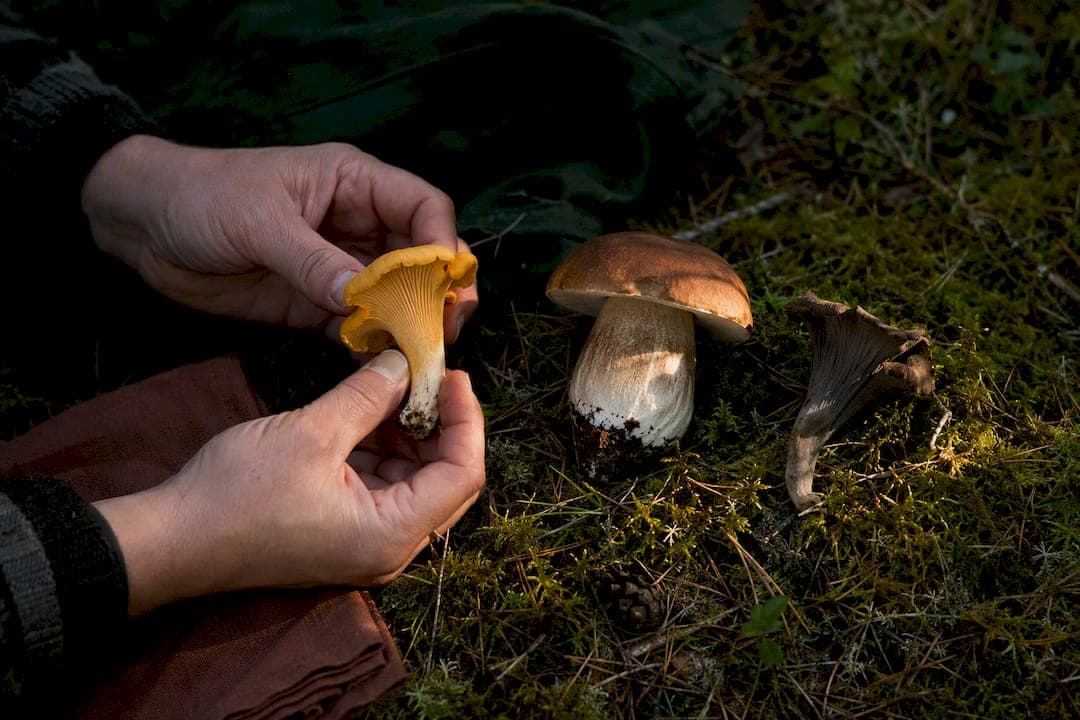
Yes. You can start svampplockning as a nybörjare safely in Sweden this autumn, provided you follow a handful of clear rules and lean on people who already know the forest. Learn two or three safe species properly, join a guided foray before you eat anything you have picked, and treat Svampkonsulenterna, Svampindex, and a countryside base like Villa Sakis as your first three resources.
TL;DR:
- Beginners should focus on learning three safe species—kantarell, karljohan, and trattkantarell—with clear identification features to avoid dangerous lookalikes.
- Using a woven basket, a specialized knife with brush, and proper sorting techniques helps maintain mushroom quality and prevent cross-contamination of spores.
- Timing for picking depends on regional rainfall, with peak seasons typically in August and September, and revisiting productive spots increases success.
- Proper field checks include underside pattern, smell, habitat, and taking photos or spore prints to confirm species before harvest.
- In-person courses and guided forays greatly improve safe foraging skills compared to relying solely on apps or books.
Table of Contents
- What does mushroom picking for beginners actually involve?
- What should go in your field kit?
- Which mushrooms should beginners start with?
- Where and when should you look in Sweden?
- What are the safety and legal basics you need to know?
- How do you check identification in the field?
- Where can you learn faster than trial and error?
- What should your first-trip checklist look like?
- A local perspective: learning to forage from a countryside base
- How do you clean mushrooms properly before cooking?
- How should you store or preserve your harvest?
- What mistakes do most beginners make?
- What can beginners cook with their first harvest?
- Why the standard beginner advice undersells local knowledge
- Turn your first foraging weekend into a proper countryside stay
- Where to verify what you learn
- Sources
What does mushroom picking for beginners actually involve?
Mushroom picking, or svampplockning, is less a single skill than three linked habits: knowing where and when to look, correctly naming what you find, and having the discipline to leave anything uncertain in the ground. Swedish foraging culture treats this as ordinary countryside knowledge, passed between neighbours and grandparents for generations. For someone starting from scratch, the standard advice from Swedish mycology groups is to narrow your focus rather than widen it. Naturplats recommends beginners commit to a handful of forgiving species such as kantarell, karljohan, and trattkantarell before attempting anything more ambiguous. That narrower scope is what makes the whole activity approachable rather than daunting.
What should go in your field kit?
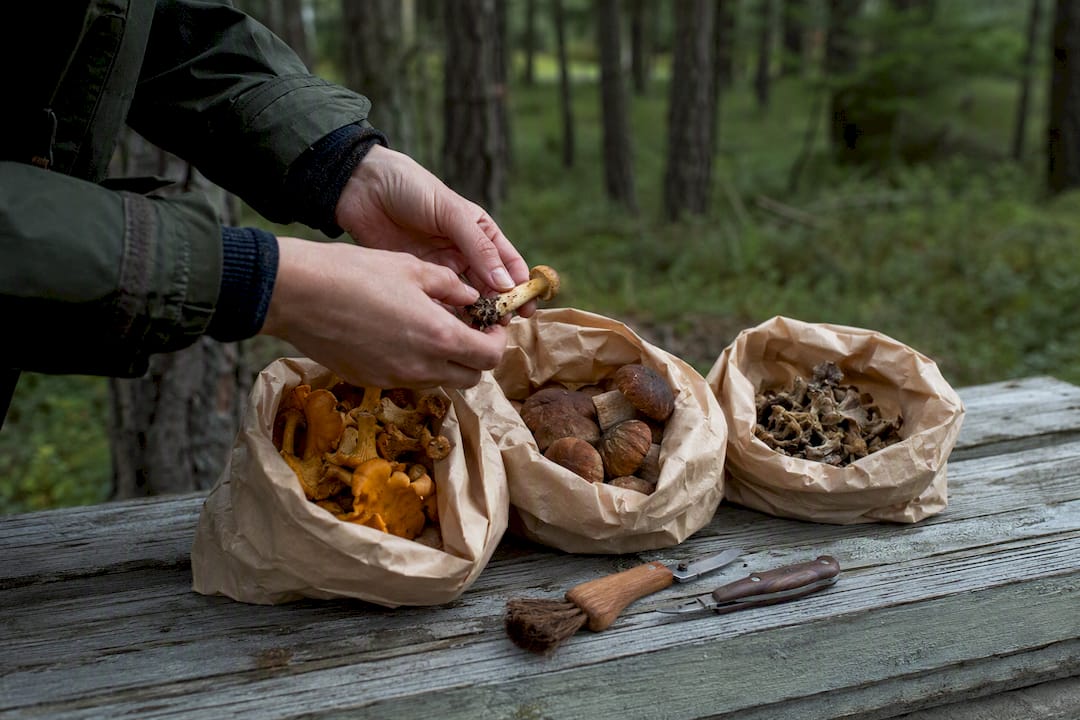
A proper kit turns a nervous first outing into a productive one. Skip the plastic carrier bag; a woven korg lets spores drop and air circulate, keeping your haul fresh and helping the forest reseed itself as you walk. A svampkniv with an attached brush handles both cutting and cleaning in one motion, which matters once your hands are muddy and your basket half full.
- Korg (woven basket), not a plastic bag
- Svampkniv with brush, plus a small folding field knife
- White paper squares for spore prints
- Charged phone with GPS, plus paper bags for sorting species separately
- Water, a snack, and something warm if the forest floor is damp
Before leaving, check Svampindex for regional reports, download the Svampguiden app, and tell someone your route and expected return time.
Pro Tip: Sort finds into separate paper bags by species as you go. Mixing an unknown specimen with a confirmed kantarell in the same bag makes cross-contamination of spores, smells, and juices far more likely, and it muddles identification later.
Which mushrooms should beginners start with?
Stick to a short list and learn it properly rather than skimming a field guide cover to cover. Repetition with two or three species builds real pattern recognition faster than trying to memorise dozens at once, and Swedish guides consistently point beginners toward the same small group for good reason.
- Kantarell (chanterelle): shallow, forked ridges (åsar) on the underside, not true gills, and a faint apricot-like scent. The ridges cannot be lifted with a fingernail, which is the single most reliable check.
- Karljohan/stensopp (porcini): look under the cap for a spongy layer of tiny pores (rör), never blade-like gills. Soppar as a group are considered safer starters because the pore structure rules out most dangerous skivlingar.
- Trattkantarell (funnel chanterelle): thinner and more funnel-shaped than kantarell, with similar ridged undersides, usually found later in the season in mossy conifer litter.
Watch for narrkantarell, a lookalike with true gills instead of ridges, and never touch small, unfamiliar white or pink-gilled mushrooms. Around a third of beginner mistakes trace back to skipping the underside check entirely. If a specimen does not tick every box, leave it.
Where and when should you look in Sweden?
Habitat matters as much as timing. Mossy barrskog (coniferous forest), mixed blandskog, north-facing slopes, and the bryn where forest meets open meadow all tend to hold more fungi than dense, uniform plantation. Kick through moss gently near spruce and pine roots rather than scanning open paths.
Season varies by region. Southern Sweden often sees the first kantareller from June or July, while the wider national peak runs through August and September, and a mild autumn can stretch productive weeks into October. New fruiting typically appears a week or two after sustained rain, so timing a trip a fortnight after a wet spell beats going out the day after a downpour.
- Check regional reports on Svampindex before you travel
- Search slowly rather than walking fast through promising ground
- Note nearby tree species and ground type when you find something
- Revisit productive spots across the season; a good mycelial patch can fruit repeatedly under different weather conditions
What are the safety and legal basics you need to know?
Sweden's foraging culture is generous, but it carries firm non-negotiables. Break these and the risk is not fines, it is poisoning.
- Only eat what you can identify with total certainty. If any feature does not match, discard the specimen rather than hoping.
- If poisoning is suspected, photograph the mushroom, keep a sample, and contact the Swedish Poisons Information Centre or emergency services immediately.
- Avoid picking near tall grass and check for ticks after every outing. Anyone spending regular time in Swedish forests should discuss TBE vaccination with a doctor, and remove any attached tick promptly with fine-tipped tweezers.
- Understand allemansrätten: you can generally pick wild mushrooms on most land without asking, but protected species stay in the ground, gardens and immediate private plots are off limits, and commercial-scale picking on someone's land needs permission.
- Leave the mycelium undisturbed and take only what you intend to use that week.
Svampkonsulenterna's own guidance is blunt on this point: never touch small white-gilled mushrooms or anything with pink or reddish gills unless you are already certain of the species.
How do you check identification in the field?
A repeatable routine catches more mistakes than memory alone ever will. Run through these steps on every specimen before it goes in your basket.
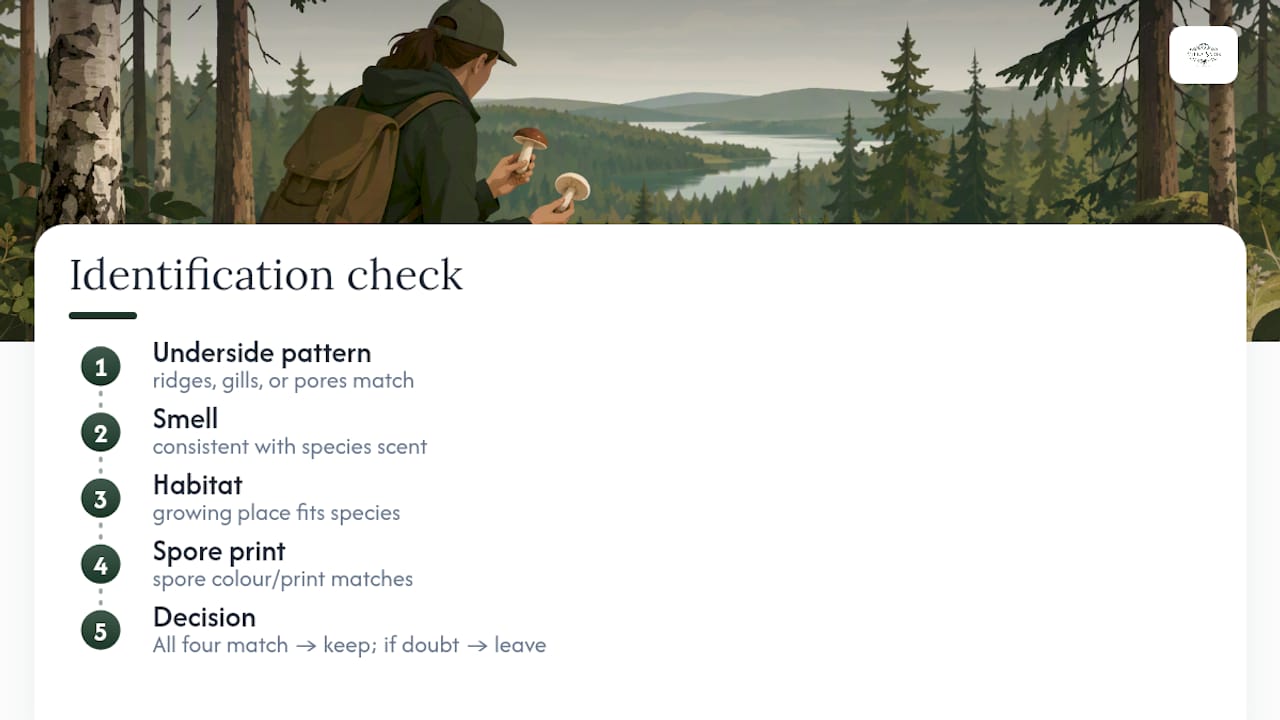
- Turn it over and check the underside: ridges (åsar), true gills (skivor), or pores (rör)?
- Smell it. Kantarell carries a faint apricot note; anything sharply chemical or unpleasant is a red flag.
- Break the flesh and note the colour, especially where it meets air.
- Note the substrate and any trees within a few metres.
- Photograph the top, side, and underside separately.
- If still uncertain, take a spore print: rest the cap gills-down on white paper overnight under a glass.
Combining several features, not relying on a single trait, is the identification method foraging guides recommend. A white spore print usually points toward common edible groups, while a pink or brown print should prompt extra caution, since several dangerous species share that trait.
Pro Tip: Never trust a phone app as your only check. Apps like Svampguiden are excellent for narrowing possibilities, but treat the result as a starting hypothesis to confirm with underside, smell, and habitat, not a final verdict.
Where can you learn faster than trial and error?
In-person instruction beats photographs every time, because an expert standing beside you can point at the exact ridge or gill that settles the question. Local svampkonsulenter groups and structured courses are widely recommended in Sweden as the fastest route to safe competence, and Medborgarskolan runs study circles specifically aimed at newcomers.
- Join a guided foray through a local svampkonsulent group
- Book a Medborgarskolan study circle if you prefer structured weekly sessions
- Use Svampindex for regional timing and Svampguiden as a field companion app
- Post carefully labelled photos to iNaturalist for community feedback, but treat replies as guidance, not confirmation
Bring a full basket of unidentified finds to a foray if you can. Guides would rather answer ten questions in the field than have you guess at home.
What should your first-trip checklist look like?
Keep this short enough to glance at before you leave the car.
| Category | Quick reminder |
|---|---|
| Essentials | Korg, svampkniv, phone charged, water |
| Top 3 ID checks | Underside pattern, smell, habitat and nearby trees |
| Safety | Tell someone your route, check for ticks after, leave anything uncertain |
| If unsure | Photograph top, side, underside; take a spore print |
A local perspective: learning to forage from a countryside base
Villa Sakis sits close to the kind of mixed forest that rewards patient, repeated visits rather than a single rushed afternoon. A short stay gives you time to try a guided foray one morning, process and sort the harvest in a proper kitchen that afternoon, and cook a simple forest dinner that evening. Our notes on Sweden's right to roam and forest hiking basics cover the access questions beginners ask most often. That rhythm, forage, learn, cook, rest, suits nervous beginners far better than a single day trip ever could.
How do you clean mushrooms properly before cooking?
Clean in the forest, not just at home. Brush off loose soil and needles with your svampkniv's brush the moment you pick each specimen, which saves significant work later and stops grit from working into the gills or ridges.
At home, avoid soaking mushrooms in water. Most species, kantarell especially, absorb moisture readily, and a soggy mushroom fries poorly and loses flavour. Instead, wipe caps with a slightly damp cloth or a soft brush, and use a small knife to trim any darkened or slug-damaged edges. For deeply ridged species like trattkantarell, a quick rinse under running water followed immediately by patting dry with a tea towel works better than soaking, since the water has less time to sit in the grooves.
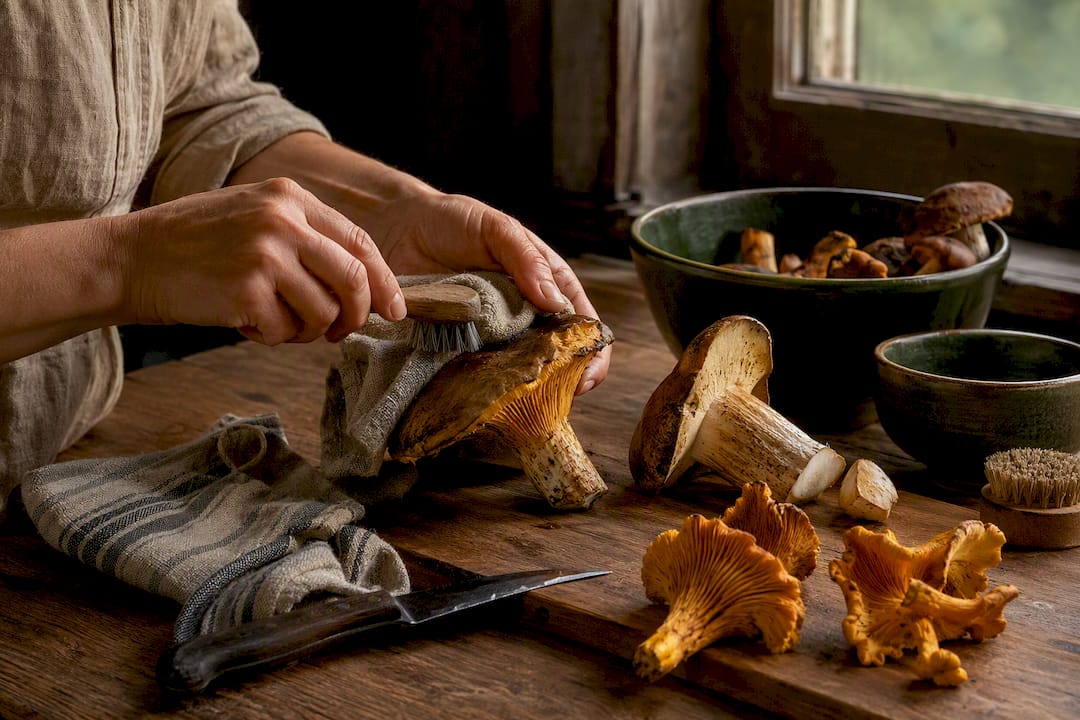
Slice larger specimens in half lengthways as you clean them. This is also your last identification check, since it reveals any hidden insect damage or discolouration you missed in the field. Any mushroom with unexpected internal staining, unusual smell, or soft, watery patches should go in the discard pile rather than the pan, no matter how promising it looked outside.
How should you store or preserve your harvest?
Fresh mushrooms do not wait. Refrigerate what you plan to eat within two or three days in a paper bag, never a sealed plastic one, since trapped moisture speeds up spoilage.
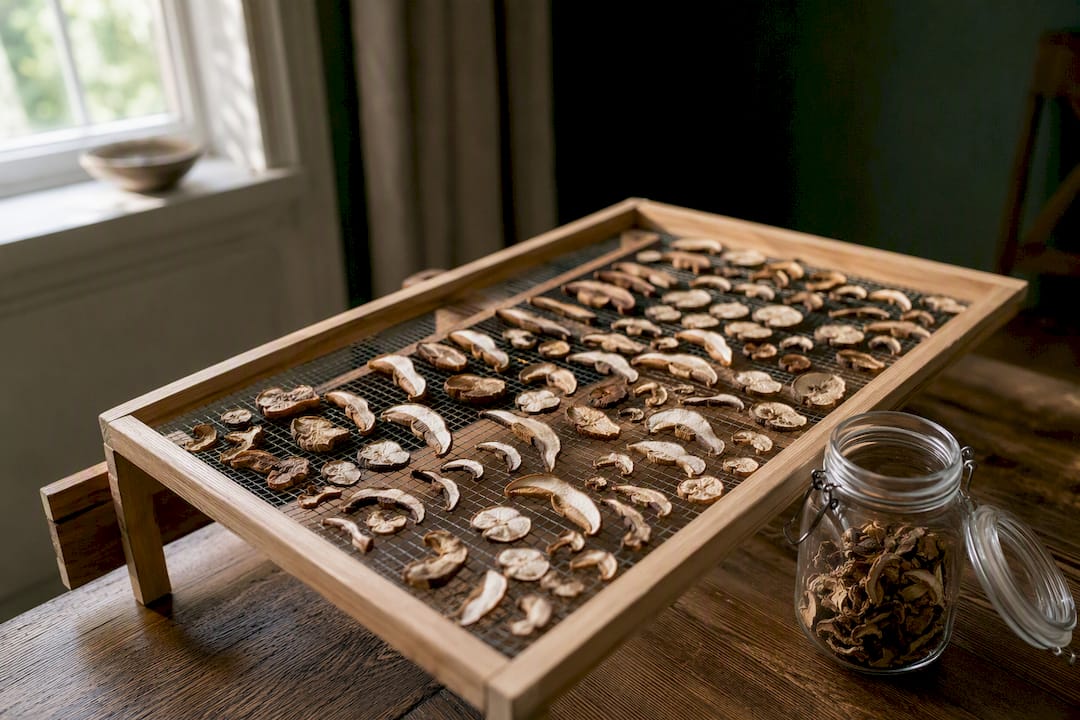
Drying suits kantarell and stensopp particularly well. Slice specimens thinly and use a dehydrator or a warm, airy spot away from direct sun; fully dried pieces should snap rather than bend. Store dried mushrooms in an airtight jar away from light, and they will keep their flavour for the best part of a year, ready to be rehydrated in warm water for soups and sauces.
Freezing works best after a quick sauté rather than raw, since raw mushrooms hold water that turns to unpleasant ice crystals. Cook slices in a dry pan until their liquid has evaporated, cool them, then freeze flat in bags for up to six months.
Pickling suits smaller trattkantarell and firm stensopp pieces. A simple vinegar, water, sugar, and salt brine, sometimes with bay leaf or peppercorns, preserves texture well and gives you a jar of forest flavour to open through winter.
What mistakes do most beginners make?
The single biggest mistake is skipping the underside check because a mushroom looks familiar from a photograph. Colour and cap shape vary enormously within a species and across weather conditions, but the ridge, gill, or pore structure rarely lies.
A close second is picking too much too soon. New foragers often fill an entire basket with one uncertain species rather than a small, confident haul of two known ones. It is far better to walk home with a modest amount you trust completely.
Many beginners also forget to separate species in the basket, letting spores, juices, and smells mix between specimens. That contamination can throw off a spore print or mislead a later identification check.
Finally, plenty of newcomers rely on a single source, one app result, one photo comparison, one confident-sounding online forum reply, instead of cross-checking multiple features. No single tool replaces the combination of underside pattern, smell, habitat, and, when needed, a spore print. When doubt lingers after all four checks, the only correct move is to leave the mushroom exactly where it grew.
What can beginners cook with their first harvest?
Simple preparation shows off wild mushrooms far better than anything elaborate. Fry sliced kantarell or trattkantarell in butter over medium heat until the released liquid evaporates and the edges turn golden, then finish with salt, a little cream, and fresh parsley. That single technique, dry-fry first, season last, works for nearly every beginner species.
Stensopp holds up well to grilling. Halve larger caps, brush with oil, and grill a few minutes per side before finishing with a squeeze of lemon.
For a first proper meal, toss fried mushrooms through pasta with garlic and a splash of the pasta water, or stir them into a simple risotto near the end of cooking so they keep some texture. Both dishes forgive small errors in seasoning and reward good raw ingredients, which is exactly what a careful first harvest gives you.
Why the standard beginner advice undersells local knowledge
Most guides to svampplockning för nybörjare hand new foragers a long species list and a stack of Latin names, which is precisely backwards. The evidence points the other way: narrow focus and repetition build safer, faster pattern recognition than breadth ever does. A beginner who can name kantarell, karljohan, and trattkantarell with total confidence is safer in the forest than one who has skimmed fifty species and trusts none of them fully.
The other gap in conventional advice is how little weight it gives to in-person learning. Apps and books are useful supplements, but nothing replaces a svampkonsulent pointing at the exact ridge that settles an argument. Sweden is unusually well served by these local networks, and beginners who skip them are choosing the slower, riskier path for no good reason.
What should come first, before species lists or gear, is simply this: find a guided foray, learn three mushrooms properly, and build every future outing on that small, solid foundation.
— Christian
Turn your first foraging weekend into a proper countryside stay
If you are planning a first foray, the forest around Villa Sakis offers exactly the kind of mixed woodland, moss, spruce, and open bryn that rewards a patient beginner. Unlike a rushed day trip from the city, a stay here gives you a private kitchen to sort and dry your harvest, direct access to forest and lake, and a quiet base to rest between outings. Explore the house and the surrounding grounds to see what a weekend here actually looks like, and browse the journal for more on pairing lodging with local food experiences, an approach also explored in this guide to combining lodging and gastronomy. When you are ready, check availability and book your stay directly at Villasakis.
Where to verify what you learn
For ongoing reference, rely on Svampkonsulenternas Riksförbund, Svampindex, and the Svampguiden app for regional, up-to-date guidance.
Sources
- Plocka svamp – Svampkonsulenternas Riksförbund
- Nybörjarguide till svampplockning — Naturplats
- Kantarell — Svampkarta
- Svampplockning för nybörjare — Medborgarskolan
- Kantareller — Svampindex