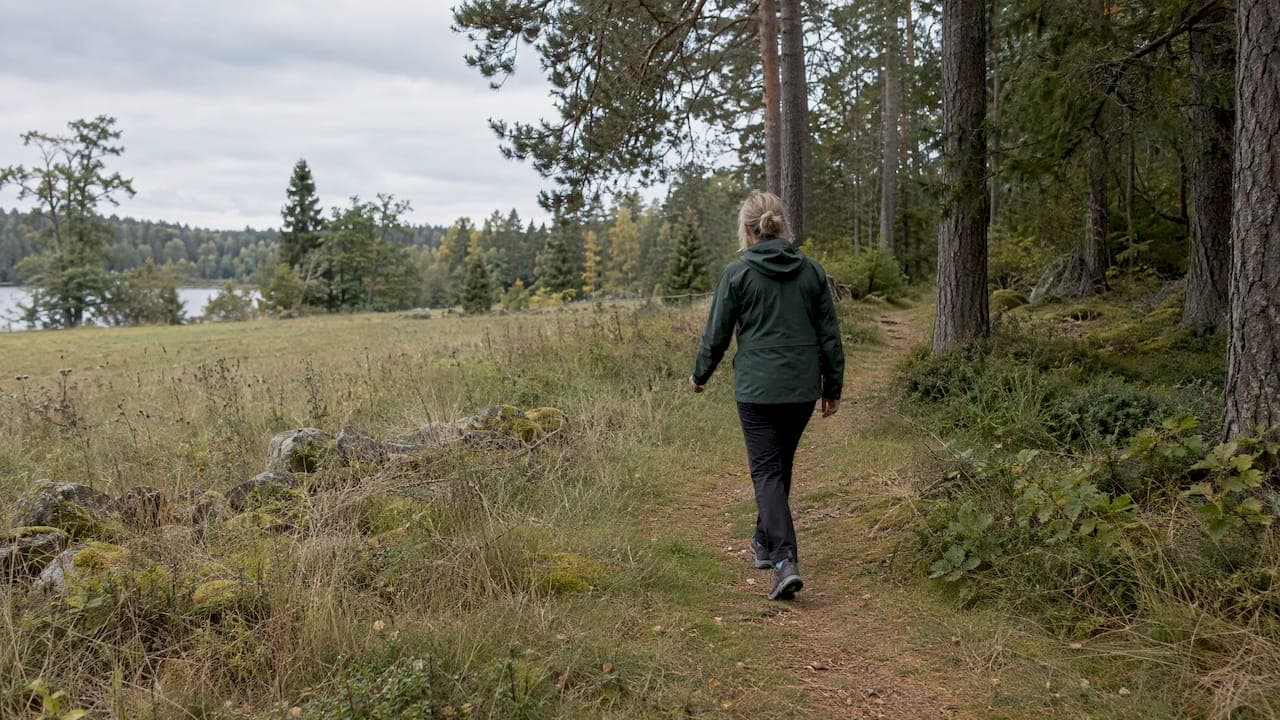
Yes, time in nature is linked to a lower pulse and measurable drops in stress markers for many people, particularly when that time involves movement rather than sitting still. Researchers look at resting heart rate (RHR), heart rate variability (HRV) and cortisol to track these shifts. A single walk produces modest, short-lived changes, but the effects tend to build with regular exposure.
TL;DR:
- Among 45 people, each extra 10 minutes of active nature movement correlated with 0.27 BPM lower nighttime pulse and 0.58 ms higher RMSSD.
- In a trial of 17 participants, cortisol fell 53% after a green walk and 37% after an urban walk; the small sample limits confidence.
- The Gävle study found clearer effects among women, but its small sample cannot establish a reliable difference between women and men.
- Viewing nature can raise vagal markers without exercise, although current evidence suggests walking through green spaces produces stronger effects.
- Build a routine of manageable walks instead of relying on one long outing, and choose safe routes and a pace suited to your fitness.
Table of Contents
- What does the recent research say about naturens påverkan på puls?
- How nature changes the body: the nervous system and cortisol
- Why walking in nature often helps more than just sitting there
- How long, how often and what actually helps
- Who sees the biggest changes, and why results vary
- Villa Sakis: an on-site example of immersive nature exposure
- A short perspective on using nature as recovery
- Consider a nature immersion stay with us
- FAQ
- Sources
What does the recent research say about naturens påverkan på puls?
The clearest recent evidence comes from a 2026 study at Högskolan i Gävle, which followed 45 people over ten months using wearables and GPS tracking, generating 3,224 person-days of data. The Gävle research found that an extra 10 minutes of active movement through natural surroundings was linked to a 0.27 BPM lower-than-usual night-time resting heart rate and a 0.58 ms rise in RMSSD, a standard marker of vagal activity. The effect was clearer among women, though the university's own summary cautions that this is one study and sex differences in this area warrant further confirmation.
Cortisol tells a similar story from a different angle. A small controlled trial comparing a green walking route with an urban corridor found that the Green Road study recorded an average 53% drop in salivary cortisol after the green walk, against 37% after the urban one, among 17 participants.
Other work points the same direction:
- A lunchtime walk study with 13 participants found greater night-time HRV (measured by SDNN and rMSSD) after a nature walk than after an equivalent walk through a built environment.
- Laboratory work on viewing nature scenes, rather than walking through them, also shows increases in parasympathetic markers, suggesting the effect does not depend on movement alone.
A large drop in cortisol was recorded after a green walk, greater than the drop after an urban one, in the Green Road study. That gap, in a small sample, is one of the more striking single-study figures in this area, though it should be read as suggestive rather than conclusive given the study's size. Sample sizes across this field are often small, and settings, measures and populations vary enough that no single number should be treated as universal.
How nature changes the body: the nervous system and cortisol
Resting heart rate and HRV are both windows into the autonomic nervous system, the part of the body that runs heart rate, digestion and stress responses without conscious input. A lower RHR and higher HRV generally indicate that the parasympathetic branch, the "rest and digest" side, has more influence relative to the sympathetic "fight or flight" side.
Cortisol adds a hormonal layer to this picture. It rises with stress via the HPA axis, the communication line between the brain and the adrenal glands, and the Green Road findings suggest that green surroundings may support a faster return to baseline than built ones.
Attention plays a part too. Natural scenes offer what is sometimes called soft fascination: visual and sensory input that holds attention gently, without demanding effort. That lighter cognitive load appears to reduce rumination, which in turn may ease sympathetic activation. Birdsong, moving water and cleaner air likely reinforce this effect, though their individual contributions are harder to isolate.

Why walking in nature often helps more than just sitting there
The Gävle findings point to something specific: it was active movement through natural settings, not simply being present in them, that correlated with lower night-time RHR and higher HRV. Passive time outdoors still has a role, but the combination of movement and setting seems to do more.
A few explanations likely overlap here:
- Exercise alone raises HRV and lowers resting heart rate over time, so some of the benefit is simply physical activity doing what it does.
- Walking through varied, natural terrain may reduce rumination more effectively than walking on a treadmill or through traffic.
- Natural light, air and sound appear to add a layer of restoration that built environments do not replicate.
Controlled lab studies on viewing nature, rather than moving through it, still find increases in vagal markers such as RMSSD, even without a change in average heart rate. Passive exposure clearly does something, just less, on current evidence, than active movement through the same kind of setting.
Pro Tip: If you only have fifteen minutes, choose a loop through trees or along water over a flat urban pavement: the research suggests the setting itself adds something exercise alone does not.
How long, how often and what actually helps
Based on the available evidence, a few practical patterns emerge for anyone testing this for themselves.
- Add movement, not just presence. The Gävle data links an extra 10 minutes of active movement in nature with small but measurable RHR and HRV benefits.
- Choose a walk over a sit where possible. A brisk loop through a park, woodland or along a shoreline seems to outperform a bench, though both have some value.
- Breathe with intention. Slow, extended exhales during a walk may support the same vagal pathways these studies measure.
- Build a routine rather than chasing one big outing. Several shorter sessions through the week likely accumulate more benefit than a single long one.
- Track if curious. A basic wearable can show RHR and HRV trends over weeks, turning a vague sense of calm into something visible.
A small 10-minute increase in active nature movement was linked to a minor reduction in night-time RHR and a modest increase in RMSSD in the Gävle study. That is a small shift for one session, which is why consistency matters more than intensity.
Choose routes that feel safe and manageable underfoot, and adjust pace to fitness and comfort rather than chasing a target heart rate.
Who sees the biggest changes, and why results vary
Not everyone responds the same way. The Gävle study found clearer effects among women, though the researchers themselves flagged the sample as too small to generalise with confidence.
Personality may matter as much as biology. Research on forest therapy and behaviour patterns suggests that people with Type B tendencies, generally more relaxed and less time-pressured, tend to show larger pulse reductions than those with Type A patterns, who run higher baseline sympathetic activity.
Setting quality counts too: perceived safety, background noise and the type of natural feature (water, dense woodland, open meadow) all appear to shift how strongly the body responds, alongside a person's baseline fitness and existing stress load.
Villa Sakis: an on-site example of immersive nature exposure
Our log house, built in the 1700s, sits among meadows and pine forest with lake access a short walk from the door. The quiet, the private sauna and the self-catering timber rooms create the kind of sensory conditions the research points to: low noise, room to move and extended time outdoors rather than a brief visit. Guests often describe their stays as genuinely restful, a sense of slowing down that lingers after they leave. Our journal post on what to expect covers the practical side of planning a stay like this.
A short perspective on using nature as recovery
Nobody's pulse drops dramatically after one walk, and treating that as the goal sets you up for disappointment. What the data actually supports is something quieter: small, repeated shifts in HRV and resting heart rate that build into something real over weeks. Pair that time outdoors with decent sleep and a few slow breaths, and track it if you want proof rather than impression.
— Christian
Consider a nature immersion stay with us
Stepping away for several days gives these small physiological shifts room to add up, which a single afternoon rarely manages. A stay at The House gives you the whole farmhouse to yourselves, with the forest, meadows and lake on your doorstep and a private sauna to end the day.
- Book the full house for a family, a group of friends, or a couple seeking a quieter few days.
- Use the self-catering kitchen and rooms to set your own pace rather than following a schedule.
- Combine daily walks with a digital detox to test the practical steps above in a setting suited to this.
For the logistics of getting a group there comfortably, corporate and group transfer planning can help if you are organising travel for several people at once. Check availability and plan your stay through The House.
This article is general information, not a substitute for advice from a qualified doctor. Consult a qualified healthcare professional about your own circumstances before acting on anything here.
FAQ
Varför mår man så bra i skogen?
Forest settings combine lower noise, cleaner air and visual patterns that hold attention gently rather than demanding it, a mix researchers link to reduced sympathetic nervous system activity. This appears to ease rumination and support a quicker return to a calmer baseline than built environments typically allow.
Har man hög puls när man är stressad?
Stress generally raises heart rate through increased sympathetic nervous system activity and cortisol release via the HPA axis. Time in natural settings, especially with movement, is linked to a faster return towards a resting baseline, as shown in the Green Road cortisol study.
Vad händer i kroppen när vi vistas i naturen?
Markers of parasympathetic activity, including heart rate variability, tend to rise while resting heart rate and cortisol tend to fall, particularly with active movement through green surroundings. Lab studies also show that simply viewing natural scenes can shift these markers, even without exercise involved.
Får man kissa och bajsa i naturen?
This is a question of local access and nature rights rather than physiology, and practice varies by country and specific location. We recommend checking the rules for wherever you are visiting rather than assuming a single answer applies everywhere.
Sources
- Everyday movement through nature linked to nighttime cardiac regulation | npj Urban Sustainability
- Green Road cortisol/HRV study (PMC article)
- A lunchtime walk in nature enhances restoration of autonomic control during night-time sleep (MDPI, 2016)
- Naturpromenad ger kvinnor lägre nattpuls - Högskolan i Gävle