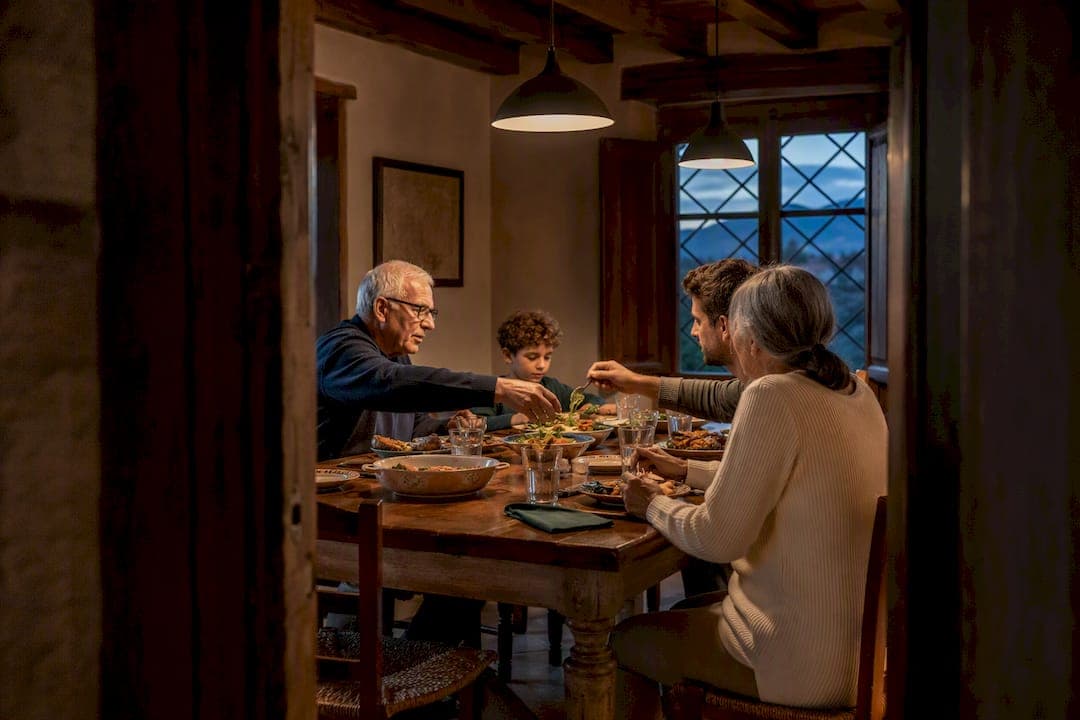
Agree your dates and money model first, then secure lodging that gives every household its own room while keeping a shared kitchen or lounge for the group, considering options like group stays in Andalucía for inspiration (Dragonfly Retreat). Build the itinerary around one anchor activity a day, with the rest left open.
TL;DR:
- Most families prefer cost models where grandparents cover the entire trip or costs are split proportionally, requiring upfront honesty and clear tracking.
- Destination choices should prioritize accessibility, outdoor space, and private accommodation, avoiding long walks and crowded landmarks for multigenerational groups.
- Limiting daily plans to one anchor activity and ensuring rest periods help maintain energy and enjoyment across ages, with optional activities for those who wish to participate.
- Booking accommodations with private bedrooms, shared kitchens, and ground-floor access minimizes friction and ensures comfort for every household during the stay.
- Using shared digital tools and assigning specific roles early prevents administrative chaos and keeps the planning process on track.
Table of Contents
- Why multigenerational resa planering deserves real attention
- How to choose destinations and accommodation that suit every age
- Budget models and money conversations that prevent disputes
- Daily pacing and the anchor-activity model
- Accessibility, medical prep and the family travel binder
- Transport and logistics: getting everyone there comfortably
- Tools and admin for keeping a large group organised
- Common problems and quick fixes
- Villa Sakis perspective: what a farmhouse teaches about multigenerational stays
- Ready to plan your own multigenerational stay?
- Sources
Why multigenerational resa planering deserves real attention
Three generations under one roof, sharing a table and a timetable, is not the same holiday as a couple's weekend away. It asks more of the planning, but it gives back more too: the kind of unhurried, shared time that a quick city break rarely allows.
The demand for it is real and growing. A 2025 family travel survey found that roughly half of grandparents pay for the entire multigenerational trip, while 48% split costs with adult children, and more than 40% of grandparents expect to take one within three years. Money, in other words, is rarely the taboo subject families assume it to be. It is usually already on the table.
Good multigenerational travel planning sets three goals before a single destination is chosen:
- An accessibility baseline everyone can manage, from toddlers to grandparents with limited mobility
- A fair balance of group time and quiet, separate time
- Clear, agreed budget terms before anyone books flights
Start the conversation six to nine months ahead. For peak summer weeks, push that to ten to twelve months, since the best family-sized properties book out fast.
How to choose destinations and accommodation that suit every age
Not every destination type serves a mixed-age group equally well. Cities offer transport links and medical access but can wear out younger children and older relatives with long walking distances. Resorts trade flexibility for convenience: daily housekeeping and structured activities suit families who want fewer logistics, but the experience can feel packaged. Rural farmhouses and countryside retreats offer space, quiet and outdoor freedom, which Road Scholar's travel data shows is exactly what many multigenerational groups now prefer over crowded landmarks. Cruises simplify transport between locations but limit how much anyone can retreat from the group.
Accommodation matters as much as destination. A few rules of thumb hold up across most family groups:
- One bedroom per household, minimum, so nobody sleeps on a sofa for a week
- One bathroom for every three to four guests, to avoid morning queues
- Ground-floor or lift access for anyone with joint pain or a pushchair
- Separate living spaces or connecting rooms so quiet mornings do not disturb a lie-in elsewhere
Favour hotels when the group needs daily housekeeping or formal accessibility features. Favour a whole-house rental, like a farmhouse with its own kitchen and grounds, when the group values shared cooking, private outdoor space and evenings that do not end in a hotel bar.
Budget models and money conversations that prevent disputes
Three cost-splitting approaches cover most family situations, and each carries its own trade-off.
- Grandparent-hosted: one generation covers the whole trip. Simple to plan, but it can quietly create pressure or resentment if expectations around future trips aren't discussed.
- Equal split by household: every family unit pays the same share regardless of income or family size. Fair on paper, though it can strain a young family with three children against a retired couple.
- Proportional split by income or usage: costs scale to what each household can genuinely afford, or to how many nights each person actually uses. Fairest in practice, but it requires more upfront honesty.
Track shared spending in one app so nobody is chasing receipts by day four.
Pro Tip: Let the household hosting or organising the trip name the first number. It sets a natural anchor for the conversation and avoids the awkward silence of everyone waiting for someone else to speak first.
Daily pacing and the anchor-activity model
The single biggest planning mistake in multigenerational travel tips is over-scheduling. Nobody, from a seven-year-old to a seventy-year-old, enjoys an itinerary packed edge to edge. The anchor-activity model solves this cleanly: one required group activity each day, and everything else optional.
A workable daily rhythm looks like this:
- Morning: the day's anchor activity, done together
- Early afternoon: rest, downtime or a nap window, especially for young children and older relatives
- Late afternoon: optional activities for those with energy left
- Evening: a shared meal, ideally cooked or eaten together
- Mid-trip: one full free day with no planned activity at all
Good anchor activities suit every age without exhausting anyone: a gentle forest walk, a family cooking session, a short boat trip, or a local cultural workshop. AFAR's reporting on group trips backs this up directly: shared, modest experiences like cooking classes build more lasting satisfaction than a single expensive attraction ever does.
Accessibility, medical prep and the family travel binder
A single folder, physical or shared digitally, saves enormous stress mid-trip. It should hold:
- Every traveller's medication list and dosages
- Emergency contacts for each generation, including a local doctor if known
- Travel insurance policy numbers and claim contact details
- Local healthcare information for the destination, including the nearest hospital
Before booking, ask the host or hotel directly about step-free access, adapted bathrooms, and realistic walking distances between rooms and communal areas. Practical Swedish travel guidance stresses planning rest breaks around both very young and older travellers, not just one or the other. Book airport assistance and mobility-friendly transfers well in advance; these services fill up faster than most families expect, particularly in summer.
Transport and logistics: getting everyone there comfortably
Driving together keeps the group flexible and allows stops on demand, but a car packed with three generations for six hours tests everyone's patience. Splitting into two vehicles gives breathing room and lets slower travellers set their own pace. Trains and direct flights suit longer distances and travellers with limited mobility far better than a long car journey or multiple connections.
A few practical rules help regardless of the mode:
- Book direct flights wherever possible; layovers punish young children and older joints equally
- Time departures around nap windows and comfort breaks, not just the cheapest fare
- Pack small comfort items separately: a travel pillow, snacks, mobility aids, and any medication that cannot go in checked luggage
Tools and admin for keeping a large group organised
Large family groups fall apart administratively long before they fall apart socially. A minimal toolkit fixes most of it: Splitwise for tracking shared expenses, Google Calendar for the group schedule, and one shared folder for documents and the travel binder.
Assign roles early, ideally as part of agreeing the budget model:
- A trip coordinator who owns the overall timeline
- A money tracker who logs Splitwise entries weekly
- A lodging lead who handles the accommodation booking and accessibility questions
- An activity planner who proposes anchor activities and books ahead
A short planning checklist by month keeps this from stalling: months nine to six, book accommodation and flights; months five to three, confirm budget model and travel binder details; months two to one, finalise anchor activities and reconfirm accessibility needs.
Common problems and quick fixes
Money disputes are the most predictable friction point. Reopen the original agreement, not a fresh argument, and set a short deadline to settle any disagreement before the trip, not during it.
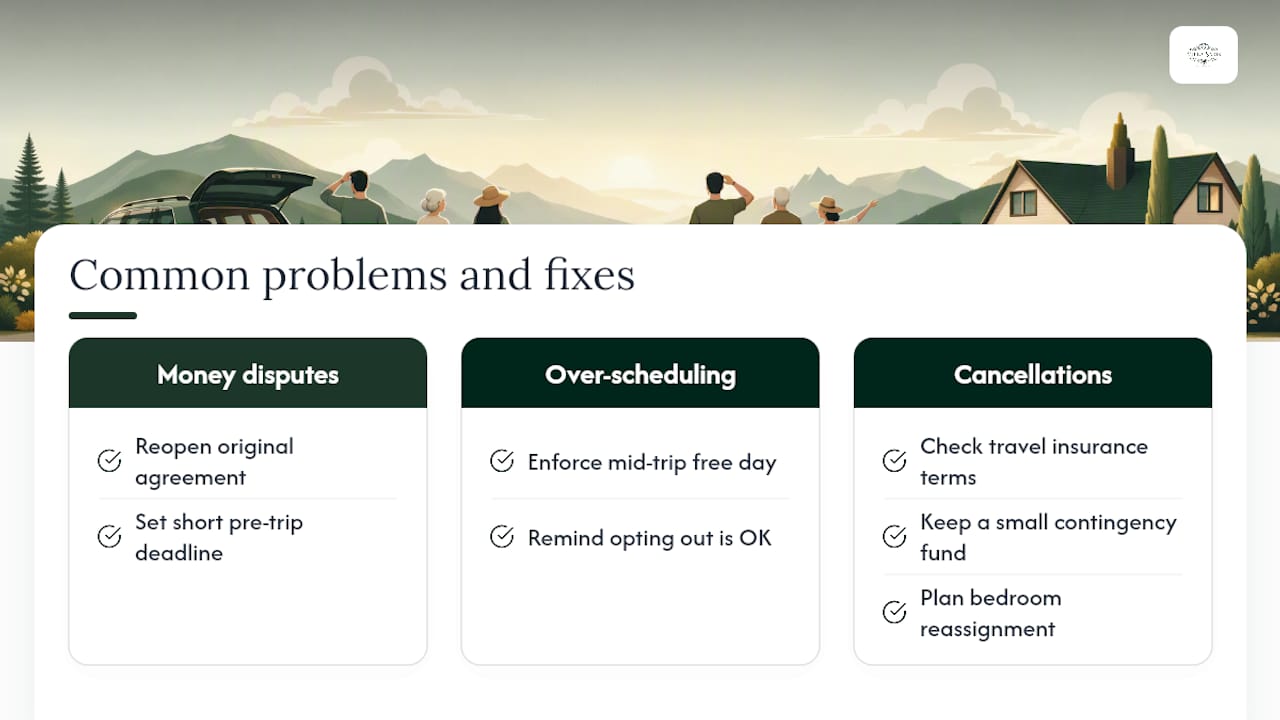
Over-scheduling is the second most common complaint. Enforce the mid-trip free day without exception, and remind the group that opting out of an optional activity is never a failure.
Last-minute cancellations happen more often in large groups simply through statistical odds. Check travel insurance terms before booking, keep a small contingency fund beyond the Buffer Rule, and have a plan for reassigning any freed-up bedroom.
Villa Sakis perspective: what a farmhouse teaches about multigenerational stays
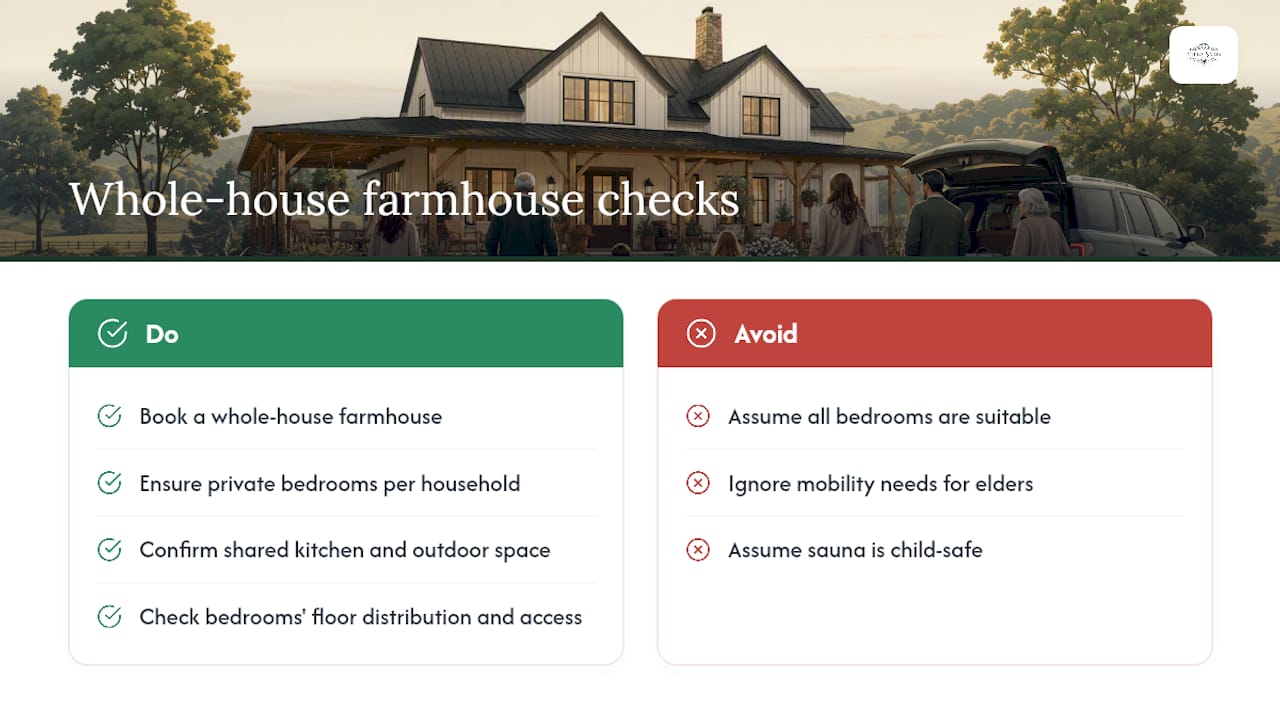
A whole-house stay solves more of this planning than people expect, and it is worth saying plainly why. When every household has its own room and the group shares one kitchen and one set of grounds, most of the friction in this guide simply does not arise. A whole-house farmhouse stay can offer private bedrooms, a shared kitchen for communal meals, and outdoor space like meadows and forest for children to play while older relatives relax nearby.
Before booking any similar property, check the practical details yourself: how bedrooms are distributed across floors, whether ground-floor rooms exist for anyone with mobility needs, and how a sauna is used safely around children. These are small questions, but they decide whether a week feels restorative or merely crowded. A successful multigenerational trip leaves room for rest, not just togetherness.
— Christian
Ready to plan your own multigenerational stay?
A whole-house rental is an alternative to booking separate hotel rooms scattered across a resort corridor: one house, private bedrooms for every household, and a shared kitchen and grounds instead of a lobby you all pass through separately. It fits the anchor-activity rhythm this guide describes almost by design, since the farmhouse itself becomes the free-day activity, whether that means a slow morning by the lake or an afternoon in the forest.
Check the house for the current room and bathroom layout before you finalise who sleeps where, and look at the grounds and area if outdoor space for children or quiet walking routes for older relatives matters to your group. If you have specific accessibility or medical-arrangement questions, contact the host directly rather than guessing from the listing. When your dates firm up, check availability and book the farmhouse before the week you want disappears.
Sources
For readers who want the primary sources behind this guide: the 2025 Family Travel Survey covers grandparent spending trends, Road Scholar's trend report tracks shifting destination preferences, AARP's planning guide offers a practical questionnaire approach, and Resaportalen covers transport safety across age groups.
- 2025 Family Travel Survey highlights rise of 'kidfluence' (NYU SPS press release)
- Res tryggt med barn och äldre: Planera transporten med omtanke och omsorg
- Multigenerational travel survey insights for families (Road Scholar blog)