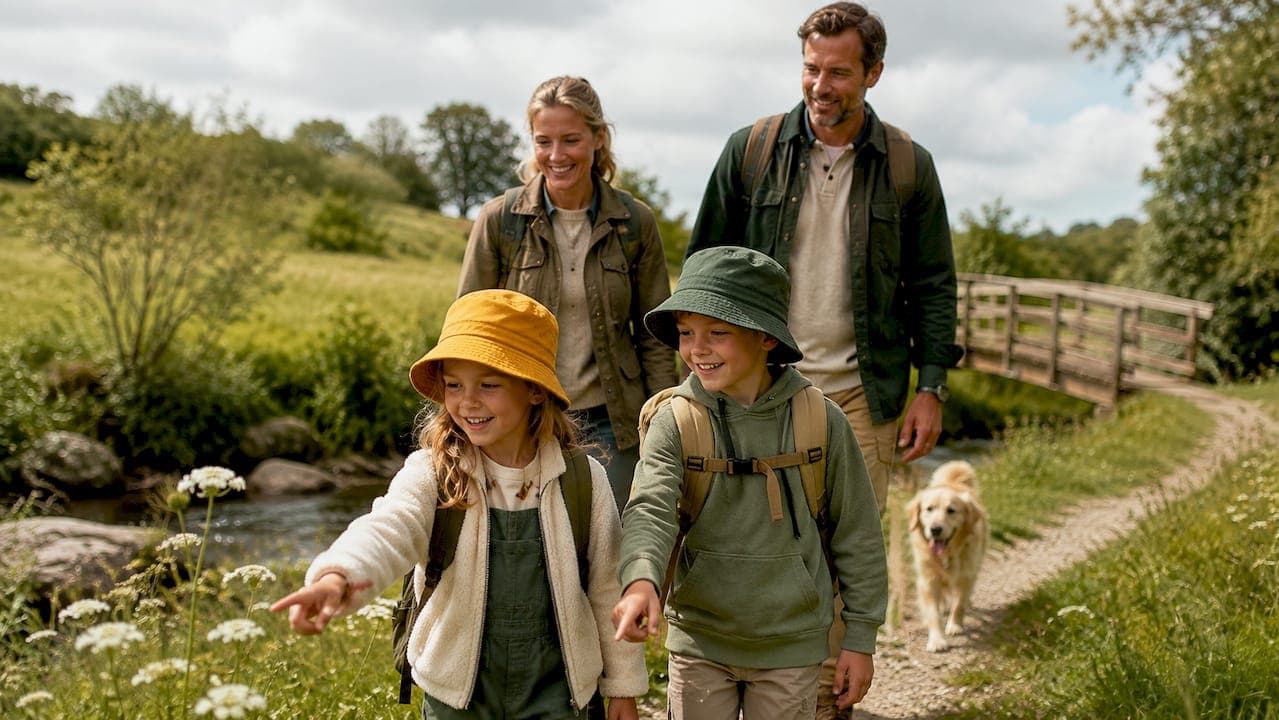
Yes, you can hike with children, and the experience is genuinely restorative when you plan for shorter distances, frequent play-based pauses, and simple kit. Start by checking your route on Ordnance Survey Maps, reading the Countryside Code (or the Scottish Outdoor Access Code if you are heading north), and writing a short kit list before you leave the house. The Ramblers route finder is the quickest way to locate a graded family walk near you.
Table of Contents
- Your one-page packing and prep checklist
- How far can children walk, and how long will it take?
- How do you choose a family-friendly route in the UK?
- Safety basics and access rights across the UK
- How do you keep children engaged on a walk?
- Three sample day plans for different ages
- What does the evidence say about adventure framing and carrier practice?
- Meal and snack planning for kids on hikes
- How do you handle fatigue, tantrums, and boredom on the trail?
- Which apps and tools help on a family hike?
- How do you prepare children mentally and physically for a hike?
- Key takeaways
- Why short loops and play-based pauses are the right default
- Where to read more: authoritative UK sources and route finders
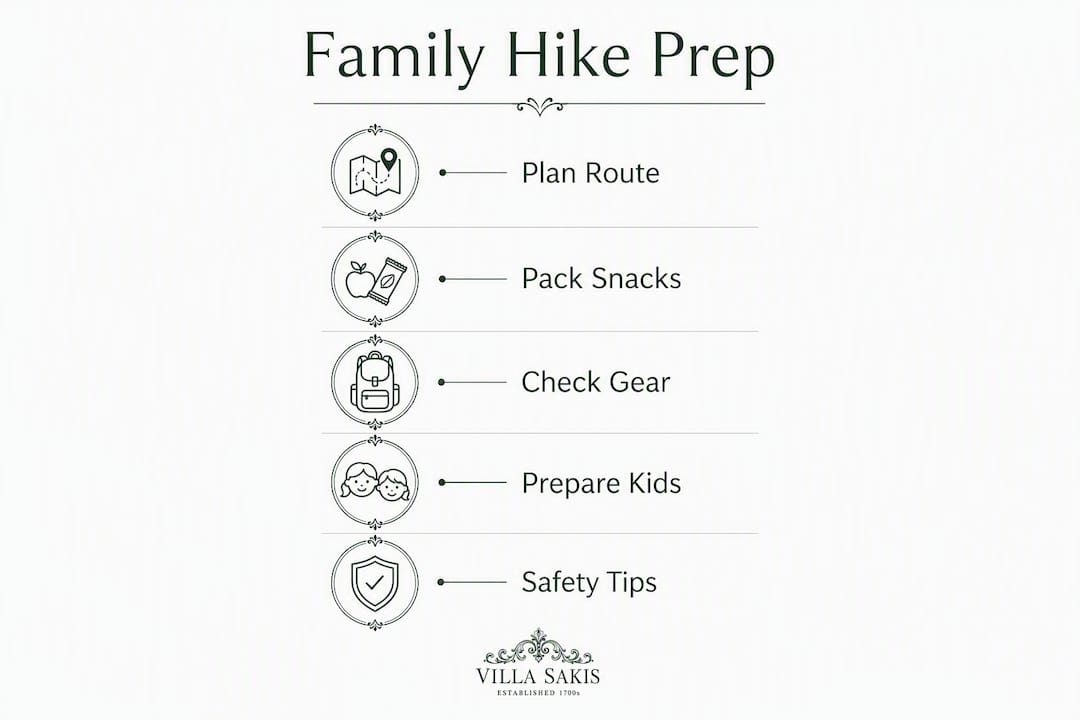
Your one-page packing and prep checklist
Kit to pack:
- Small day rucksack sized for a child to carry their own water bottle and snack
- Front carrier (bärsele) for infants; child-carrier backpack (bärstol) for toddlers up to roughly 15–20 kg
- Spare base layer and a waterproof jacket for every person
- Sturdy ankle-supporting footwear with grip; wellies for very short, muddy loops
- Basic first-aid kit: plasters, blister pads, antiseptic wipes, a foil blanket
- Water (at least 500 ml per child) and calorie-dense snacks
Before you leave:
- Check the Met Office forecast and note any wind or rain windows
- Share your planned route and expected return time with another adult
- Set a firm turnaround time and stick to it regardless of distance covered
- Note the nearest exit point from the route in case of early return
Pro Tip: Pack one small treat — a favourite sweet or a sticker pack — and keep it hidden until the final stretch. Telling children there is a reward waiting at the end is a low-effort way to sustain enthusiasm when legs start to tire.
How far can children walk, and how long will it take?
Realistic distance and pacing vary more by age than most parents expect. A 2.5 km family ascent with children can take up to two to two and a half hours once play stops and exploration are included. Build that ratio into every plan.
| Age group | Suggested distance | Rough pace (km/h) | Carrier notes |
|---|---|---|---|
| Infant (up to roughly 15–20 kg) | Carrier only | Adult pace | Front carrier (bärsele) with head/neck support |
| Toddler (1–3 years) | 1–3 km | 1 | Bärstol backpack carrier; weight limit 15–20 kg |
| Early primary (4 years) | 3–6 km | 1.5 | Carrier on standby for tired legs |
| Older primary (6 years) | 6 km | 2–3 | No carrier needed; child carries own snacks |
| — | — | 3–4 | Full day pack; involve in navigation |
Arriving "late" because a child spent twenty minutes watching a beetle is not a failure. Experienced family hikers schedule more time than an OS Maps distance estimate suggests precisely to protect that curiosity.
How do you choose a family-friendly route in the UK?
The terrain matters as much as the distance. A 4 km route across open moorland can exhaust a six-year-old far more than a 6 km woodland loop with a stream to paddle in.
Route features to prioritise:
- Circular loops so you return to the same car park or bus stop
- Clear waymarking (National Trail acorns, coloured posts, or OS-verified paths)
- Picnic spots, benches, or flat rocks at roughly the halfway point
- Public toilets or a café within reach of the start or finish
- Firm, well-drained surfaces if you are bringing a pushchair
- Easy escape points: a lane, a car park, or a village within 1–2 km at all times
Where to search:
The Ramblers route finder lets you filter by distance and difficulty. OS Maps shows gradient, surface type, and rights-of-way in detail. The National Trust site lists graded family walks on its properties, many with facilities. For Scotland, check the Scottish Outdoor Access Code to understand where you may walk legally. Starting local — a familiar park or woodland — builds confidence before you attempt longer routes.
Safety basics and access rights across the UK
Safety checklist:
- Check the forecast the morning of the walk, not the night before
- Pack a basic first-aid kit and know the NHS guidance for common trail injuries: sprains, cuts, insect stings
- Carry a fully charged phone and a small power bank
- Note your OS grid reference or What3Words location before you set off
- Brief children on two rules: stay on the path and tell an adult before leaving the group
Access rights:
The Countryside Code for England and Wales asks walkers to respect the land, leave gates as found, and keep dogs under control. Scotland's Scottish Outdoor Access Code grants broader access rights but pairs them with clear responsibilities around crops, livestock, and privacy. National Trust land generally welcomes walkers; check individual property pages for any seasonal restrictions.
Emergencies:
For a serious incident, call 999 and ask for Police, who will coordinate Mountain Rescue. Local Mountain Rescue team numbers vary by region; save your regional team's number before heading into remote terrain. For minor injuries, the NHS first-aid pages cover sprains, blisters, and hypothermia clearly.
How do you keep children engaged on a walk?
The most common parental mistake is treating a hike as a task to complete. Framing it as a family adventure and letting children participate in planning increases engagement on the trail.
Activity ideas:
- Nature bingo: print or draw a grid of things to spot (oak leaf, feather, spider's web, rabbit hole)
- "Detective" tasks: find the oldest tree, count the different bird calls, identify three insects
- Story prompts: ask children to invent a name for each landmark you pass
- Short physical challenges: balance on a log, jump across a puddle, find the highest point
Motivation strategies:
- Let children choose which snack to eat at the halfway point
- Give them a small role: map reader, pace-setter, or official photographer
- Allow genuine choice about which fork in the path to take when both options are safe
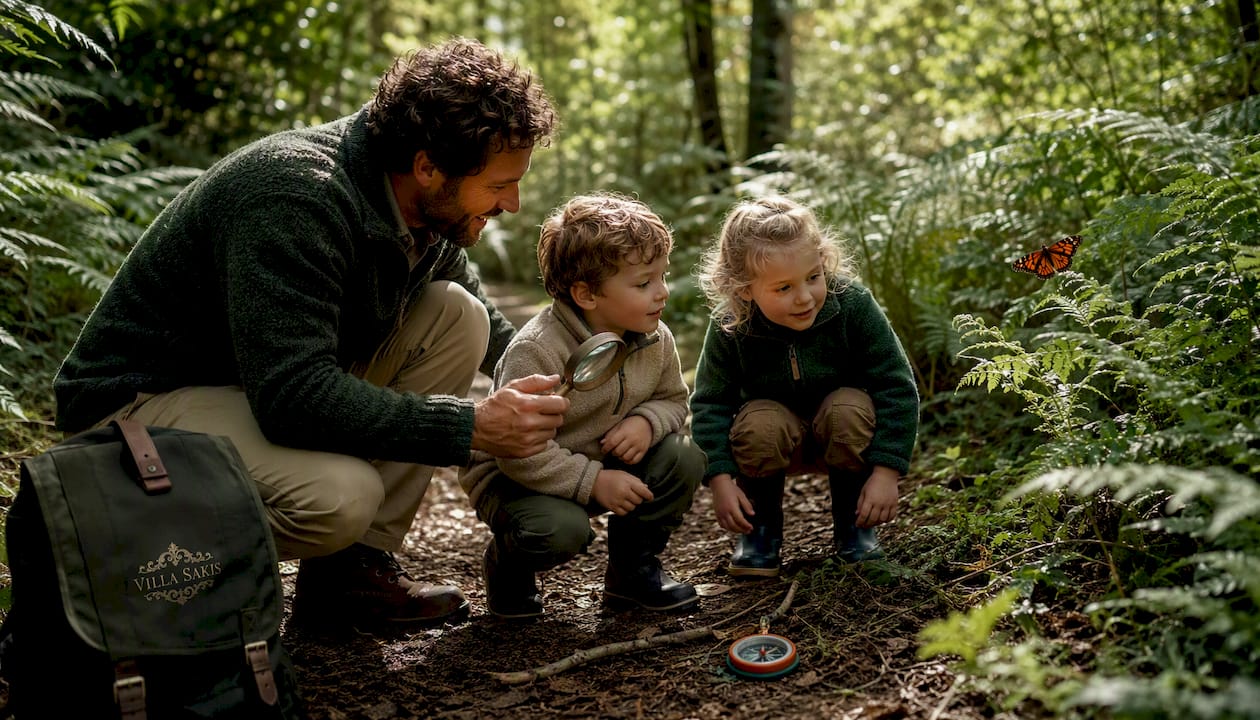
Pro Tip: Budget time for unscheduled discoveries. A magnifying glass, a pair of binoculars, or a simple field guide turns a forest walk into a living classroom. The detour is the destination.
Three sample day plans for different ages
| Plan | Distance | Estimated time | Key activities | Notes |
|---|---|---|---|---|
| Toddler loop | 1–3 km | 1.5–2 hours | Stream paddling, leaf collecting, short picnic | Bring bärstol; plan a nap window; firm turnaround at 1 hour |
| Primary-age day | 4–6 km | 3–4 hours | Nature bingo, packed lunch at halfway, bug hunt | Child-carrier on standby; choose a route with toilets |
| Older children | — | — | Navigation tasks with OS map, timed challenges, longer lunch | Full day packs; clear exit points; involve children in route choice |
For multi-day trips, making a short base-camp and doing day walks reduces carried loads and keeps younger children comfortable. A farmhouse or cottage with direct forest access removes the daily drive and lets you adjust distance based on how everyone feels that morning.
What does the evidence say about adventure framing and carrier practice?
On the carrier side, Svenska Turistföreningen guidance recommends a front carrier with head and neck support for infants, moving to a bärstol backpack once a child sits stably. Once a child approaches 15–20 kg, redistribute communal kit across the group to avoid overloading the carrying adult. Split food and shelter gear to balance loads.
Meal and snack planning for kids on hikes
Children burn energy faster than adults on uneven terrain, and hunger accelerates fatigue. Pack more food than you think you need, and distribute it across the day rather than saving it all for a single lunch stop.
Good trail snacks are calorie-dense and easy to eat without stopping: oatcakes, cheese portions, dried fruit, nut butter sachets, and small chocolate pieces. A hot drink in a flask is worth carrying from October through April. For a full lunch, a simple wrap travels better than a sandwich and stays intact in a rucksack.
Let children carry their own snack pouch. The ownership increases the likelihood they will eat without prompting, and the weight is light enough not to slow them down.
How do you handle fatigue, tantrums, and boredom on the trail?
Fatigue usually arrives earlier than the map suggests it should. The practical response is to stop before a child asks to stop, not after. A ten-minute sit-down with a snack at the two-thirds mark prevents the final kilometre from becoming a negotiation.
Tantrums on the trail almost always have a physical cause: hunger, cold, wet feet, or tiredness. Work through the checklist before attempting distraction. If the cause is genuine exhaustion, treat flexibility as success and turn back. A shortened walk that ends happily is better preparation for the next one than a completed route that ends in tears.
Boredom responds well to novelty. Change the activity, not the pace. A nature bingo card or a simple detective task resets attention within minutes.
Which apps and tools help on a family hike?
OS Maps is the most authoritative navigation app for UK walking. Download the relevant map tile before you leave home so it works offline. The app shows rights-of-way, gradient, and grid references, all of which matter when you need to find an exit point quickly.
What3Words is useful for communicating your precise location to emergency services. Save your start-point address and note the three-word code for any remote sections of the route.
Keep screen time intentional. Use apps for navigation and safety, then put the phone away. A screen-free family day in the countryside has its own quiet value, and children notice when adults are present rather than distracted.
How do you prepare children mentally and physically for a hike?
Start with short local walks several weeks before a longer trip. Familiar terrain builds confidence and gives you a realistic sense of each child's pace and stamina. The Naturkompaniet guidance on starting close to home applies equally in the UK: a local park or woodland path is the right first step.
Involve children in planning the route. Show them the OS map, point out the stream or the viewpoint you will reach, and let them mark the halfway snack stop. Children who understand where they are going are more patient about getting there.
On the morning of the walk, check footwear and layers before leaving. A blister from a loose boot or a cold child in a thin jacket will end the day faster than any distance.
Key takeaways
Family hiking works best when you plan for the child's pace, not the map distance, and treat every unscheduled discovery as the point of the walk.
| Point | Details |
|---|---|
| Match distance to age | Toddlers manage short distances; older primary children can cover longer distances with play pauses built in. |
| Use trusted UK route tools | OS Maps, Ramblers, and National Trust pages give graded, waymarked family routes. |
| Know the access rules | Follow the Countryside Code in England and Wales; use the Scottish Outdoor Access Code in Scotland. |
| Pack an emergency snack | A hidden treat kept for the final stretch reduces late-stage fatigue and tantrums. |
| Flexibility is success | Turning back early because the group is tired is good judgement, not failure. |
Why short loops and play-based pauses are the right default
There is a quiet argument to be made against the long, ambitious family hike. The walks that children remember are rarely the ones that covered the most ground. They remember the stream where they found a crayfish, the hollow tree that became a den, the moment they spotted a deer at the field edge. Short loops create the conditions for those moments because they remove the pressure of distance and leave room for the walk to become something else entirely, like a stroll on the Treetop Walk Bachledka where play pauses and discovery stops enhance the experience.
At Villa Sakis, the meadows and pine forest surrounding the 18th-century farmhouse are designed for exactly this kind of unhurried exploration. Guests arrive with a plan and often abandon it within the first hour, drawn instead by what the land offers on that particular morning. That is not a failure of planning. It is the whole point. If you are considering a nature-immersion stay as the base for a family walking trip, the farmhouse offers direct forest access, a private sauna for tired legs, and the kind of stillness that makes children slow down naturally.
For families planning a Swedish countryside stay, the combination of short daily walks and a fixed, comfortable base is the most restorative approach we know.
Where to read more: authoritative UK sources and route finders
- Ramblers: The UK's leading walking charity. Use the route finder to search by distance, difficulty, and location. Excellent for graded family walks.
- Ordnance Survey Maps: The definitive UK mapping tool. Download offline tiles, check gradients, and find grid references for emergency use.
- National Trust: Lists family-friendly walks on its properties across England, Wales, and Northern Ireland, with facilities noted.
- Countryside Code (England & Wales): The official access guidance for walkers on public rights of way and open access land.
- Scottish Outdoor Access Code: Explains Scotland's broader access rights and the responsibilities that accompany them.
- Mountain Rescue England & Wales: Find your regional team's contact details before heading into remote terrain.
- NHS first-aid guidance: Clear, practical advice for trail injuries including sprains, cuts, and hypothermia.
- Grounding in nature — Villa Sakis: Practical nature-immersion techniques for families, including simple outdoor activities for children.
- Sweden right to roam — Villa Sakis: A model for briefing families on respectful countryside access, useful reading before any rural stay.