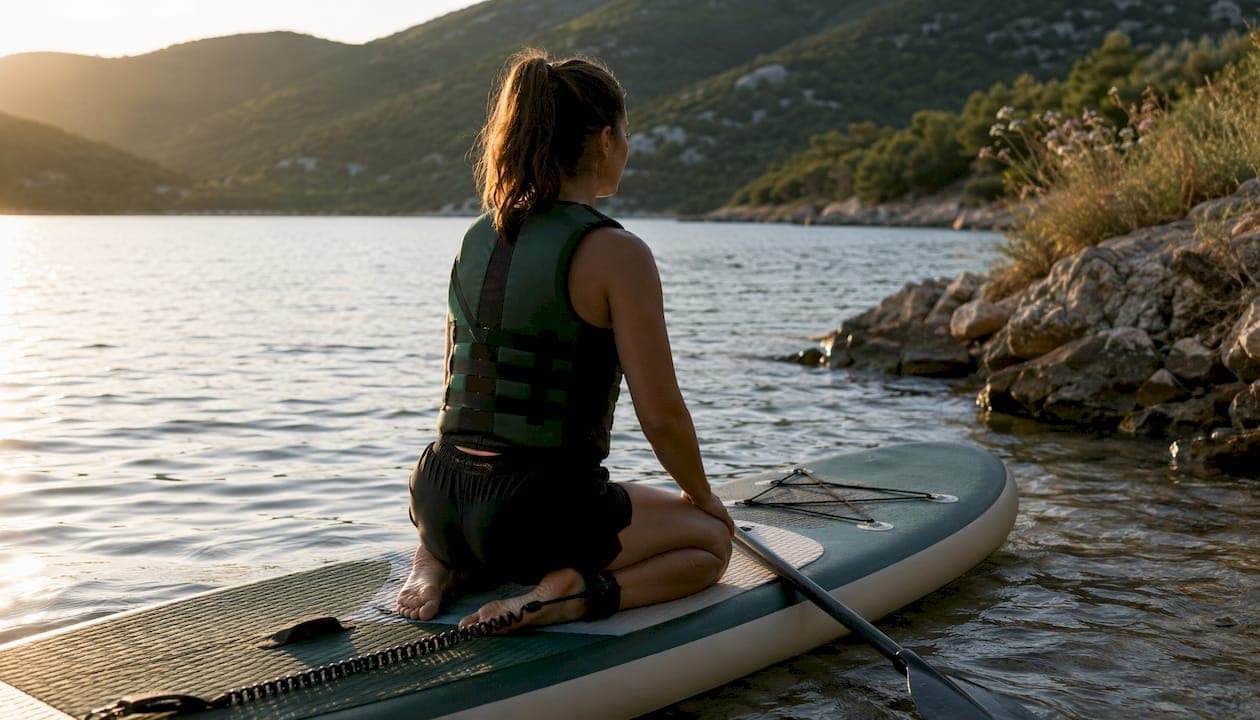
Stand-up paddleboarding (SUP) is well within reach for complete beginners, and a calm, sheltered lake is genuinely the best place to start. The short answer: yes, you can learn safely on your first outing, provided you wear a properly fitted buoyancy aid (PFD), attach a leash to your ankle, and choose a morning when the water is glassy and the wind is low. RNLI guidance and the Canal & River Trust both name these three steps as the foundation of safe first sessions. Villa Sakis, with its private lake access and quiet Swedish surroundings, offers exactly the kind of setting where paddleboarding for beginners feels natural rather than nerve-wracking.
Before your first session, confirm these three things:
- A leash is clipped to your ankle and attached to the board
- Your PFD fits snugly and is fastened
- Wind is calm, the surface is glassy or only lightly rippled, and you have told someone your plan
Table of Contents
- What kit do you actually need for beginner SUP?
- How to paddleboard: the beginner sequence from shore to stroke
- Why do beginners fall, and how do you stop wobbling?
- Choosing where to launch on a small countryside lake
- A simple session plan and typical UK costs
- Five short drills to build confidence across holiday sessions
- Paddleboarding from Villa Sakis: what guests can expect
- Key takeaways
- Why SUP belongs in a restorative countryside stay
- A quieter way to learn: stay at Villa Sakis
- Useful sources and further reading
What kit do you actually need for beginner SUP?
Every piece of kit below earns its place. Nothing here is optional.
- Buoyancy aid (PFD): A properly fitted PFD is the single most important item. Choose one designed for watersports, not a bulky sailing jacket, so it does not restrict your paddle stroke.
- Leash: A leash prevents board drift if you fall. A gust can move an unattended board dozens of yards in seconds, leaving you stranded in open water.
- Paddle: Adjust the shaft so the blade tip sits a little above your head when you hold the T-grip at arm's length.
- Correctly inflated board: Inflatable SUPs perform best when properly inflated to the manufacturer's recommended pressure, which significantly improves ride stability.
- Whistle or phone in a waterproof case: Keep it accessible, not buried in a dry bag.
- Footwear: Water shoes or neoprene socks protect your feet on rocky shores and give grip on the board.
Before you carry the board to the water, check the fin is secure, the valve is fully closed, and the leash attachment point is undamaged.
Pro Tip: Pump your inflatable board to the top of its recommended PSI range before every session. A firm board is noticeably more stable underfoot, which makes standing up far less daunting for a first-timer.
How to paddleboard: the beginner sequence from shore to stroke
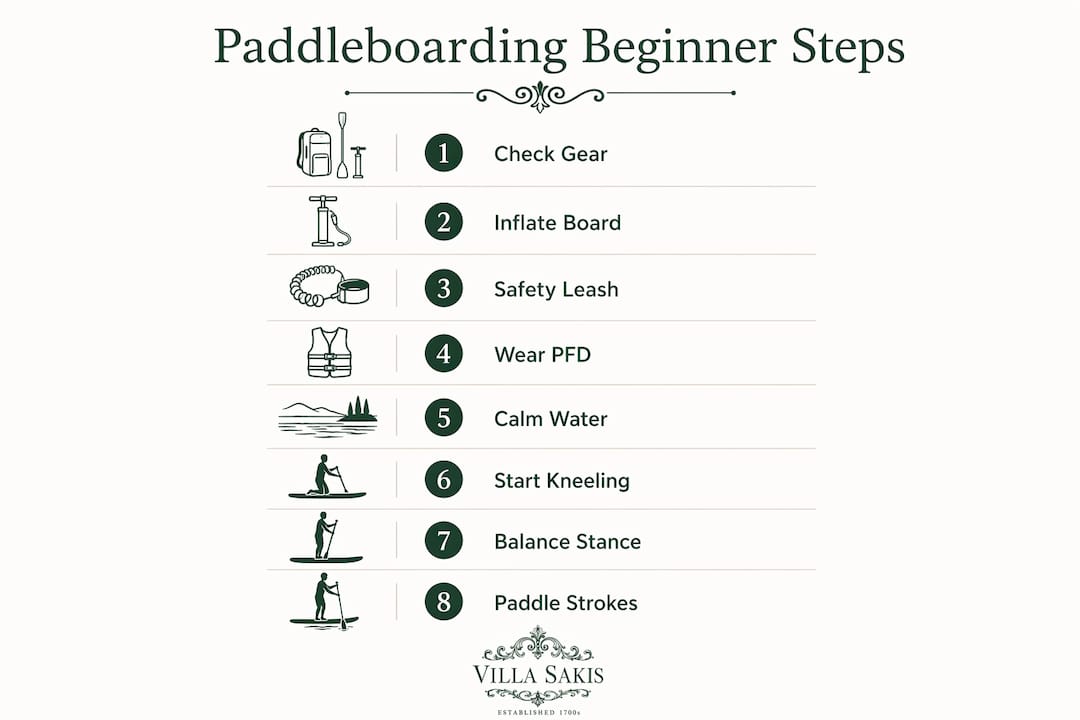
Follow this order on your first outing. Resist the urge to skip straight to standing.
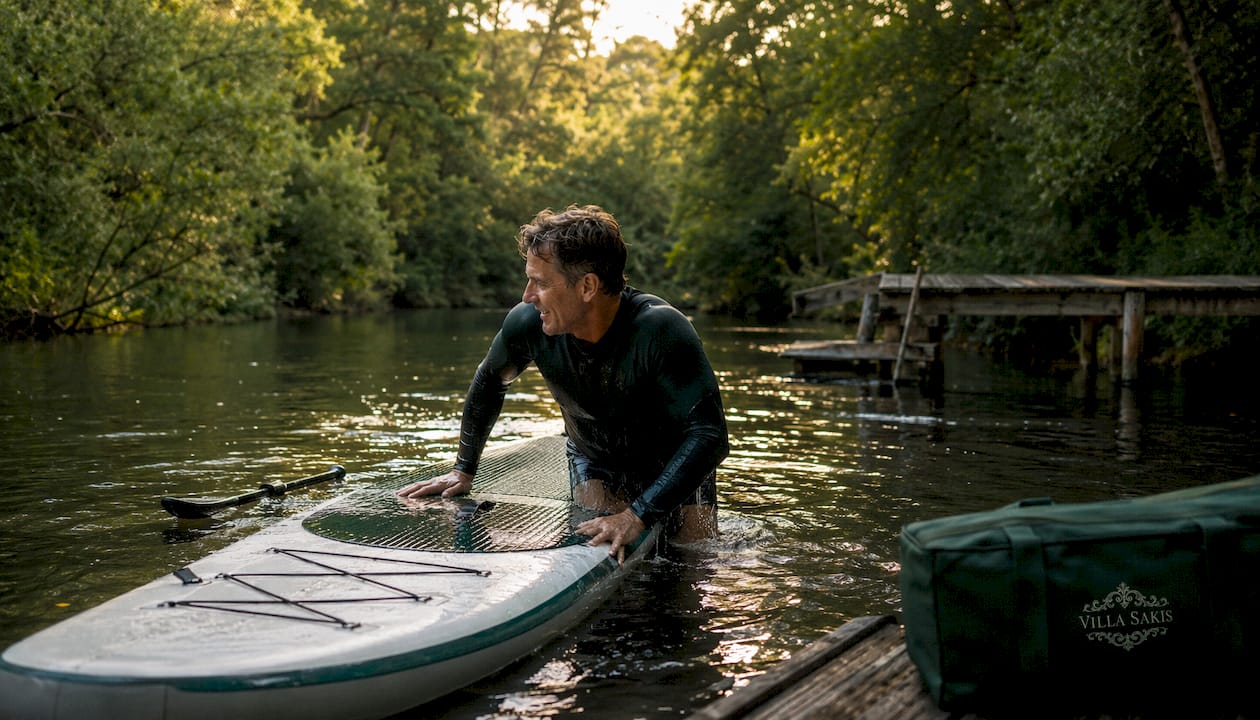
- Carry the board to knee-deep water with the fin pointing down and away from the lakebed. Wade in until the fin clears the bottom.
- Mount from the side at the centre handle. Kneel with your knees either side of the handle, which marks the board's balance point.
- Paddle on your knees for 5–10 minutes. This is not a shortcut — it teaches you how the board responds before you add height and instability.
- Place the paddle across the board in front of you. Plant both hands on the deck, bring one foot up at a time to where your knees were, then rise slowly into a half-squat.
- Extend your legs to stand, keeping knees soft. Fix your gaze on the horizon immediately. Looking down at your feet shifts your centre of gravity forward and is the leading cause of beginner wobble.
- Begin paddling at once. A moving board is more stable than a stationary one; start paddling immediately rather than freezing in place.
- Check your blade orientation. The blade should angle toward the nose of the board, not toward you. Holding it backwards produces weak, tiring strokes and is one of the most common beginner errors.
Common mistakes to avoid at each stage:
- Rushing from kneeling to standing before the board feels settled
- Locking the knees once upright
- Gripping the paddle with tense, rigid arms rather than loose, relaxed ones
- Standing too far back on the tail, which lifts the nose and slows the board
Why do beginners fall, and how do you stop wobbling?
Instability almost always traces back to one of three causes: looking down, locked knees, or standing off-centre. The fix for all three is the same calm, deliberate adjustment.
- Eyes on the horizon: This single cue reduces wobble more reliably than any other beginner tip. Your body follows your gaze; look down and your hips shift forward.
- Soft knees: Slightly bent knees act as shock absorbers. The moment you lock them, every small ripple travels straight into your upper body.
- Centred stance: Feet parallel, hip-width apart, directly over the carry handle. If the nose rises or the tail drags, shuffle your feet forward or back by a few centimetres.
- Core, not arms: Paddle by rotating from the torso. Arm-only paddling tires you quickly and makes the board rock side to side.
When you do fall, aim away from the board rather than onto it. Landing on the deck risks injury. To remount, position yourself beside the board at the centre handle, let your legs float to the surface, then kick and pull yourself onto the board in one controlled movement.
Pro Tip: If you feel a wobble building, bend your knees a little more and take two or three short paddle strokes. Movement settles the board; freezing makes it worse.
Choosing where to launch on a small countryside lake
Read the conditions before you carry the board to the water.
- Wind: Avoid going out when the wind is strong enough to create whitecaps on the water. A glassy or lightly rippled surface is ideal for beginners.
- Entry point: Choose a sandy or gently shelving shore where you can wade in gradually. Avoid reedbeds, boat channels, and any area where the fin might strike submerged rocks.
- Water depth: Launch where the water is knee-deep so the fin clears the bottom and you can step off safely if needed.
Pre-launch checklist (run through this every time):
- Board pumped to recommended PSI, valve closed
- Leash clipped to ankle and board attachment point checked
- PFD fastened and adjusted
- Phone or whistle accessible
- Someone onshore knows your plan and expected return time
A simple session plan and typical UK costs
Short, frequent sessions build balance and muscle memory faster than long, exhausting ones. Ten 30-minute outings will teach you more than two two-hour slogs.
| Session phase | Duration | Focus |
|---|---|---|
| Shore warm-up and kit check | 5 min | Stretch, check board pressure, attach leash |
| Kneeling paddle | 10 min | Board feel, basic forward stroke, small turns |
| First stand attempts | 10 min | Controlled rise, horizon gaze, immediate paddling |
| Forward stroke and straight-line work | 15 min | Blade orientation, 4-stroke side swaps |
| Turns and return to shore | 10 min | Sweep stroke, controlled landing |
| Rest and board care | 10 min | Rinse board, dry, store fin-safe |
For a 30-minute taster, compress the kneeling and first-stand phases and skip the extended stroke work. That is plenty for a holiday afternoon.
Typical UK costs (ballpark guidance):
- Board hire only: roughly £15–£25 per hour at most inland venues
- Beginner group lesson or taster session: roughly £30–£50 per person
- Private one-to-one lesson: roughly £50–£80 per hour
Prices vary by location, season, and whether kit is included. Coastal venues and popular tourist spots tend to sit at the higher end. For inspiration on how outdoor hospitality providers organise beginner water activities, the Devon outdoor activity guide offers a useful reference point.
Five short drills to build confidence across holiday sessions
- Knee figure-of-eights: Paddle a slow figure-of-eight on your knees to learn how the board pivots before you add the complexity of standing.
- Controlled stand-up repetitions: Aim for five successful stand-ups in a row, beginning to paddle immediately each time. Repetition builds the muscle memory that makes rising feel automatic.
- Four-stroke side swaps: Count four strokes on the left, four on the right, and focus on keeping a straight line. This trains the torso rotation that efficient paddling depends on.
- Sweep stroke turns: Plant the paddle near the nose and sweep it in a wide arc toward the tail. Practise turning both ways until the movement feels unhurried.
- Controlled fall and remount: In shallow, safe water, deliberately step off the board, then remount from the side using the centre handle. Knowing you can get back on calmly removes the anxiety that causes most beginner falls.
Safety reminder for every drill: leash on, depth checked, fall away from the board.
Paddleboarding from Villa Sakis: what guests can expect
Villa Sakis sits within a historic 18th-century Swedish log farmhouse, surrounded by meadows, pine forest, and a private lake whose calm, sheltered water is close to ideal for first-time SUP sessions. Early mornings and late afternoons tend to offer the stillest conditions, when the lake surface is at its most glassy and the light is quietly beautiful.
The grounds and lake access at Villa Sakis mean guests avoid the logistics that complicate beginner sessions elsewhere: no crowded public launch points, no boat traffic, no need to transport kit across a car park. After a session, the property's private sauna is a genuinely restorative way to warm through, particularly on cooler Swedish mornings.
Guest action items before heading out:
- Ask the host about board storage, the preferred launch point, and any local wildlife or seasonal considerations
- Check conditions from the shore before carrying kit down: look for a glassy surface and still tree canopy
- Rinse the board with fresh water after each session, dry it before storage, and protect the fin during transport
Key takeaways
A calm lake, a leash, a properly fitted PFD, and eyes fixed on the horizon are the four things that make paddleboarding safe and genuinely enjoyable from the very first session.
| Point | Details |
|---|---|
| Leash and PFD are non-negotiable | Attach the leash before entering the water; wear a fitted PFD every time, without exception. |
| Eyes on the horizon | This single cue reduces wobble more reliably than any other adjustment a beginner can make. |
| Start on your knees | Spend 10 minutes kneeling before standing; the board's behaviour becomes familiar and standing feels far less daunting. |
| Short sessions work best | Ten 30-minute sessions build skill faster than long, fatiguing outings. |
| Villa Sakis lake access | The private, sheltered lake at Villa Sakis offers calm, traffic-free water that is well suited to first-time SUP sessions. |
Why SUP belongs in a restorative countryside stay
There is a particular quality to paddling on a still lake at seven in the morning, when the pine forest is reflected perfectly in the water and the only sound is the pull of the blade. SUP is low-impact enough to suit guests who are resting and recovering, yet engaging enough to feel like genuine exercise. It asks for presence rather than effort, which is precisely what a stay at a place like Villa Sakis tends to invite.
My honest suggestion: go out before breakfast, paddle for 30 minutes on your knees if that is where you are, and let the stillness do the rest. The sauna afterwards is not a luxury. It is the logical conclusion of the morning.
A quieter way to learn: stay at Villa Sakis

Villa Sakis offers something that no public hire venue can replicate: a private lake, a calm shoreline, and the unhurried pace of a Swedish countryside retreat. Guests have direct access to the water from the farmhouse grounds, with secure storage, drying space, and a wood-fired sauna waiting after every session. There is no queue, no car park, and no stranger's wake to contend with. For anyone wanting to learn SUP at their own pace, in genuinely beautiful surroundings, it is a rare kind of setting.
Check availability at Villa Sakis and plan your stay around the stillest season for Swedish lake paddling.
Useful sources and further reading
Good beginner guidance is worth reading before you arrive at the water. These sources cover the areas that matter most.
- RNLI beginner SUP tips: Safety-first guidance on leashes, PFDs, and the horizon cue. The clearest UK-specific safety reference for new paddlers.
- Canal & River Trust paddleboarding guide: Covers taster sessions, buoyancy aids, and licence requirements for inland waterways. Useful if you plan to paddle beyond private lake access.
- REI Expert Advice: how to paddleboard: Detailed technique notes on stance, strokes, falling safely, and remounting. Thorough and well-illustrated.
- NIXY Sports beginner guide: Practical notes on board pressure, session length, and kit care. Particularly good on why the final few PSI matter.
- PaddleSesh: how to paddleboard: Step-by-step technique with clear notes on wind conditions, blade orientation, and stability principles.
For practical notes on how outdoor accommodation providers organise beginner water activities for guests, the Devon rivers outdoor guide offers a useful comparison from a UK hospitality context.
Always consult local guidance and speak with your host before heading out. Conditions, wildlife, and any local courtesy rules vary by property and season. This article is general information, not professional safety or legal advice — confirm current rules with the relevant authority for your specific situation.