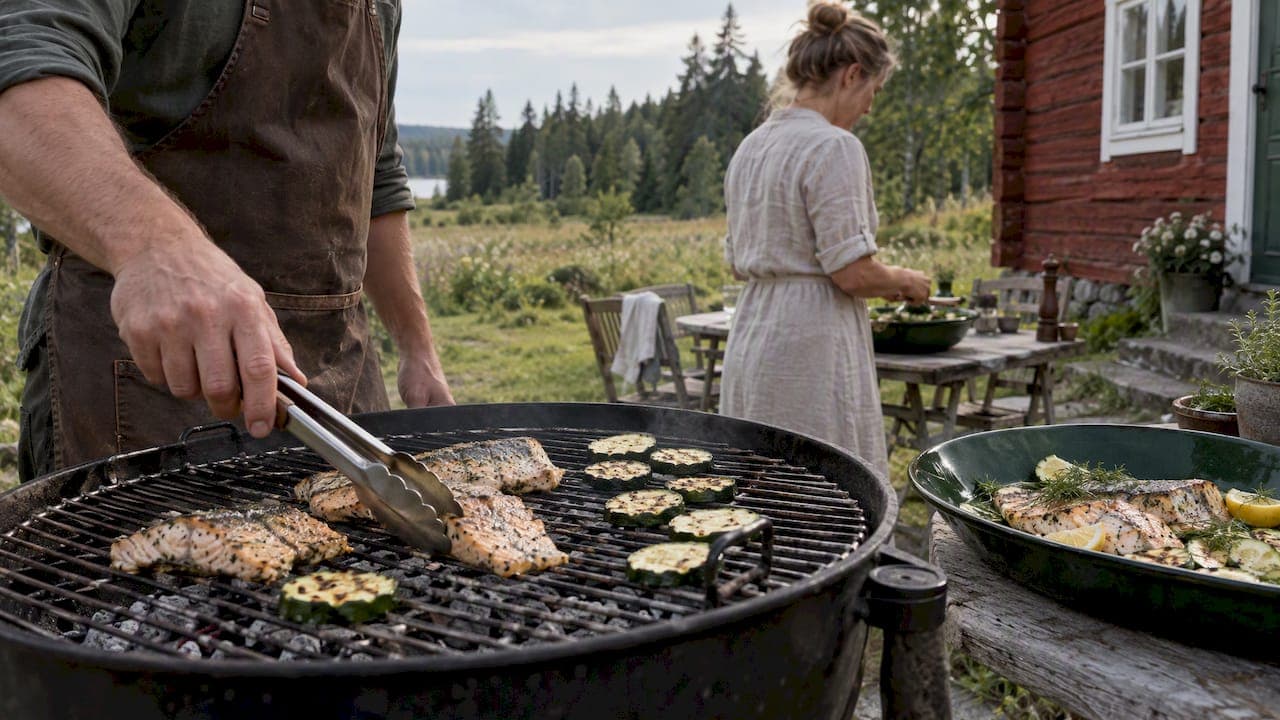
A healthy barbecue evening rests on three things: how you grill, what sits beside the meat, and how unhurried the evening is. Wait for grey coals rather than flames, keep fat from dripping onto the heat, fill half the plate with vegetables and wholegrains, and check poultry with a thermometer. Do that and a grill night becomes one of the lighter ways to eat outdoors.
Below we go through the technique, the menu, the food safety and the fire rules. We also describe how we think about an evening like this at a farmhouse in the Swedish countryside.
TL;DR
- Grill over grey, glowing coals, not open flames, and keep dripping fat and marinade away from the heat.
- Build the plate around vegetables, legumes and wholegrains, and let a modest portion of lean meat, fish or a vegetarian main sit beside them.
- Use a thermometer: 72°C for chicken breast, 82°C for whole chicken and legs. Colour and grill marks prove nothing.
- Check for a fire ban with your municipality or the Brandrisk Ute app before you light anything, and keep water within reach.
- Slow the evening down: prepare ahead, eat outside, and finish with fruit, berries or a warm sauna.
Table of Contents
- What makes a barbecue evening healthy
- Grill cleanly: the technique that matters most
- Build the menu around the plate, not the grill
- Food safety at the grill
- How often is too often?
- Fire rules: the part of a healthy evening nobody posts about
- A farmhouse perspective
- Make the evening part of a slower stay
- A sample healthy grill evening, hour by hour
- FAQ
- Sources
What makes a barbecue evening healthy
Most Swedish advice on healthy grilling, from dietitians to food-safety authorities, comes back to the same idea: the food is rarely the problem, the method and the accompaniments are. Sausages in white bread with a heavy sauce and a bowl of crisps make a very different evening from grilled fish, charred-edged courgette, a bean salad and a jug of herby yoghurt.
There is also a reassuring side. A risk assessment from the Norwegian Scientific Committee for Food and Environment finds that for most people the risk from eating grilled food is low, though grilling at high temperatures forms more harmful substances than pan-frying. It also suggests that technique matters more than frequency. Frequent meals of heavily charred food are a concern, while lean, uncharred food leaves a wide safety margin. So you need not give up the summer ritual, only change how you carry it out.
Grill cleanly: the technique that matters most
When fat meets hot embers it burns and sends smoke back up onto the food. That smoke carries PAH compounds (polycyclic aromatic hydrocarbons). The Swedish Food Agency explains PAH and advises to grill gently and avoid smoking if you want to lower your exposure. Most of the practical measures follow from that.
Wait for the coals
The agency's guidance on safe grilling is to avoid cooking over flaming embers. Light the charcoal or wood early and begin only when the flames have died and the coals have turned grey. This usually means starting the fire well before anyone is hungry, which suits an unhurried evening anyway.
Keep fat off the fire
Dripping fat and marinade cause flare-ups, and flare-ups put harmful substances on the surface of the food. Three habits help:
- Choose leaner cuts, and trim visible fat before it reaches the grate.
- Wipe off excess oily marinade, or brush it on at the end.
- Cook indirectly where you can: coals banked to one side, food on the other, or a tray beneath to catch the drips.
If you grill often, equipment that stops fat reaching the coals, such as a vertical grill, is worth considering.
Lower the heat and turn the food
A dietitian quoted in a Swedish piece from May 2026 advises lowering the grill temperature if possible and turning the meat often so it does not burn. Distance helps too: raise the grate or move the food away from the hottest part. A little colour is fine. Blackened crusts are what you want to avoid, and if an edge burns, cut it off.
Check your grate
Use a grate of stainless steel, cast iron or porcelain enamel. Plastic or PTFE-coated grilling nets can melt at the temperatures a grill can reach, so leave them in the shop. Keep the grate clean too, since old residue burns and sticks to the next meal.
Build the menu around the plate, not the grill
The quickest way to make an evening healthier is to stop treating the meat as the centre. Swedish dietary advice asks adults to eat at least 500 grams of vegetables, fruit and berries a day, and says coarse vegetables such as root vegetables, white cabbage, cauliflower, broccoli and onion are especially good. A grill evening is an easy place to catch up on that figure.
What to put on the grate
| Course | Ideas | Why it works |
|---|---|---|
| Vegetables | Courgette, peppers, aubergine, red onion, corn, cauliflower steaks, asparagus | Cook quickly, take smoke and char well, little fat to drip |
| Fish | Salmon or trout in a foil parcel or on a plank, whole small fish | Gentle heat, no flare-ups from marinade |
| Poultry | Skinless chicken skewers with lemon and herbs | Lean, but needs a thermometer (see below) |
| Plant mains | Halloumi, marinated tofu, bean burgers | Firm enough to turn and little loose fat |
| Fruit | Peaches, pears, pineapple, apples | A dessert that needs no cream |
What to put beside it
Much of what makes a barbecue heavy is on the side: creamy potato salads, sugary sauces, white bread. Swap them one at a time:
- Warm potatoes with dill, lemon and a spoon of yoghurt instead of a mayonnaise salad.
- Bulgur, barley or rye berries with roasted roots, rather than white pasta salad.
- A lentil or white bean salad with plenty of parsley.
- Tzatziki or a herb and quark dip in place of a bottled sauce.
- Crisp cabbage slaw with apple and mustard vinaigrette.
Nutrition advice generally says wholegrains, legumes and a large helping of vegetables keep you fuller for longer and are kinder to the gut than a menu built from refined food. If you like to prepare sides the day before, these meal prep tips for busy cooks offer ideas for making colourful, nutritious dishes ahead of time, so the evening itself stays calm.
A simple plate rule
Half the plate vegetables and salad, a quarter wholegrain or potatoes, a quarter protein. It needs no counting and works for guests of any age. If the evening includes a lot of different dishes, small portions of each look generous on the table and leave nobody hungry.

Food safety at the grill
A healthy evening is also one where nobody falls ill. The Swedish Food Agency's guidance covers the whole chain, starting with the shop: get chilled meat, poultry and fish into the fridge as soon as you can.
Cook poultry to temperature
Grill marks tell you nothing about the inside. A thermometer in the thickest part of the meat, away from bone, is the only dependable check. The figures given in a Swedish guide to chicken temperatures are 72°C for chicken breast and 82°C for whole chicken, drumsticks and thigh fillet. Let the meat rest for a few minutes afterwards so the temperature evens out and the juices settle.
Keep raw and cooked apart
The commonest mistake is carrying cooked food back on the tray that held it raw. Use separate boards, plates and tongs for raw and finished food, and keep raw meat and poultry away from salads, sauces and anything eaten as it is. Svensk Fågel's kitchen hygiene tips for chicken add the basics: wash your hands with soap and water before you start, and keep foods separate.

Marinate in the fridge
Marinating adds flavour without added fat, especially with lemon, garlic, herbs, mustard or yoghurt. Do it in the fridge, not on the worktop in the sun, and discard any marinade that has touched raw meat rather than serving it as a sauce.
How often is too often?
The Norwegian assessment mentioned earlier gives a useful sense of proportion. Its findings suggest that around 15 to 25 meals a year grilled in a way that produces high PAH levels could be a concern, whereas leaning towards lean, uncharred food allows far more frequent grilling, well over a hundred times a year, with a safe margin. We read that as encouragement: grill as often as you like, but grill well. Anyone who is pregnant, or who has a specific health condition, should ask their midwife, doctor or a registered dietitian about what suits them.
Fire rules: the part of a healthy evening nobody posts about
A safe evening begins before the match. In Sweden you may grill on your own land unless a fire ban applies, but the right to roam does not give you an automatic right to light a fire. The Swedish Civil Contingencies Agency's short guide to fire and the right to roam says it gives only the possibility, at your own responsibility, to make a fire under safe conditions.
Check for a ban
It is the municipality, in consultation with the rescue service, that decides on a fire ban. If the whole county is at very high risk, the county administrative board can decide on a county-wide ban, as the county board explains. Ask the municipality where you are staying, or use the Brandrisk Ute app. The national agency notes that in spring and summer it is sometimes forbidden to light a fire or grill in forest and open land, so always find out what applies first. During extreme drought a ban may cover all open flames.
Set up safely
- Follow the grill's instructions and stand it on firm, level ground, clear of dry grass, walls and low branches.
- Keep water or a fire extinguisher within reach, even when a fire is permitted.
- Never use lighter fluid on a lit grill, and do not leave the fire unattended.
- Put the embers out thoroughly with water at the end of the evening.
The Swedish Fire Protection Association's advice sheet on grilling and the Gothenburg rescue service's safe grilling page cover the same ground in more detail. For fires that are not grills, our host notes on three checks before lighting a fire pit apply just as well.
A farmhouse perspective
We look after an eighteenth-century log house in Bergslagen, with meadows on one side and pine forest on the other. The evenings are what guests remember, and they rarely remember a clever recipe. They remember that nothing was rushed.
Our view is that a healthy evening outdoors is as much about pace as about ingredients. Start the fire early, because grey coals need time anyway. Let someone slice vegetables at the table while it burns down. Eat slowly, with the light going long over the field, and the food tends to take care of itself, because people who are not hurrying eat less hurriedly and more attentively.
We would also say that the best preparation is local. Fresh produce from nearby growers needs little more than oil, salt and heat, and we have written about cooking countryside produce safely for guests who arrive with a cool box and a plan. For a longer stay, our weekly meal plan for a cabin holiday shows how a barbecue night fits among simpler meals.
And we would always finish the evening away from the smoke: a walk across the meadow, then a warm sauna and a quiet night's sleep. For guests who come to restore their energy rather than collect activities, that sequence is the real wellness programme.
— Christian
Make the evening part of a slower stay
If you would like to try this somewhere with space, silence and a kitchen of your own, Villa Sakis is a whole-house rental: a historic Swedish log farmhouse with timber rooms, a private sauna, lake access, a self-catering kitchen and direct access to forest and meadow. You can read more about the house itself or go straight to booking the whole farmhouse. We also list the house on Airbnb. Before you plan any fire, please read our guidance on fire rules above and check the local ban status for your dates.
If you want the wider picture first, our journal piece on what to expect from a Swedish countryside holiday is a good place to start, and our guide to a private sauna holiday in Sweden explains the sauna side of an evening.
A sample healthy grill evening, hour by hour
A rough timeline shows how the pieces fit. Adjust it to your group and your grill.
- Late afternoon: check for a fire ban, set up the grill on safe ground, put out water and a thermometer. Marinate fish, chicken or tofu in the fridge.
- An hour before eating: light the charcoal or wood. Prepare the sides: roast roots in the oven, cook the grain, mix the bean salad and the yoghurt dip.
- Thirty minutes before: chop vegetables and thread skewers. Use separate boards for raw and ready food.
- When the coals are grey: grill vegetables first, then fish, then poultry with a thermometer. Turn often, and keep fat away from the embers.
- At the table: rest the meat for a few minutes, serve with plenty of colour, and sit down together.
- Afterwards: grilled fruit with a spoon of yoghurt or berries, then douse the embers thoroughly with water.
FAQ
Which sides go well with a healthy barbecue?
Warm potatoes with herbs, bean or lentil salads, grain salads with roasted roots, crisp slaw and a yoghurt or quark dip all work well. They add fibre and fill the plate without relying on heavy dressings. Aim for a large share of vegetables, in line with the 500 grams a day that Swedish dietary advice recommends.
Is grilled food unhealthy?
For most people the risk is low. Grilling does form more harmful substances than pan-frying, but technique makes the difference: grey coals, no dripping fat, moderate heat and no blackened crust. If you are concerned for health reasons, speak to your doctor or a dietitian.
What is the best fish or meat to grill if I want a lighter meal?
Fish, skinless chicken, lean cuts and plant-based options give off less fat onto the coals. Wrap delicate fish in foil or cook it on a plank. Check chicken with a thermometer: 72°C for breast and 82°C for whole chicken and legs.
Can I grill anywhere in Sweden?
You can generally grill on your own property, but not when a fire ban is in force, and the right to roam does not give you a right to light a fire anywhere. Ask the municipality or use the Brandrisk Ute app before you light up, and keep water within reach.
Sources
- Grilla säkert och njut av maten, Livsmedelsverket
- Polycykliska aromatiska kolväten (PAH), Livsmedelsverket
- Grönsaker, frukt och bär, Livsmedelsverket
- Risk Assessment of Grilled Food, VKM
- Hur många grader ska kyckling vara?, Skeendet
- Säkra kycklingstips, Svensk Fågel
- Eldning och allemansrätt, MSB
- Eldningsförbud, MCF
- Brandrisk och eldningsförbud, Länsstyrelsen
- Grillning, Brandskyddsföreningen
- Grilla säkert, Räddningstjänsten Storgöteborg